Registering a company with SSM is only half the story. Before a shop, office, restaurant, factory or warehouse can legally open its doors anywhere in Malaysia, the local council — the majlis perbandaran or majlis bandaraya that governs the address — must issue a business premise licence for that exact location. Each council runs its own system, forms, fees and inspection style. This 2026 hub guide explains the two-layer rule, walks through the anatomy of a typical application, and compares the major councils across Kuala Lumpur and Selangor — DBKL, MBSJ, MBPJ, MBSA, MP Kajang, MP Sepang, MPKS, MP Selayang and MBDK — so you know exactly which counter your address answers to.
Quick answer (as at September 2026): Every shop, office, restaurant, factory or warehouse in Malaysia needs a business premise licence from the local council that governs its address, in addition to SSM registration. It is issued under the Local Government Act 1976 (Act 171) and each council's by-laws, usually as a composite licence covering the premises and the signboard, and signboard wording must first be cleared by Dewan Bahasa dan Pustaka. A clean application typically takes about one to two months. Licences are normally valid for one year — in Selangor usually to 31 December — while DBKL has allowed renewal for up to three years since 1 July 2026. Trading without a licence can lead to compounds of up to RM1,000 and, on conviction, fines of up to RM2,000 (MBPJ by-laws).
| Question | Short answer |
|---|---|
| Who issues it? | The council for the address: DBKL in Kuala Lumpur; MBPJ, MBSJ, MBSA, MP Kajang, MP Sepang, MPKS, MP Selayang or MBDK in the Klang Valley parts of Selangor |
| Legal basis | Local Government Act 1976 (Act 171) + the council's trade, business and industrial licensing by-laws |
| What it covers | Premises + signboard (composite licence); DBP wording approval for the sign |
| Typical time | About 1–2 months with complete documents; longer if an inspection is triggered |
| Processing fee (reference) | RM50 business / RM100 industrial (MBPJ by-laws, MBSA rates), plus the annual licence and signboard fees |
| Validity | One year; Selangor councils mostly to 31 December. DBKL: up to 3 years since 1 July 2026 |
| Penalty (MBPJ by-laws) | Compound up to RM1,000; on conviction up to RM2,000 or 1 year, plus RM200 a day if continuing |
Two separate layers: SSM registers the company, the council licenses the premises
The single most common misunderstanding among new business owners — local and foreign alike — is assuming that an SSM certificate is a licence to trade. It is not. SSM registration under the Companies Act 2016 creates the legal entity: it lets your Sdn Bhd sign contracts, open bank accounts and hire staff. It says nothing about whether any particular address may be used for any particular business activity. That question belongs to the local authority (pihak berkuasa tempatan, or PBT) under the Local Government Act 1976 (Act 171) and each council's own by-laws on trades, premises and advertisements.
So every physical premise needs two authorisations answering two different questions. SSM asks: does this company legally exist? The council asks: is this address allowed to carry out this activity? A perfectly valid Sdn Bhd trading from an unlicensed shopfront is committing an offence, and it is the premises — not the company file — that an enforcement officer stands in front of. Councils issue compounds, and in persistent cases sealing or closure orders, against unlicensed premises. The licence is issued per address and per activity: move locations, or materially change what you do at the same address, and you generally need a fresh or amended licence.
Which council you apply to is purely a question of geography. Kuala Lumpur city centre is DBKL territory; cross into Petaling Jaya and you are dealing with MBPJ; a warehouse in a Shah Alam industrial park answers to MBSA; a café in Kajang town answers to MP Kajang. Multi-outlet businesses must license every outlet with its own council — a five-outlet chain across the Klang Valley can easily deal with four or five different authorities, each with its own forms and timelines.

Anatomy of a council licence application
The good news is that, while every council has its own portal and quirks, the underlying anatomy is remarkably consistent across Malaysia. A typical application has four moving parts:
- The premise licence itself (lesen premis perniagaan) — permission to run a stated business activity at a stated address. Most councils bundle it with the signboard licence into a single composite application for new businesses.
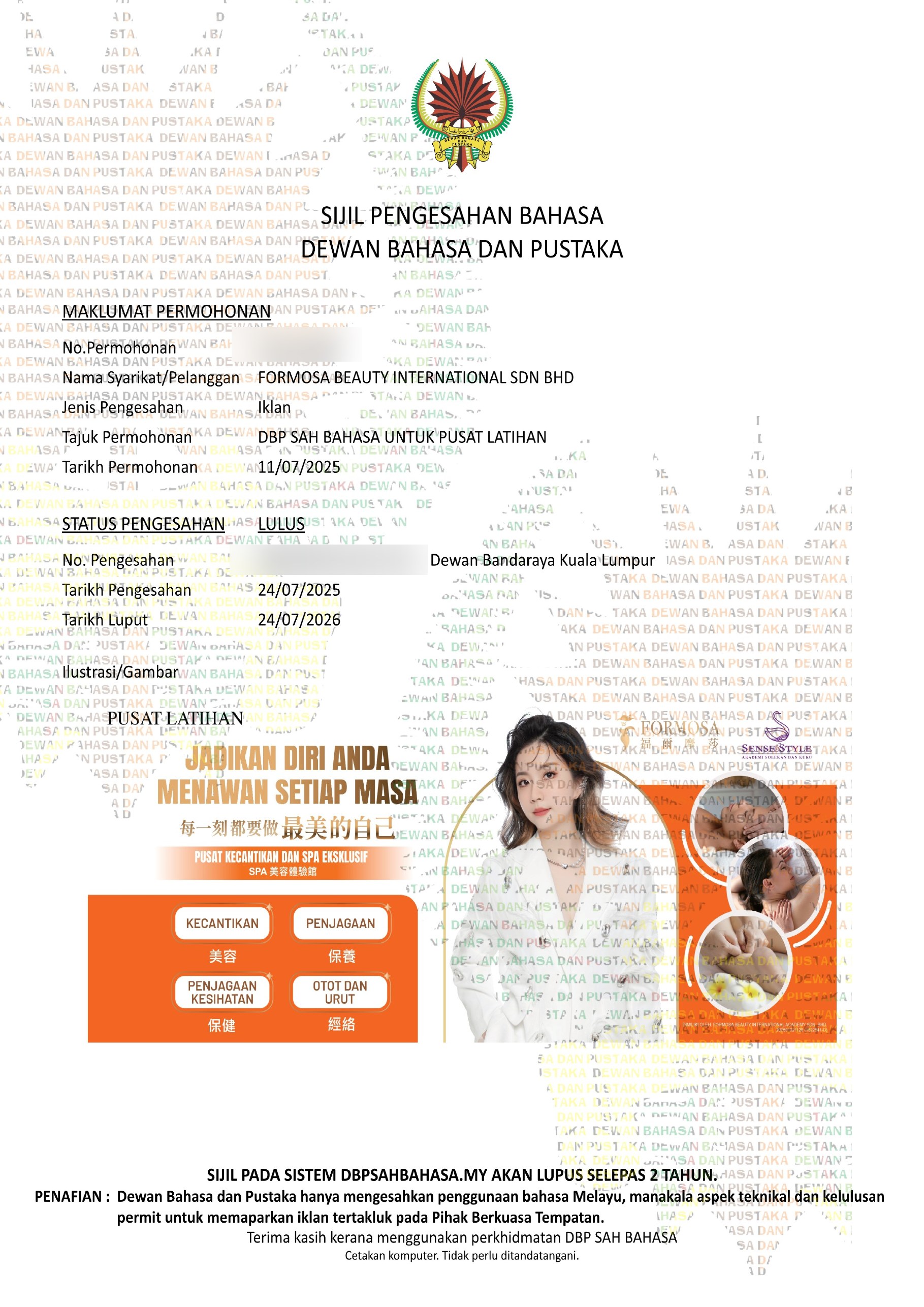
- The signboard / advertisement licence (lesen iklan / papan tanda) — required before any external signage goes up, priced by the sign's size and type. Before the council will approve the sign, its wording must be vetted by Dewan Bahasa dan Pustaka (DBP), the national language authority: Bahasa Malaysia must be present and given due prominence, and foreign-language text must comply with DBP's translation rules. This is the step that most often stalls foreign brands — see our DBP signboard wording approval service for how the vetting works.
- Supporting clearances — depending on the activity and the building: Bomba (Fire & Rescue Department) clearance for larger or higher-risk premises, health-department conditions plus food-handler and typhoid-vaccination records for F&B, and sector permits (e.g. WRT for foreign-owned retail) where applicable.
- Zoning / land-use compliance — the activity must match the approved use of the building shown on its Certificate of Fitness / CCC. A kitchen in an office-zoned unit, or retail in an industrial lot, will be refused no matter how good the paperwork is.
The document set is equally predictable: SSM company profile, the tenancy agreement or proof of ownership (ideally in the applicant company's name), premises photos and floor plan, the DBP-cleared signboard visual, plus the activity-specific clearances above. Councils increasingly take all of this online — DBKL through eLesen, and Selangor councils through their own e-licensing portals — but the decision logic is the same everywhere: prove the company exists, prove you lawfully occupy the address, prove the address is zoned for what you intend to do there.
We saw all four parts come together in a real case: a signboard-first retail client whose artwork failed the language rules twice before we rebuilt it — the full story is in our Formosa signboard and DBKL/DBP case study.
The major councils compared: KL and Selangor
The Klang Valley is carved up among one federal-territory city hall and a ring of Selangor city and municipal councils. Here is how the major ones compare. Processing times are typical ranges for a clean, complete application — every council moves faster with complete documents and slower when an inspection is triggered, and exact fees vary by council, activity and premise size.
| Council | Area covered | Typical processing time | Notes |
|---|---|---|---|
| DBKL (Kuala Lumpur City Hall) | Kuala Lumpur Federal Territory | A few weeks to ~2 months | Composite premise + signboard licence via the eLesen portal; from 1 July 2026, renewal for up to 3 years with discounts |
| MBSJ (Subang Jaya City Council) | Subang Jaya, USJ, Puchong, Seri Kembangan, Bandar Sunway | ~1–2 months (varies) | One of Malaysia's busiest councils for retail and F&B; premise + signboard applied together |
| MBPJ (Petaling Jaya City Council) | Petaling Jaya, the Damansara commercial corridor | ~1–2 months (varies) | Mature commercial areas — expect close attention to land use, parking and renovation approvals |
| MBSA (Shah Alam City Council) | Shah Alam, including major industrial parks | ~1–2 months (varies) | The key council for factories and warehouses; Bomba clearance and industrial land-use checks are routine |
| MP Kajang (Kajang Municipal Council) | Kajang, Semenyih, Bangi (Hulu Langat district) | ~1–2 months (varies) | Fast-growing F&B market; health and food-handler conditions apply to restaurants |
| MP Sepang (Sepang Municipal Council) | Sepang district — Cyberjaya, Salak Tinggi, Dengkil, KLIA corridor | ~1–2 months (varies) | Aviation and logistics corridor; premises near KLIA may carry extra conditions |
| MPKS (Kuala Selangor Municipal Council) | Kuala Selangor district | ~1–2 months (varies) | Upgraded from district to municipal council in 2024; agro-food and tourism premises common |
| MP Selayang (Selayang Municipal Council) | Selayang, Rawang, Batu Caves (Gombak district) | ~1–2 months (varies) | Mixed industrial and retail territory north of KL |
| MBDK (Klang Royal City Council) | Klang and Port Klang | ~1–2 months (varies) | Royal city council status since 2023; the council for Port Klang logistics, depots and trading premises |
DBKL deserves the longest look because it licenses the national capital and has moved furthest on digitalisation. Its composite licence bundles the premise and signboard approvals into one eLesen application, and from 1 July 2026 businesses can renew for up to three years at once — 5% off a two-year renewal, 10% off a three-year one. We cover the full process, documents and the multi-year renewal maths in our dedicated DBKL business licence guide, and you can see a real outcome in the Superheal case study, where we took a KL waterproofing company from bare premises to an issued DBKL licence.
The Selangor councils each run their own e-licensing systems and counters, but share the state's broad framework: premise and signboard licences applied together, annual validity as the norm, and the same DBP language rule for signboards. The practical differences show up in emphasis. MBSA sees far more factory and warehouse files than shopfronts, so its officers focus on industrial land use and fire safety. MBSJ and MBPJ process heavy volumes of retail and F&B in dense, older commercial areas, where parking, renovation and land-use mismatches are the classic snags. MP Kajang's caseload skews toward food businesses — our Aicha case study walks through a real MP Kajang F&B licence from tenancy check to issuance. MBDK, elevated to royal city council status in 2023, is the authority for the Port Klang logistics belt. And beyond the nine in the table, smaller district and municipal councils follow the same playbook — our Fanxing case study shows a restaurant licensed under MP Kuala Langat (MPKL), a council with its own forms but the same underlying anatomy.
Outside the Klang Valley? Johor runs the same Act 171 system through 16 councils of its own, with different counters, fee schedules and renewal dates — see our Johor business licence guide for MBJB, MBIP and MPKu Kulai.
Renewal rules: the part everyone forgets
A premise licence is not a one-off. The standard pattern across Malaysian councils is annual validity with renewal before expiry, typically through the same portal or counter that issued the licence. Many Selangor councils align licences to the calendar year — under by-law 6 of the MBPJ 2007 licensing by-laws a licence runs from the date the fee is paid until 31 December — which makes the October-to-December renewal window a predictable but easy-to-miss deadline; DBKL renews from the issue date and, from 1 July 2026, lets established businesses lock in up to three years at once. Signboard licences renew alongside the premise licence and are re-priced if the sign changes.
Three renewal rules of thumb keep companies out of trouble. First, diarise the expiry the day the licence is issued — late renewal attracts penalties, and an expired licence means the premise is legally unlicensed from the day after expiry. Second, renewal is not automatic re-approval: if your activity, floor area, signage or shareholding has changed materially, disclose it, because an inspection that finds the premises no longer matching the licence turns a routine renewal into an enforcement issue. Third, a move is never a renewal — a new address means a new application with the council that governs the new address, even if it is fifty metres across a council boundary. For everything else that has to change when you relocate (SSM, LHDN, SST, CIDB, ESD and the bank), see our guide to moving office in Malaysia.
For the step-by-step version — which Selangor licences can simply be paid online, which must be re-submitted, what the by-laws say about refusal and cancellation, and the fees and penalties council by council — see our guide to Selangor business licence renewal for 2027 (MBPJ, MBSJ, MBSA).
Why applications get rejected
Across every council we work with, the same handful of defects account for the overwhelming majority of rejections and stalled files:
- Land-use mismatch. The intended activity does not match the building's approved use — the number-one killer, and the one no amount of paperwork can fix. Verify zoning before signing the lease.
- Tenancy in the wrong name. The lease is signed by a director personally or by a related company rather than the applicant Sdn Bhd.
- Signboard fails DBP vetting. Missing or subordinate Bahasa Malaysia text, or non-compliant foreign-language wording — the artwork must be redesigned and re-vetted, stalling the whole composite application.
- Missing clearances. No Bomba certificate for a premise that needs one; no food-handler or typhoid records for an F&B outlet; a required sector licence not yet in hand.
- Unauthorised renovation. The premises were altered without council approval, so the floor plan submitted no longer matches what the inspector finds.
- Opening before approval. Trading while the application is "in progress" is trading without a licence — and councils do inspect, especially after complaints.
Notice the pattern: rejections are almost never the council being arbitrary. Each cause is checkable — and fixable — before the first submission. That is why the sensible sequence is always premises first, lease second, application third, opening date last.
How ONEKEY helps
ONEKEY BIZ handles council licensing end to end, across every authority in the Klang Valley and beyond: we verify the unit's land use before you commit to a lease, put the tenancy and floor plan in order, run the DBP language vetting for your signboard, assemble the premise-plus-signboard application with the right Bomba and health clearances, and file and track it with the correct council — DBKL, MBSJ, MBPJ, MBSA, MP Kajang, MP Sepang, MPKS, MP Selayang or MBDK. For foreign owners, the practical value is dealing with one team in your own language while we handle the Bahasa Malaysia paperwork and the council counters, then manage every renewal so no premise ever trades a day out of compliance.
Start by confirming which council your address falls under, then line up the licence before your fit-out finishes — not after. If your premises are in KL, go deeper with our DBKL business licence guide; wherever you are, talk to our team — WhatsApp +60 12-321 1349 — and we will map your address to its council and its exact requirements.
Frequently asked questions
My company is registered with SSM — do I still need a council business licence?
Yes. SSM registration creates the legal entity; the local council licence is what allows a specific address to be used for a specific business activity under the Local Government Act 1976 (Act 171). They are two separate layers, and trading from an unlicensed premise is an offence even if the company itself is fully registered.
How do I know which council (majlis) my premises fall under?
It is decided purely by the address. Kuala Lumpur is DBKL; in Selangor, Subang Jaya/USJ/Puchong is MBSJ, Petaling Jaya is MBPJ, Shah Alam is MBSA, Kajang/Semenyih/Bangi is MP Kajang, the Cyberjaya–KLIA corridor is MP Sepang, Kuala Selangor is MPKS, Selayang/Rawang is MP Selayang and Klang/Port Klang is MBDK. Each outlet is licensed by the council for its own address.
How much is a business licence in Malaysia?
It depends on the council, the activity and the floor area. As published reference points, MBPJ and MBSA charge a processing fee of RM50 for a business licence and RM100 for an industrial licence, then an annual licence fee from the council's schedule. MBPJ's signboard fee starts at RM100 a year for an unlit sign up to 8 m² and RM150 for a lit one, with a one-off deposit equal to the signboard fee.
How long does a council business licence take, and how long is it valid?
With complete documents, expect roughly one to two months at most councils — faster for clean files, slower if a site inspection is triggered; exact fees and timelines vary by council. Annual validity is the norm nationwide. DBKL is the exception on renewal: from 1 July 2026 it allows renewal for up to three years at once, with 5% off two years and 10% off three.
What are the most common reasons a licence application is rejected?
Land-use mismatch between the activity and the building's approved use (the number-one cause), a tenancy not in the applicant company's name, signboard artwork that fails DBP language vetting, missing Bomba or health clearances, unauthorised renovation that contradicts the submitted floor plan, and opening for business before approval. All are checkable — and fixable — before the first submission.
Related services
We handle the process described in this article end-to-end.
- DBKL Business Premise Licence (Kuala Lumpur)Business premise & signboard licence with Kuala Lumpur City Hall (DBKL).
- MBSJ Business Licence Application (Majlis Bandaraya Subang Jaya)Business premise licence with Subang Jaya City Council (MBSJ).
- MBSJ Business Licence Renewal (Majlis Bandaraya Subang Jaya)Renew your existing MBSJ (Subang Jaya) business licence.
Sources & references
- MBPJ — Trade, Business and Industrial Licensing By-Laws 2007 (Sel. P.U. 71)
- MBSA — Composite licence (business / industrial)
- DBKL — Business Licence
- MBSJ — Subang Jaya City Council (Licensing)
- MBPJ — Petaling Jaya City Council (Licensing)
- MBSA — Shah Alam City Council (Licensing)
- MP Kajang — Kajang Municipal Council
- MBDK — Klang Royal City Council
This article is general information only, not legal, tax or immigration advice. Policies, thresholds and official fees are set by the relevant Malaysian authorities and may change. Talk to our consultants about your specific situation.