You registered your Sdn Bhd, signed the tenancy, fitted out the shop — and you still cannot legally open the doors. In Kuala Lumpur, a company is not licensed to trade until Dewan Bandaraya Kuala Lumpur (DBKL) issues a business-premise licence for the exact address you occupy. For a foreign-owned company that surprise can cost weeks of lost revenue. Here is the complete 2026 guide to the DBKL licence — the composite premise-plus-signboard route, the eLesen system, documents, timelines, fees, and the new multi-year renewal.
Quick answer (as at September 2026): Every business trading from a physical premise in Kuala Lumpur needs a DBKL business premise licence under the Local Government Act 1976 (Act 171). SSM registration does not cover this. New businesses apply online through eLesen for a composite licence covering the premise and the signboard, and the sign needs Dewan Bahasa dan Pustaka (DBP) approval first. Approval takes from a few weeks to about two months. Since 1 July 2026, most licences can be renewed for up to three years, with 5% off a two-year renewal and 10% off a three-year one. Any unpaid DBKL compound, traffic summons or rental arrears now blocks both new applications and renewals.
| DBKL licence at a glance | Position as at September 2026 |
|---|---|
| Who needs it | Any shop, office, restaurant, clinic, salon, warehouse or outlet operating from a premise in the Federal Territory of Kuala Lumpur, whether locally or foreign-owned |
| Legal basis | Local Government Act 1976 (Act 171) and DBKL licensing by-laws |
| How to apply | Online on eLesen (elesen.dbkl.gov.my), as a composite premise + signboard licence |
| Signboard pre-condition | DBP language approval (Sijil Pengesahan Bahasa) |
| Processing time | A few weeks to about 2 months; apply 6–8 weeks before opening |
| Renewal period | 1, 2 or 3 years (multi-year option from 1 July 2026) |
| Multi-year discount | 5% for 2 years · 10% for 3 years |
| Not eligible for multi-year renewal | Beauty-related and entertainment licences |
| Renewal blocker | Unpaid DBKL compounds, traffic summonses or rental arrears (eLesen is linked to DBKL's compound system from 1 July 2026) |
What a DBKL business licence is — and who needs one
A DBKL business licence (Lesen Perniagaan) is the local-authority permission to operate a commercial premise at a specific location within the Kuala Lumpur Federal Territory. It is separate from — and additional to — your SSM company registration. SSM makes your company exist as a legal entity; DBKL makes the premises legal to trade from. Every shopfront, office, restaurant, café, clinic, salon, warehouse and retail outlet operating physically in KL needs one, whether the owner is Malaysian or foreign. It is issued per address and per activity, which is why a change of location, or even a material change in what you do at the same address, generally means a fresh or amended licence rather than an automatic carry-over.
This is the licence a foreign investor most often overlooks. You can incorporate a 100% foreign-owned Sdn Bhd, obtain your sector licence (see our note on the WRT licence for foreign-owned trading companies), and still be shut down on inspection day because the premise itself was never licensed by City Hall. The distinction matters because the two authorisations answer different questions. SSM asks "does this company legally exist?" DBKL asks "is this address allowed to carry out this activity?" A company can be perfectly valid on paper while the premises it trades from are entirely unlicensed — and it is the premises, not the company, that an enforcement officer stands in front of.
The rule scales with your footprint, too. A single café needs one composite licence for one address; a retail chain opening five outlets across the city needs five separate premise licences, one per location, each judged against that unit's own land use and its own signboard. Foreign groups planning a multi-outlet roll-out in KL should budget both the fees and the lead time per site, not once for the brand.
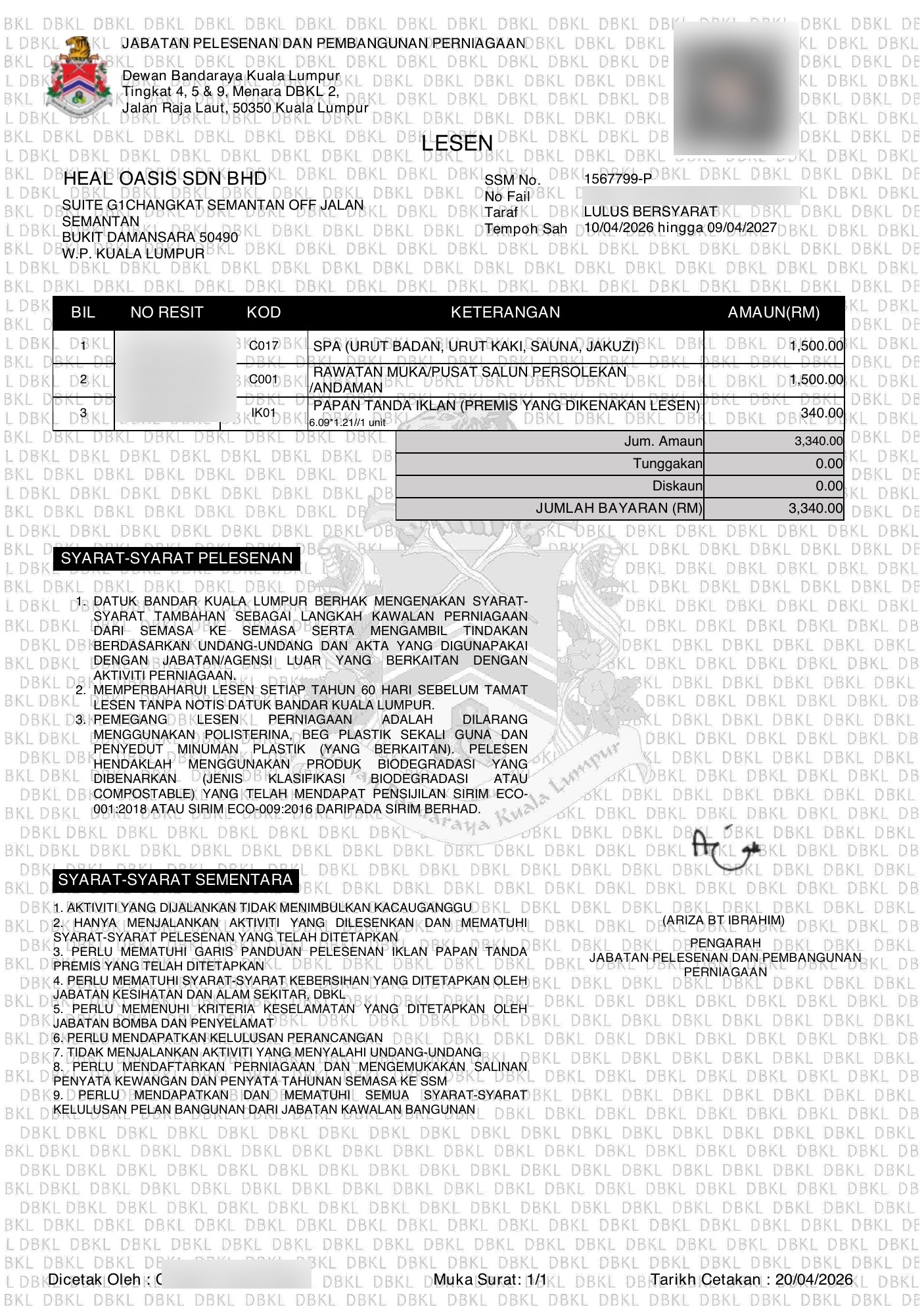
The legal basis: Act 171 and DBKL by-laws
DBKL — Dewan Bandaraya Kuala Lumpur, or Kuala Lumpur City Hall — licenses businesses under the Local Government Act 1976 (Act 171) together with its own local by-laws governing trades, premises and advertisements. The Department of Licensing and Business Development administers the process. Because the power comes from statute, operating a commercial premise without the required licence is not a paperwork slip — it is an offence, exposing the company to fines, compounds and closure orders.
The composite licence: premise + signboard in one
Most new KL businesses need two things from DBKL at once: permission to run the premise, and permission to display a signboard. DBKL bundles these into a single Composite Licence (Lesen Komposit) — the business-premise licence and the signboard/advertisement licence processed and approved together in one application. For a new business this is the most efficient route: one submission, one review cycle, one set of fees, both licences issued together rather than chased separately.
If your outlet will show any sign — a shopfront fascia, a logo board, a directional sign — the composite route is almost always the right one. Applying for the premise licence alone and then bolting on the signboard later usually means two rounds of processing and two waits.
Think of the composite licence as the standard package for anyone opening a visible, public-facing outlet. The rare case for splitting them is a business with no external signage at all — a back-office operation, a warehouse with no customer traffic, a unit trading purely under a building's existing directory board. Even then, most foreign-owned businesses want their brand on the door, which puts them back on the composite path. When in doubt, assume you need both and let the composite application handle them together.

The signboard licence and the DBP language rule
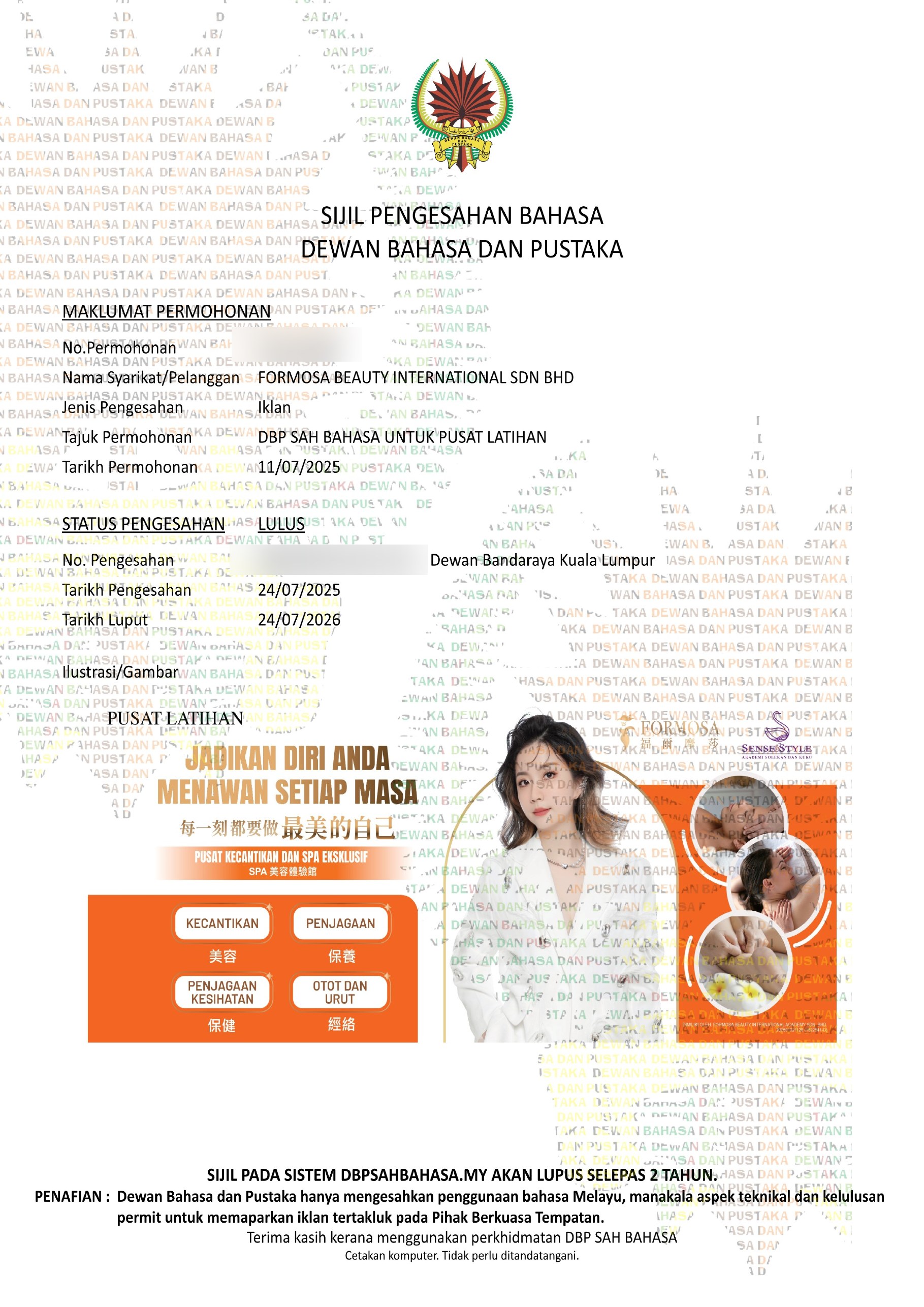
The signboard licence (Lesen Iklan Papan Tanda Premis) is mandatory before you display any signage. There is a step foreign owners regularly trip on: every signboard in KL must first be vetted and approved by Dewan Bahasa dan Pustaka (DBP) — the national language authority — for its language and wording. DBKL will not process the signboard portion of your application until DBP has cleared the sign.
In practice this means Bahasa Malaysia must be present and correct on the sign, and any Chinese, English or other-language text must comply with DBP's rules on prominence and translation. For a Chinese brand entering KL, this is the single most common cause of signboard delay — the artwork that works back home fails DBP vetting and has to be redesigned. Getting the DBP endorsement right the first time keeps the whole composite application moving. For the exact size and position rules (other languages no taller than ¾ of the Malay, Malay on top) and the MyIPO trademark exception, see our guide to signboard language rules in Malaysia.
Documents and pre-conditions
DBKL's licensing decision turns on whether your paperwork proves the premise is legitimate and the activity matches the approved use of the building. The core checklist:
| Document / pre-condition | Why DBKL wants it |
|---|---|
| SSM company registration (Section 14 & 17 / company profile) | Proves the applicant company legally exists |
| Tenancy agreement or proof of premises | Shows you lawfully occupy the address — ideally in the company's name |
| Premises floor plan / layout | Confirms the size and internal use of the unit |
| Land-use / Certificate of Fitness for Occupation (CF/CCC) | The activity must match the building's approved use |
| DBP signboard language approval | Prerequisite for the signboard portion of the composite licence |
| Food handler & typhoid vaccination records (F&B only) | Health condition for restaurants, cafés and food premises |
| Bomba (Fire & Rescue) clearance (certain premises) | Fire-safety condition for higher-risk or larger premises |
The two conditions that most often derail a foreign-owned application are (1) a tenancy that is not in the company's name, and (2) a business activity code that does not match the land use of the unit. Both are fixable — but far more cheaply before you sign a lease than after. A tenancy signed in a director's personal name can usually be reassigned or reissued to the company, yet only if the landlord agrees; a unit zoned for the wrong use may simply be the wrong unit, and no amount of paperwork will change what the building's certificate of fitness permits. This is precisely why the sensible sequence is to verify the premises first and sign second.
The document set also flexes with your industry. A plain retail shop clears the checklist above; a restaurant adds kitchen-hygiene and food-handler conditions; a clinic or salon may carry health-department requirements; a larger or higher-occupancy premise triggers Bomba fire-safety clearance. Map your specific activity to its conditions early — discovering a missing Bomba certificate the week before launch is a classic, avoidable delay.
Step by step through eLesen
DBKL runs its licensing online through eLesen (elesen.dbkl.gov.my), where you apply, renew, amend, cancel and check status. The typical composite-licence flow:
- Register the company and applicant on the eLesen portal.
- Select the composite licence — premise plus signboard — and enter the business activity and premise details.
- Upload documents — SSM profile, tenancy, floor plan, land-use/CF, DBP signboard approval and any sector permits.
- Submit and pay the applicable fees online.
- Inspection (if required) — DBKL may schedule a site visit to confirm the premise matches the application.
- Approval and issuance — the composite licence is issued digitally; display it at the premise.

Timeline, fees and validity
Processing takes anywhere from a few weeks up to about two months. The main variables are whether a site inspection is required and how complete your documents are. Apply 6–8 weeks before your planned opening so you are not tempted to trade without a licence while you wait.
A new premise licence is issued for one year. Before July 2026 every renewal was also for one year. That has now changed; see the next section.
| Item | Detail |
|---|---|
| New premise licence validity | 1 year from issuance |
| Renewal options (from 1 July 2026) | 1, 2 or 3 years in one renewal |
| 2-year renewal discount | 5% off the licence fee |
| 3-year renewal discount | 10% off the licence fee |
| Signboard licence fee | RM200–RM500 per year (by size/type) |
| Typical processing time (new) | A few weeks up to ~2 months |
| When to apply | 6–8 weeks before opening |
How to renew a DBKL business licence in 2026
DBKL announced the multi-year renewal on 20 May 2026, and it took effect on 1 July 2026. DBKL expects about 95,000 licensees in Kuala Lumpur to benefit. The multi-year option covers office premises, workshops and engineering, warehouses and storage, hotels, manufacturing and industrial, food and beverage, trade and commerce, livestock and agriculture, and "other businesses". Beauty-related and entertainment licences are excluded and stay on annual renewal. If your premises host karaoke, live music, arcades or other entertainment, you also need a separate licence under Act 493: see our Kuala Lumpur entertainment licence guide.
The bigger change is the condition attached. On 22 May 2026, DBKL announced that eLesen would be linked to its compound system (SPJ). From 1 July 2026, no new application or renewal goes through while any DBKL compound, traffic summons or rental arrears is outstanding. A business that has been ignoring old parking or enforcement compounds will find its licence renewal blocked until they are paid.
- Clear arrears first. Check for any unpaid DBKL compounds, traffic summonses or rental arrears linked to the licensee, and settle them.
- Log in to eLesen (elesen.dbkl.gov.my) with the licensee's account, ideally a month before expiry.
- Choose the renewal period: 1, 2 or 3 years, if your licence category is eligible.
- Pay online. DBKL says a straightforward online renewal and payment takes about three minutes. The 5% or 10% discount is applied to multi-year renewals.
- Download and display the renewed licence at the premise.
A renewal only works if nothing about the business has changed. A new address, a different activity, a new signboard or a change in the premise's use means an amendment or a fresh application, not a renewal.
Common mistakes and foreign-owner scenarios
A 100% foreign-owned Sdn Bhd can hold a DBKL premise licence — ownership is not the barrier. The friction is almost always practical:
- Tenancy in the wrong name. The lease is signed personally, or by a related company, not by the licence applicant. Put the tenancy in the operating company's name.
- Activity vs land use. Running an F&B kitchen in a unit zoned only for office use, or retail in an industrial lot — DBKL will refuse the mismatch. Confirm the unit's approved use before you sign.
- Signboard designed for the home market. A Chinese- or English-only sign that ignores DBP's Bahasa Malaysia rule gets rejected, stalling the whole composite licence.
- Opening before approval. Trading while the licence is "in progress" is still trading without a licence — and enforcement does inspect.
- Old compounds left unpaid. Since 1 July 2026 an unpaid DBKL compound or traffic summons blocks the renewal on eLesen. Clear them before the licence expires, not on the day.
- Missing sector conditions. F&B needs food-handler and typhoid records (see our food handler certificate and typhoid injection guide); larger or higher-risk premises need Bomba clearance. Left out, they hold up issuance.
- Underestimating the timeline. Foreign teams used to faster jurisdictions assume days, not weeks. Where an inspection is triggered, the calendar stretches — build the two-month worst case into your fit-out and opening plan.
There is a pattern in all of these: the delay is almost never DBKL being slow for its own sake. It is a document that was wrong, a lease that named the wrong party, a sign that ignored DBP, or an activity that never fit the unit. Each is entirely preventable with the right groundwork before the first submission — which is exactly where local experience earns its keep.
If your business will run events, festivals or temporary activations in KL, note that those need a separate DBKL permit — see our guide to the DBKL event permit.

How ONEKEY helps
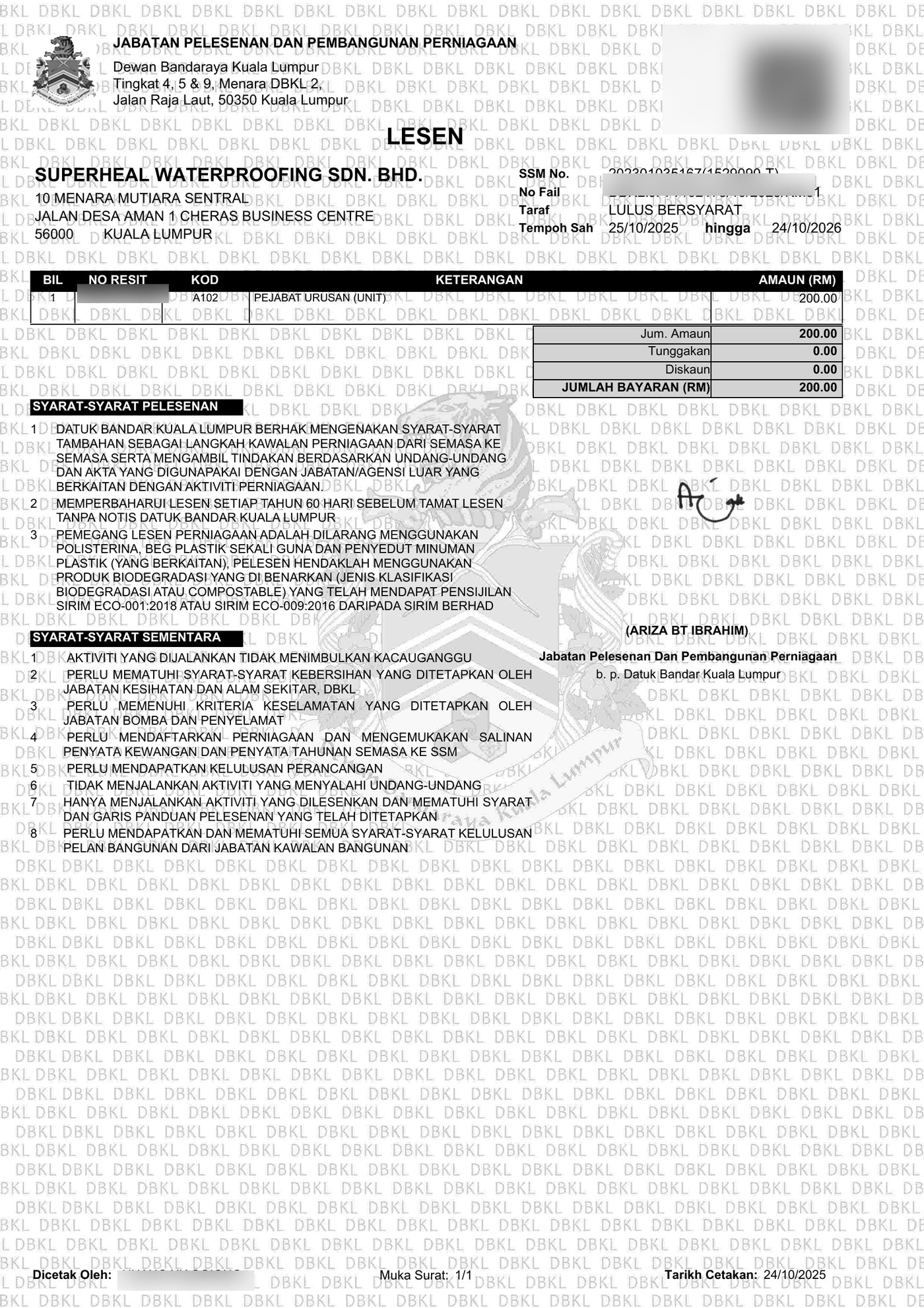
ONEKEY BIZ handles the full DBKL journey so a foreign-owned company can open on schedule: we check the premise's land use before you commit to a lease, get the tenancy and floor plan into shape, run the DBP language vetting for your signboard, assemble the composite-licence pack, and file and track it through eLesen — including the F&B health and Bomba conditions where they apply. We have completed DBKL licensing for real KL clients across spa, beauty, F&B and retail shopfronts.
For a Chinese or foreign owner, the practical value is that you deal with one team in your own language while we handle the Bahasa-Malaysia paperwork, the DBP counter and the DBKL portal on your behalf. We flag the land-use and tenancy issues before they become expensive, get the signboard artwork right the first time, and keep the composite application moving so your launch date holds. When it is time to renew, we assess whether the new multi-year option saves you money and file it too — so the licence never lapses and the premise never trades a day out of compliance.
Getting your premises licensed is the last gate between incorporation and opening day. Start with our Sdn Bhd registration guide for foreigners, confirm your WRT / foreign-ownership position, and if you'll be running events, read the DBKL event permit guide. When you're ready to license your KL premises, explore our DBKL licensing service or talk to our team — WhatsApp +60 12-321 1349.
Frequently asked questions
What are the DBKL business licence requirements?
As at September 2026 you need an SSM-registered business, a tenancy or proof of occupation (ideally in the company's name), a floor plan, a premise whose approved land use and CF/CCC match your activity, DBP approval for any signboard, and sector conditions such as food-handler and typhoid records for F&B or Bomba clearance for larger premises. The application is made online through eLesen.
How do I renew a DBKL business licence?
Log in to eLesen (elesen.dbkl.gov.my), choose a one-, two- or three-year renewal if your category is eligible, pay online and download the renewed licence. Since 1 July 2026, eLesen is linked to DBKL's compound system, so you must first clear any unpaid DBKL compounds, traffic summonses or rental arrears or the renewal will be blocked.
Can I renew my DBKL licence for three years?
Yes, from 1 July 2026 for most categories, including offices, F&B, trade, warehouses, hotels, workshops and manufacturing. A two-year renewal gets 5% off and a three-year renewal 10% off. Beauty-related and entertainment licences are excluded and remain on annual renewal.
Do I need a DBKL licence if my company is already registered with SSM?
Yes. SSM registration creates the company; a DBKL business premise licence is what lets that company legally operate a shop, office or restaurant in Kuala Lumpur. They are two separate steps and you need both.
Why does my signboard need Dewan Bahasa dan Pustaka approval?
Every signboard displayed in Kuala Lumpur must first be vetted by Dewan Bahasa dan Pustaka (DBP) for language and spelling; DBKL will not process the signboard licence without DBP approval, so non-Malay signage must be arranged correctly up front.
How long does DBKL licensing take?
Typically a few weeks up to about two months, depending on whether the premises need an inspection. Apply six to eight weeks before your planned opening date so licensing does not delay your launch.
Related services
We handle the process described in this article end-to-end.
- DBKL Business Premise Licence (Kuala Lumpur)Business premise & signboard licence with Kuala Lumpur City Hall (DBKL).
- MBSJ Business Licence Application (Majlis Bandaraya Subang Jaya)Business premise licence with Subang Jaya City Council (MBSJ).
- MBSJ Business Licence Renewal (Majlis Bandaraya Subang Jaya)Renew your existing MBSJ (Subang Jaya) business licence.
Sources & references
This article is general information only, not legal, tax or immigration advice. Policies, thresholds and official fees are set by the relevant Malaysian authorities and may change. Talk to our consultants about your specific situation.