A council officer walks into a new shop in Klang, a café in Kajang or a small factory unit in Shah Alam, and one of the first things they look for is a red cylinder on the wall. Fire extinguishers are the cheapest fire-safety item a business buys, yet they cause a steady stream of failed licence inspections: wrong type for the hazard, mounted behind a door, no service tag, or simply missing. Above a certain size, a premises also needs a Bomba Fire Certificate, and the penalty for operating without one rose tenfold in 2018. This guide explains what the law actually requires, from the Fire Services Act 1988 to the Malaysian Standard on siting extinguishers, the new rules on who may service them, and the point at which a building has to hold a Fire Certificate.
Quick answer (as at November 2026): Every business premises in Malaysia needs portable fire extinguishers suited to its hazards. Under MS 1539-3, each storey needs a total Class A rating of at least 0.065 × the floor area in m² (minimum 26A), and nobody should have to walk more than 20 m to reach one. Since 3 February 2026, extinguishers may only be serviced by a Bomba-registered competent person or fire safety contractor. Larger buildings listed as designated premises must also hold a Fire Certificate, renewed every year (Act 341 s.28). Operating without one carries a fine of up to RM50,000, up to 5 years' jail, or both (s.33).
| Question | Short answer | Where it comes from |
|---|---|---|
| Do all businesses need fire extinguishers? | Yes in practice. Building by-laws require portable extinguishers under the relevant code of practice, and councils make them a licence condition (Klang made one unit compulsory for licences in 2026) | UBBL 1984 by-law 227; MS 1539-3; council licence conditions |
| How many? | Total Class A rating per storey ≥ 0.065 × floor area (m²), minimum 26A; 13A for a single-occupancy upper floor of 100 m² or less | MS 1539-3:2003 |
| Where? | On exit routes, near room exits, corridors, stairs and landings; no one should travel more than 20 m to reach one; never hidden behind doors or in cupboards | MS 1539-3:2003 |
| Mounting height | Units of 4 kg or less: handle about 1.5 m from the floor. Heavier units: about 1 m | MS 1539-3:2003 |
| Who may service them? | Only a competent person or fire safety contractor registered with Bomba (from 3 Feb 2026) | Fire Services (Amendment) Act 2025, ss.36C–36H; 2026 regulations |
| Fire Certificate | Required for designated premises; renewed annually | Act 341 ss.27–28 |
| Penalty, no Fire Certificate | Up to RM50,000, up to 5 years, or both (owner liable) | Act 341 s.33, as amended by Act A1568 (2018) |
Which law applies: Act 341, the by-laws and MS 1539
Fire safety for business premises in Malaysia rests on three layers that are easy to confuse.
The first is the Fire Services Act 1988 (Act 341), administered by the Fire and Rescue Department of Malaysia (Jabatan Bomba dan Penyelamat Malaysia, "Bomba"). It creates the Fire Certificate system for larger buildings, gives Bomba the power to deal with fire hazards in any premises, and since 2025 regulates who may install and service fire-fighting equipment. Its definition of a fire hazard expressly includes fire-fighting equipment that is missing or "not in efficient working order". An empty or seized extinguisher is therefore not just poor practice. Under s.10 Bomba can serve a notice to abate it, and ignoring that notice carries up to RM5,000 or 3 years, plus RM100 a day while it continues.
The second layer is the Uniform Building By-Laws 1984 (UBBL), adopted by each state under the Street, Drainage and Building Act 1974. By-law 227 requires portable extinguishers to be provided in accordance with the relevant codes of practice and sited prominently on exit routes. This is the rule your architect and the Bomba plan checker apply when a building is designed.
The third layer is the Malaysian Standard MS 1539, the code of practice that by-law 227 points to. Part 3 covers selection and installation, Part 4 covers maintenance and Part 5 covers Class F (cooking oil) extinguishers. The numbers in this guide on quantity, travel distance and mounting height come from MS 1539-3.
On top of these, your local council adds fire equipment to its licence conditions, and its officers are usually the first to check. For a new outlet, getting the extinguishers right is part of getting the council business licence.
How many fire extinguishers does a business need?
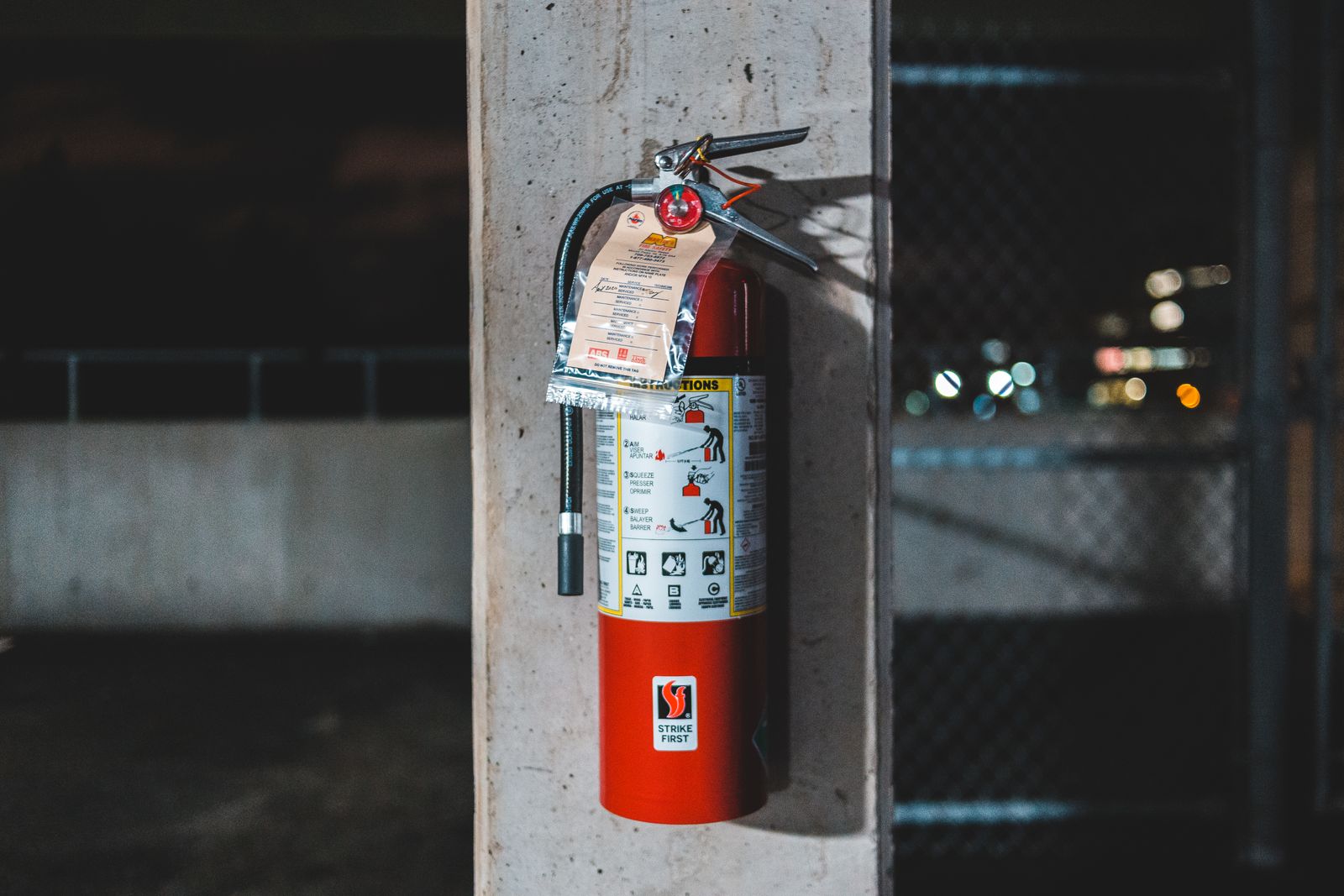
MS 1539-3 does not count cylinders. It counts fire ratings. Each extinguisher carries a rating such as 13A or 27A for solid-material fires, printed on its label. The standard asks for a total Class A rating on each storey of at least:
0.065 × floor area of the storey (m²), with a minimum of 26A.
A single-occupancy upper floor of 100 m² or less needs only 13A. The second test is distance: extinguishers must be placed so that no one has to travel more than 20 m from any point to reach one. In long or partitioned premises, the distance test, not the rating sum, usually decides the number of units.
| Premises (one storey) | Floor area | Minimum total Class A rating | What that often looks like in practice |
|---|---|---|---|
| Small office or shop lot, upper floor | 90 m² | 13A (≤ 100 m², single occupancy) | One multi-purpose unit by the exit |
| Ground-floor shop or café | 150 m² | 26A (0.065 × 150 = 9.75, so the 26A minimum applies) | Two units, or one high-rated unit, plus a Class F unit if there is deep frying |
| Showroom or office floor | 600 m² | 39A (0.065 × 600) | Two or three units, spaced so that no point is more than 20 m away |
| Factory or warehouse floor | 2,000 m² | 130A (0.065 × 2,000) | Several units along aisles and exits, sized for the materials stored; usually alongside hose reels and sprinklers |
These are worked examples of the formula, not a substitute for a site assessment. Ratings vary by model, special hazards (fuel, chemicals, server rooms, kitchens) need their own units on top of the general cover, and the Bomba-approved building plan may already specify more. If you are fitting out a new outlet, our Bomba-certified fire extinguisher supply and installation service sizes the units against the floor plan before the council inspection.
Which type: matching the extinguisher to the fire
MS 1539-3 classifies fires as A (solids such as paper, wood and fabric), B (flammable liquids), C (gases), D (metals), E (live electrical equipment) and F (cooking oils and fats). The extinguisher's label shows which classes it is rated for. Most premises end up with a combination:
- Multi-purpose dry powder (ABC). The default for offices, shops and warehouses with mixed hazards. Cheap and versatile, but the powder makes a mess and damages electronics.
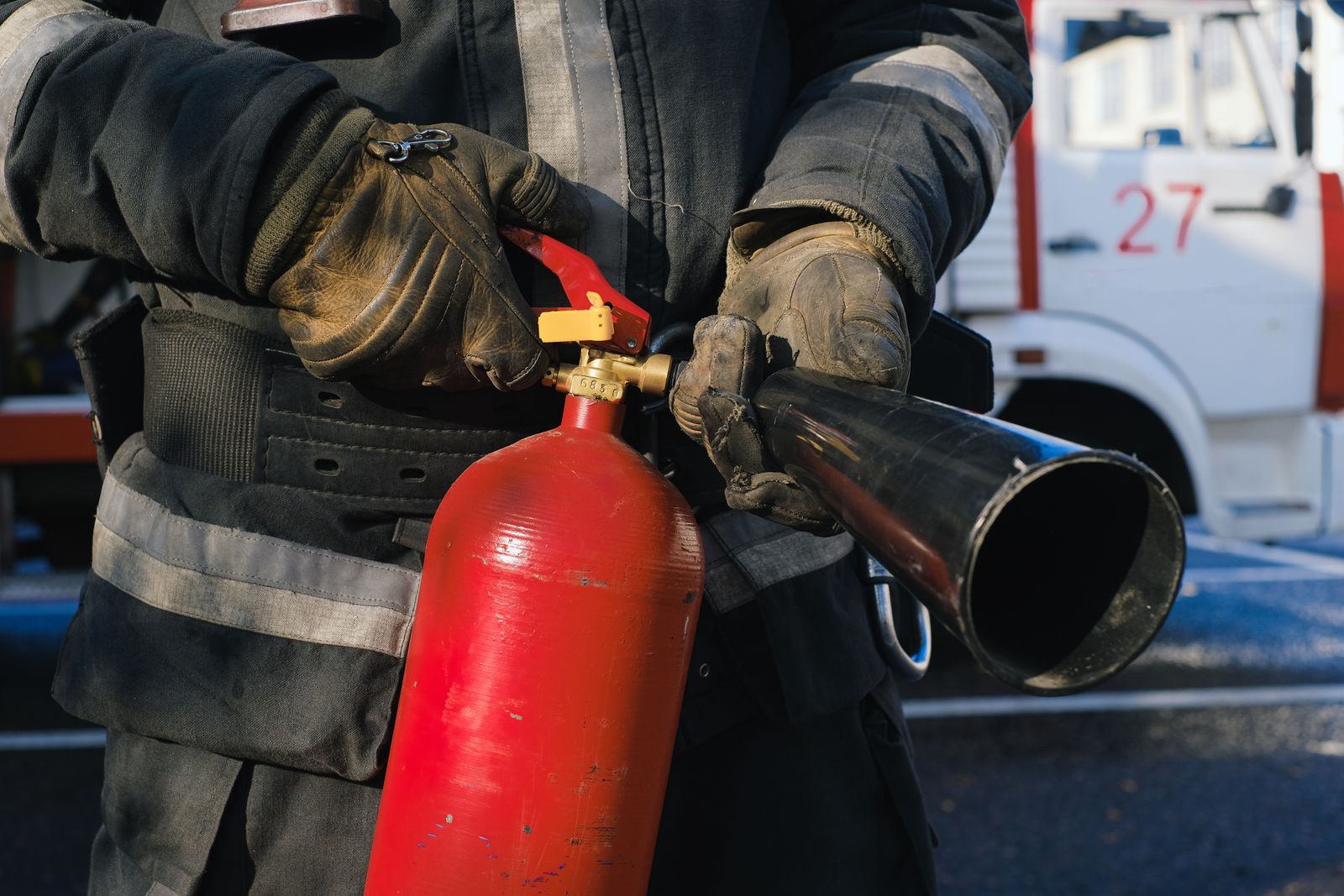
- Carbon dioxide (CO₂). For electrical rooms, server racks and switchboards. It leaves no residue. The standard is explicit that only types marked as suitable should be used on live electrical equipment. Water and foam units carry a "do not use on live electrical equipment" warning.
- Class F (wet chemical). For commercial kitchens with deep-fat fryers. MS 1539-3 recommends Class F extinguishers for deep-fat frying. Water on burning oil is the classic kitchen disaster, and a powder unit is a poor substitute.
- Foam or water. Useful for solid and liquid-fuel risks in workshops and stores, but never near live electrics.
Where to mount them, and the details inspectors check
MS 1539-3 is specific about placement, and these details are what council and Bomba officers look at:
- Height. Units weighing 4 kg or less should be mounted with the handle about 1.5 m from the floor. Heavier units should be mounted at about 1 m. Some council checklists ask for a photo showing the extinguisher hung on the wall, not standing on the floor.
- Location. Near room exits, in corridors, on stairs and landings, so that a person escaping passes one. Not behind doors, not in cupboards, not blocked by stock.
- Signage. Location signs to MS 981 where the unit is not obvious from the approach.
- Records. Keep a record of the type, number and location of extinguishers. It helps with inspections, insurance claims and planning the annual service.
The most common failures we see at licence inspections are not about numbers. They are a unit placed on the floor, a powder unit in a frying kitchen, a gauge in the red, or a tag showing the last service was two years ago.
Servicing: who may do it after the 2025 amendment
Extinguishers are pressure vessels that lose charge, cake or corrode. MS 1539-4 is the Malaysian code of practice for their maintenance, and the service interval your contractor follows should be taken from it and from the manufacturer's instructions. In practice, Malaysian premises have their extinguishers serviced and tagged once a year, and councils and Bomba treat an out-of-date tag as a failed item.
What changed recently is who may do that work. The Fire Services (Amendment) Act 2025 passed the Dewan Rakyat on 5 March 2025 and the Dewan Negara on 23 March 2025. It inserted new sections 36C–36H into Act 341. Section 36D requires anyone who installs, tests, services, recharges or repairs prescribed fire-fighting equipment to be registered as a competent person or a fire safety contractor. The supporting regulations were gazetted on 29 January 2026 and came into force on 3 February 2026.
For a business owner, this means asking a supplier for its Bomba registration before letting it service your units, and keeping a copy with your fire-safety records. A cheap refill from an unregistered vendor can leave you with equipment that does not count at an inspection.
When your premises needs a Bomba Fire Certificate
Extinguishers apply to everyone. The Fire Certificate (Perakuan Bomba) applies only to larger buildings that the Director General of Bomba has listed as designated premises under s.27 of Act 341. Section 28(1) is short: "Every designated premises shall require a fire certificate", and s.28(2) adds that it "shall be renewable annually". Places of public religious worship and single private dwellings are exempt.
The list of designated premises is set out in the Fire Services (Designated Premises) Order 1998, as amended in 2020 (P.U.(A) 289/2020). The thresholds below are from that amended schedule as summarised by fire-safety practitioners. Confirm your building's status with the Bomba district office before relying on them.
| Type of premises | Designated (needs a Fire Certificate) when… |
|---|---|
| Office | 30 m high or more, or total floor area 10,000 m² or more |
| Shop | Total floor area 3,000 m² or more |
| Factory | 2,000 m² or more with automatic sprinklers; special structures with hazardous processes |
| Storage / general | 1,000 m² or more, or 7,000 m³ or more, with sprinklers; sprinklered underground car parks of 2,000 m² or more |
| Hotel | Open-corridor blocks with 100 rooms or more; other designs from 51 rooms (4 storeys and above) or 101 rooms (2–3 storeys) |
| Hostel / dormitory | Open corridor: 10 storeys or 5,000 m² and above. Other designs: 6 storeys or 3,000 m² and above |
| Hospital / nursing home | 2,000 m² or more, or 5 storeys and above |
| Place of assembly | 2,000 m² or more; or 1,000 m² or more below the exit level |
| Library | 2,000 m² or more |
Most small and medium businesses that rent a shop lot or an office suite do not hold a Fire Certificate themselves. The building owner or management corporation does, because the certificate attaches to the premises. A company that builds or buys its own factory, or that occupies a whole qualifying building, becomes the applicant. Section 29 makes the owner, occupier or person in overall management responsible for applying.
The application goes to Bomba with the building's details. Bomba may ask for plans, and if they are not supplied in time the application is treated as withdrawn. Bomba then inspects. If the fire-safety installations are satisfactory, it issues the certificate, with conditions where needed. If not, it serves a notice listing what must be fixed first. Before any material change to the building, s.32(2) requires you to notify Bomba. The process sits naturally at the end of a factory project, after the Certificate of Completion and Compliance; our end-to-end factory setup guide shows where it falls in the sequence.
Renewal, penalties and what changes on 1 April 2027
Renewal. The Fire Certificate is renewed annually. Under the Fire Services (Fire Certificate) Regulations 2001, renewal is filed at least 30 days before expiry. Following amendments in force from 1 October 2020, a certificate that has lapsed can no longer be revived by paying a late penalty. The owner has to apply afresh, with a new inspection.
Penalties. Act A1568 (in force 2018) raised the s.33 penalty for designated premises without a Fire Certificate in force to a fine of up to RM50,000, imprisonment of up to 5 years, or both, and it is the owner who is liable. Older articles still quote RM5,000 and 3 years; that is the pre-2018 figure.
Fire Safety Organisation. The same 2018 amendment inserted s.27A, which requires the owner, occupier or manager of designated premises to establish a fire safety organisation, again on pain of up to RM50,000 or 5 years. Under the 2020 regulations it consists of a fire safety manager and at least three fire safety officers certified by Bomba. Bernama reported on 6 October 2026 that the 9,451 designated buildings in Malaysia must appoint fire safety managers and officers from 1 April 2027, with a run-in period of 6 to 18 months. After that, Bomba will renew Fire Certificates on the basis of annual inspection reports prepared by the fire safety manager rather than its own yearly physical inspection.
| Provision (Act 341) | What it requires | Maximum penalty |
|---|---|---|
| s.28 + s.33 | Designated premises must hold a Fire Certificate, renewed annually | RM50,000, 5 years, or both (owner) |
| s.27A | Designated premises must establish a fire safety organisation (FSM + FSOs from 1 Apr 2027) | RM50,000, 5 years, or both |
| s.10 | Comply with a notice to abate a fire hazard (including equipment not in working order) | RM5,000, 3 years, plus RM100 a day |
| s.36D (2025 amendment) | Only registered competent persons or fire safety contractors may install, test, service, recharge or repair prescribed equipment | Offence; amount not confirmed in published sources |
| s.58 | General penalty where no specific penalty is set | RM5,000, 3 years, or both |
Fire extinguishers and your council licence
For most small businesses, the council inspection, not Bomba, is where extinguishers get checked. Requirements vary by council and by activity, but the pattern is consistent:
- Klang (MBDK) made one portable extinguisher per premises a condition for new licences and renewals in 2026.
- Selayang (MPS) asks applicants for a photograph showing the extinguisher hung on the wall, and many applications are sent back over that detail.
- Food-premises conditions typically require "adequate" fire-fighting equipment. Sabak Bernam's written conditions for food establishments, for example, use that word.
- Some councils add that the extinguisher must not be expired, as in Langkawi's business premises licence guideline.
Food outlets carry the highest risk and the most scrutiny, so plan the kitchen's Class F unit together with the grease trap and the staff's food-handler training. Our F&B licensing guide covers the rest of that checklist.

A practical checklist before your inspection
- Measure each storey and apply 0.065 × m² (minimum 26A), then check the 20 m travel distance on the floor plan.
- Match types to hazards: ABC powder for general areas, CO₂ beside electrical boards and servers, Class F in kitchens with fryers.
- Mount correctly: about 1.5 m to the handle for units of 4 kg or less, about 1 m for heavier ones, on exit routes, never behind doors.
- Check the gauge and tag: pressure in the green and a current service tag from a Bomba-registered contractor.
- Keep a register of type, location and service date, and keep a copy of your contractor's Bomba registration.
- Ask the landlord whether the building is designated premises and whether its Fire Certificate is current, especially before signing for a whole building or a large floor.
- Read your council's conditions for your licence category, and photograph the installation for the application.
Fire equipment is a small line in a fit-out budget, and it is a common reason for a failed inspection that delays opening. If you are opening a new outlet or renewing a licence and want it right the first time, our fire extinguisher installation service for business premises handles sizing, supply, mounting and the service record, and we can coordinate the council licence alongside it. Contact us with your floor plan and business type.
Frequently asked questions
How many fire extinguishers are required for a shop in Malaysia?
Under MS 1539-3, each storey needs a total Class A rating of at least 0.065 × the floor area in m², with a minimum of 26A (13A for a single-occupancy upper floor of 100 m² or less). Extinguishers must also be placed so that no one travels more than 20 m to reach one. Some councils, such as Klang (MBDK), also make at least one unit a licence condition.
Who can service fire extinguishers in Malaysia?
From 3 February 2026, only a competent person or fire safety contractor registered with Bomba may install, test, service, recharge or repair prescribed fire-fighting equipment (Fire Services Act 1988 s.36D, inserted by the 2025 amendment). Ask your supplier for its Bomba registration and keep a copy.
Which premises need a Bomba fire certificate?
Only designated premises under s.27–28 of the Fire Services Act 1988, listed in the Designated Premises Order 1998 (amended 2020). Examples: offices 30 m high or 10,000 m² and above, shops of 3,000 m² and above, sprinklered factories of 2,000 m² and above, and larger hotels, hostels and hospitals. The certificate attaches to the building and is renewed every year.
What is the penalty for not having a fire certificate in Malaysia?
Under s.33 of the Fire Services Act 1988, as amended by Act A1568 in 2018, the owner of designated premises without a Fire Certificate in force faces a fine of up to RM50,000, imprisonment of up to 5 years, or both. Since 1 October 2020, a lapsed certificate cannot be revived by paying a late penalty; a fresh application is needed.
How often must fire extinguishers be serviced in Malaysia?
The maintenance code is MS 1539-4, read with the manufacturer's instructions. In practice, Malaysian premises have extinguishers serviced and tagged once a year, and councils and Bomba treat an out-of-date tag as a failed item. Confirm any pressure-test interval for each unit with your Bomba-registered contractor.
Related services
We handle the process described in this article end-to-end.
- Bomba-Certified Fire Extinguisher Supply & InstallationSupply and install certified dry powder fire extinguishers that meet Fire and Rescue Department (Bomba) requirements.
- DOSH Factory & Plant Registration (Certificate of Fitness)Register your factory and plant with DOSH under the amended OSHA 1994.
- Department of Environment (DOE) Approval & Official Opinion LetterFind out what environmental approval your project or business needs from DOE.
Sources & references
This article is general information only, not legal, tax or immigration advice. Policies, thresholds and official fees are set by the relevant Malaysian authorities and may change. Talk to our consultants about your specific situation.