Almost every foreign F&B group that fails in Malaysia fails in the same place, and it is not the food. It is the gap between signing a tenancy and being legally allowed to serve a paying customer — a gap that involves at least five separate authorities, runs on independent clocks, and cannot be compressed by paying rent faster. A Malaysian Sdn Bhd can be incorporated in a week. A foreign-owned restaurant that is fully licensed to trade takes, realistically, four to eight months from the day the company exists. This guide sets out the entire licence stack in the order it actually binds: the KPDN Wholesale, Retail and Trade (WRT) licence with its RM1 million paid-up capital expectation and its "unique concept" test; the premises themselves, where zoning, the Certificate of Completion and Compliance and Bomba sign-off decide whether the unit is licensable at all; the local council business and signboard licence, including DBKL's composite licence and the Dewan Bahasa dan Pustaka rule that quietly redesigns your logo; the Food Act 1983 and Food Hygiene Regulations 2009 regime that governs every person who touches food; halal; liquor under the Excise Act 1976; the staffing problem; and the RM1.5 million service tax line that behaves differently from the rest of the SST system.
The structural mistake: treating the licences as paperwork that follows the lease
In China, Taiwan, Hong Kong and Singapore, F&B operators are used to a sequence in which the site is secured first and the permits are processed against it. Malaysia inverts the risk. Two of the gates — foreign equity approval and the licensability of the premises — are determined by facts that exist before you sign anything, and neither can be fixed retroactively by a landlord who wants the unit filled.
The result is a pattern we see repeatedly with incoming Chinese hotpot, tea, bakery and regional-cuisine brands: a lease is signed in month one with three months of rent-free fit-out, the WRT application is filed in month two, and by month five the brand is paying full rent on a shuttered unit while KPDN asks for a revised menu and the council asks for a fire safety document the landlord never obtained. The rent burn, not the licence fee, is what kills the P&L of the first outlet.
The full licence stack at a glance
| Requirement | Authority | Legal basis | Typical timeline |
|---|---|---|---|
| Sdn Bhd incorporation | SSM | Companies Act 2016 | 3–7 working days |
| WRT licence (foreign equity in distributive trade) | KPDN | Guidelines on Foreign Participation in the Distributive Trade Services | 2–4 months |
| Premises licensability — zoning, CCC, change of use | Local authority / PBT | Town and Country Planning Act 1976; UBBL 1984 | Immediate if compliant; 6–18 months if a change of use is needed |
| Fire safety sign-off for the premises | Bomba (JBPM) | Fire Services Act 1988 | 2–8 weeks after plans |
| Business premise licence (Lesen Perniagaan) | Local authority (DBKL, MBPJ, MBSA…) | Local Government Act 1976 s.107 | 1–3 months |
| Signboard licence (Lesen Iklan) + DBP endorsement | Local authority + Dewan Bahasa dan Pustaka | Local Government Act 1976; national language policy | 2–6 weeks (DBP first) |
| Food handler training + anti-typhoid vaccination (every handler) | MOH (KKM) via approved trainers | Food Hygiene Regulations 2009 reg. 30/31 | 3-hour minimum course; do it before inspection |
| Halal certification (optional, commercially decisive) | JAKIM / JAIN | Trade Descriptions (Halal) Order 2011; MS1500:2019 | 2–6 months |
| Liquor licence (if serving alcohol) | Licensing Board via local authority; Customs | Excise Act 1976 s.35 | 2–6 months |
| Service tax registration (F&B) | RMCD (MySST) | Service Tax Act 2018, Group B | 30 days after crossing RM1.5m |
| MyInvois e-invoicing | LHDN | Income Tax Act 1967 s.82C | By your phase date |
Gate one: WRT — the licence that decides whether you may own the restaurant at all
Restaurants sit inside distributive trade. Under the Guidelines on Foreign Participation in the Distributive Trade Services administered by the Ministry of Domestic Trade and Cost of Living (KPDN), any company with foreign equity carrying on distributive trade must hold a WRT licence, and must be locally incorporated under the Companies Act 2016 — a Malaysian Sdn Bhd, not a branch of the Chinese parent.
Three features of the WRT decide the shape of the whole project:
Paid-up capital. KPDN in practice expects a minimum paid-up capital of about RM1,000,000 for a company with 100% foreign equity in distributive trade. This is not a deposit and not a fee — it is share capital that must actually be paid into the company and shown in the accounts. Budgeting RM1 million as "capital on paper" is the single most common structuring error, because the money is examined.
The "unique concept" test. KPDN does not exist to help foreign capital compete with local hawkers and kopitiams. WRT approval for F&B is granted where the concept is genuinely differentiated — an authentic regional cuisine, a specialised format, a branded chain with its own IP. Applications are assessed on the full menu, the chefs' credentials (CVs generally expected to show around three years' relevant experience), and photographs or renders of a properly fitted, air-conditioned premises. A generic mixed-rice or noodle shop is the profile most likely to be refused.
Time. Two to four months is normal, longer when the queue is deep. This is the item that must be started first, because nothing about it accelerates.
The WRT rules, the restricted business formats and the capital thresholds are set out in full in our guide to the KPDN WRT licence and in 100% foreign ownership and the WRT licence.
Gate two: the premises decide more than the concept does
A local authority will not licence a food business in a unit that is not lawfully usable as one. Three documents govern this, and all three belong to the landlord or the developer rather than to you:
- Land use and planning permission. The unit must sit on land and in a building approved for commercial use, and specifically for a food premises where the council draws that distinction. Converting a shoplot's approved use, or operating out of a unit zoned residential or light industrial, is a planning matter under the Town and Country Planning Act 1976 and is measured in months to years, not weeks.
- Certificate of Completion and Compliance (CCC). Since 12 April 2007 the CCC has replaced the old Certificate of Fitness for Occupation. A building without a CCC cannot reliably support a premise licence application.
- Fire safety. Kitchen fit-outs — gas piping, exhaust hoods, suppression systems, additional exits — routinely require Bomba review, and for food premises the council will typically want that comfort before issuing or renewing.
Ask for these before the letter of offer, not after. The correct diligence question to a Malaysian landlord is not "can I open a restaurant here?" but "please provide the CCC, the approved use for this unit, and the last Bomba correspondence."
Gate three: the council business licence, the signboard, and Dewan Bahasa dan Pustaka
The business premise licence (Lesen Perniagaan) is issued by the local authority under section 107 of the Local Government Act 1976. There are more than 150 local authorities in Malaysia and each sets its own forms, fees and conditions — a licence obtained from DBKL says nothing about what MBPJ, MBSA or MPKlang will ask for.
DBKL's composite licence. Kuala Lumpur is the exception worth knowing: DBKL offers a Lesen Komposit that bundles the business premise licence and the signboard licence in one application. No Selangor council offers this, so a brand opening simultaneously in KL and PJ will run two structurally different processes.
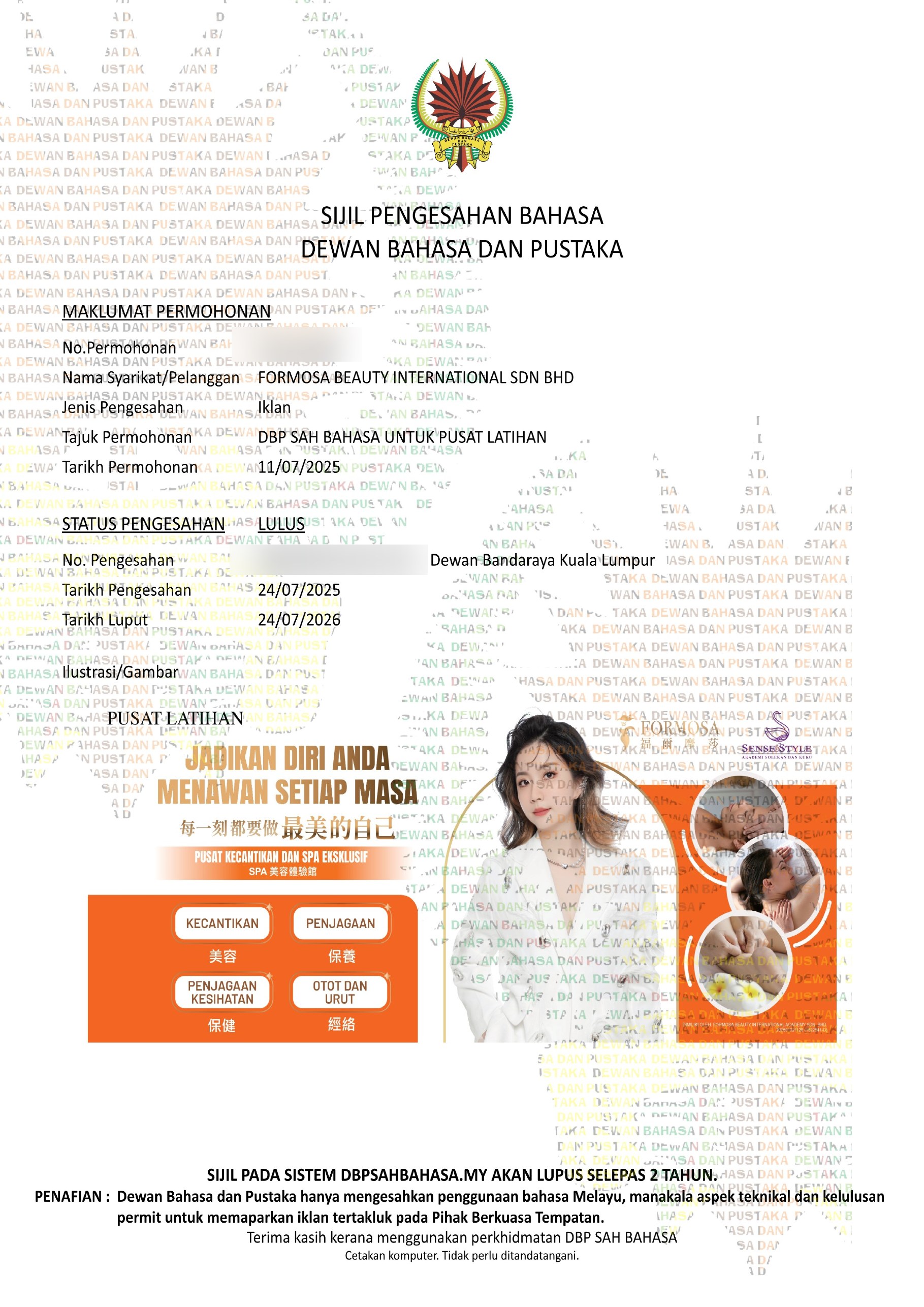
The signboard is a separate licence, and it is a language problem before it is a licensing problem. Malay must appear on the signboard, and where other languages are used the Malay text must generally be the most prominent — commonly applied as being at least 30% larger. The Malay wording must be validated by Dewan Bahasa dan Pustaka (DBP) before the council will issue the licence. For an incoming Chinese brand this is the step that most often forces a redesign: a logo built around Chinese characters with a small English descriptor will not pass, and the fabricator will have already quoted on the wrong artwork. Indicative DBKL signboard fees run roughly RM200–300 per year for a non-illuminated sign and RM300–400 for an illuminated one, scaling with size, type and location up to RM2,000 or more.
Gate four: the Food Act 1983 regime, which governs people, not just premises
Food safety is regulated by the Ministry of Health under the Food Act 1983 and the Food Hygiene Regulations 2009, which have been fully enforced since 2014. Two obligations attach to every individual who handles food, including the owner working the pass on a busy night:
- Food handler training. Regulation 30 requires every food handler to complete a food handlers' training course at an institution recognised by the Director and to hold the resulting certificate. The course runs for at least three hours at a recognised school, and can be taken online with schools on MOH's online list. A food handler who works without it commits an offence carrying a fine of up to RM10,000 or imprisonment of up to two years on conviction.
- Anti-typhoid vaccination. Councils and the MOH require food handlers to be vaccinated against typhoid, and the certificate is checked at inspection and at licence renewal. Who counts as a food handler, how the three-year typhoid cycle works and what the employer must keep on file are set out in our guide to the food handler certificate and typhoid injection.
The practical consequence is a staffing rule rather than a compliance rule: every new kitchen or service hire must be trained and vaccinated before their first shift, and the certificates must be on file at the premises. Councils will refuse applications and hold renewals where any staff member is uncertified — and in a high-turnover F&B operation the file drifts out of compliance within months of opening unless someone owns it.
MOH also grades food premises on inspection (commonly A/B/C). The grade is a public-facing signal and, in shopping-mall tenancies, increasingly a contractual one.

Halal: optional in law, decisive in the market
Halal certification is not compulsory for a restaurant that makes no halal claim. It becomes compulsory the moment you make one: under the Trade Descriptions (Halal) Order 2011, describing food as halal without valid certification from JAKIM or the relevant state religious authority (JAIN) is an offence. There is no such thing as an informal or self-declared halal restaurant.
The commercial calculus is straightforward and often decided too late. Malaysia's Muslim population is roughly two-thirds of the country; most premium mall landlords weigh halal status in tenant selection; and corporate, government and family catering demand is effectively closed without it. Certification under MS1500:2019 constrains the menu (no pork, no alcohol as an ingredient, no alcohol served), the supply chain (certified suppliers), the layout (dedicated storage and preparation, no cross-contact) and staffing (a halal executive or committee, with Muslim staff requirements in the kitchen).
Those constraints are structural, not cosmetic — they must be designed into the kitchen and the menu at concept stage. A Chinese restaurant group that intends to seek halal later almost always finds that "later" means rebuilding. The certification process itself is covered in our JAKIM halal certification guide.
Liquor: a separate legal universe
Alcohol is not part of the food licensing chain. Retail sale of alcoholic beverages for consumption on the premises is licensed under the Excise Act 1976, with approval of the Licensing Board under section 35, and applications run through the local authority with input from the district office, police, Bomba and Customs.
Two constraints shape planning. First, location: premises must be in a commercially zoned area and are generally refused where they sit close to schools, places of worship, residential areas or community facilities — which removes a set of otherwise attractive shoplots. Second, who may hold the licence: applicants are generally required to be Malaysian citizens or permanent residents and at least 21 years old, and Muslims may not hold liquor retail licences. For a foreign-owned Sdn Bhd this means the licence is held through a qualifying individual within the structure — a point to resolve with counsel at incorporation, because retrofitting it later means changing the people on your board or in your management.
Fees, conditions and renewal cycles vary materially by state and council. Selangor, Kuala Lumpur, Penang, Johor and Kelantan are not interchangeable, and a concept whose margin depends on beverage sales should confirm the position in the specific council area before the site is chosen.
Staffing: the kitchen you designed may not be the kitchen you can staff
Foreign F&B brands typically need two categories of foreign staff, and they are governed by entirely different systems.
Expatriates — executive chefs, brand or operations leads, R&D — go through the Expatriate Services Division on an Employment Pass, subject to the salary tiers in force from 1 June 2026: EP Category I at RM20,000 and above, Category II at RM10,000–19,999, Category III at RM5,000–9,999. A head chef role priced at RM6,000 sits in Category III, which carries the shortest validity and the tightest scrutiny, and it must clear the local-hiring gates first.
Operational foreign workers — line cooks, kitchen hands, service staff — are a quota system administered by the Ministry of Home Affairs, not an ESD matter. Restaurants are among the service subsectors eligible under the quota window opened from 19 January 2026, whose original 31 March closing date was subsequently removed, leaving applications open-ended subject to prevailing policy. Quotas are capped by sector and location and are not guaranteed; national policy has been tightening, and the overall foreign workforce ceiling has been under review through 2026. Design the kitchen around the labour you can actually obtain, and confirm the quota position before committing to a format that needs fifteen back-of-house staff.

Tax: the RM1.5 million line that is not the usual RM500,000
F&B is the exception in Malaysia's service tax architecture, in both rate and threshold.
| F&B service (Group B) | Most other taxable services | |
|---|---|---|
| Service tax rate | 6% | 8% for most categories |
| Registration threshold | RM1,500,000 in a 12-month period | Generally RM500,000 |
| Registration deadline | Within 30 days of the end of the month in which the threshold is crossed — via MySST | |
| Filing | Bi-monthly SST-02 return, on an accounted basis | |
Two operational points follow. First, the threshold is a rolling 12-month test, not a financial-year test: a strong opening quarter can pull a single outlet across RM1.5 million faster than the budget assumed, and the 30-day registration clock starts from the month-end, not from the year-end. Second, registration is at company level across the taxable service — an operator running three outlets in one Sdn Bhd aggregates their turnover, which is a real argument for how outlets are grouped between entities. The wider SST framework, including sales tax on imported ingredients and equipment, is set out in our SST expansion guide.

A realistic timeline and the five ways foreign F&B projects stall
| Month | What should be happening |
|---|---|
| 0–1 | Sdn Bhd incorporated with the right paid-up capital plan; site shortlist with CCC and approved-use checks; concept and menu documented to WRT standard |
| 1–2 | Capital injected and evidenced; WRT filed; conditional tenancy or option secured, not a full lease |
| 2–4 | WRT under review; DBP signboard wording submitted; fit-out design reviewed against Bomba requirements; halal decision made and designed in |
| 4–5 | WRT approved; full lease executed; council business + signboard licence filed; food handler training and vaccinations completed for the opening team |
| 5–7 | Fit-out and Bomba sign-off; council inspection; licences issued; liquor application in parallel if applicable |
| 7–8 | Soft opening; MyInvois in place; SST monitoring against the RM1.5m rolling test from day one |
The five recurring failures are worth naming because each is avoidable at zero cost if seen early:
- Signing the lease before WRT. Rent burn on a unit that cannot legally open is the largest single loss in a failed first outlet.
- Under-capitalising. Treating the RM1 million paid-up expectation as nominal, then having to inject real money mid-application while the landlord's clock runs.
- A concept too close to local operators. KPDN's differentiation test is real; a menu written for a mass local audience is the profile most likely to be refused.
- Deferring the halal decision. Retrofitting halal into a completed kitchen and a fixed supply chain costs more than designing for it, and closes the market in the meantime.
- Letting food handler certification lapse. The compliance file drifts with staff turnover, and it surfaces at inspection or renewal, when the cost is a stop-work rather than a course fee.
One more, less visible than the others: appointing an intermediary who promises to "handle the council". Malaysia's corporate liability regime under section 17A of the MACC Act 2009 makes the company — and its directors personally — liable for what an appointed agent does in its name, whether or not management knew. That exposure is set out in our companion guide to section 17A corporate liability and adequate procedures, and it is worth reading before you engage anyone to accelerate a licence.
Where to start
The sequence that works is unglamorous: fix the corporate structure and the paid-up capital first, document the concept to the standard KPDN actually assesses, diligence the premises before you commit to them, and treat the signboard, the food handler file and the halal decision as design inputs rather than closing tasks. Everything else follows on a schedule you can hold your landlord to.
ONEKEY BIZ handles the whole stack in one file — incorporation and capital structuring with SSM, the WRT application with KPDN, the local council business and signboard licences including DBP endorsement, food handler training coordination, halal readiness, and the Employment Pass and accounting work behind them. Tell us the concept and the shortlisted sites and we will tell you, before you sign anything, which of them can actually be licensed. Talk to us via the contact page or WhatsApp +60 12-321 1349, or see the local council licensing service.
Frequently asked questions
Can a 100% foreign-owned company open a restaurant in Malaysia?
Yes, but through a locally incorporated Sdn Bhd holding a WRT licence from KPDN, not through a branch of the foreign parent. KPDN administers the Guidelines on Foreign Participation in the Distributive Trade Services, and in practice expects a minimum paid-up capital of about RM1,000,000 for a company with 100% foreign equity in distributive trade — real share capital paid into the company and visible in the accounts, not a nominal figure. Approval for F&B also turns on a differentiation test: KPDN grants WRT where the concept is genuinely distinct — an authentic regional cuisine, a specialised format, a branded chain with its own IP — assessed on the full menu, chefs' CVs (generally around three years' relevant experience) and photographs of a properly fitted, air-conditioned premises. A generic mixed-rice or noodle shop competing directly with local operators is the profile most likely to be refused. Allow two to four months.
Do we need the signboard approved by Dewan Bahasa dan Pustaka before the council licence?
Yes. Malay must appear on the signboard and, where other languages are used, the Malay text must generally be the most prominent — commonly applied as being at least 30% larger. The Malay wording must be validated by Dewan Bahasa dan Pustaka before the local authority will issue the signboard licence. For an incoming Chinese brand this is the step that most often forces a redesign, because a logo built around Chinese characters with a small English descriptor will not pass and the fabricator has usually already quoted on the wrong artwork. Indicative DBKL fees run roughly RM200–300 per year for a non-illuminated sign and RM300–400 for an illuminated one, scaling with size, type and location up to RM2,000 or more. In Kuala Lumpur, DBKL offers a Lesen Komposit bundling the premise and signboard licences — an arrangement no Selangor council offers.
What exactly must every kitchen and service staff member have before their first shift?
Two things, and both attach to the individual, not to the company. First, a food handlers' training certificate from an institution recognised by the Director — required by regulation 30 of the Food Hygiene Regulations 2009, which have been fully enforced since 2014. The course takes one day. A food handler working without it commits an offence carrying a fine of up to RM10,000 or imprisonment of up to two years on conviction. Second, anti-typhoid vaccination, whose certificate is checked at inspection and at licence renewal. Councils refuse applications and hold renewals where any staff member is uncertified, so in a high-turnover operation the file drifts out of compliance within months of opening unless one person owns it. MOH also grades premises on inspection (commonly A/B/C), which mall landlords increasingly treat as a tenancy condition.
When must a restaurant register for service tax, and why is the threshold different?
F&B is the exception in Malaysia's service tax architecture on both counts. The rate stays at 6% while most service categories moved to 8%, and the registration threshold is RM1,500,000 rather than the general RM500,000. The test is a rolling 12-month one, not a financial-year test, and registration must be made through MySST within 30 days of the end of the month in which the threshold is crossed. Two operational points follow: a strong opening quarter can pull a single outlet across the line faster than the budget assumed; and registration is at company level across the taxable service, so an operator running three outlets inside one Sdn Bhd aggregates their turnover — a real argument for how outlets are grouped between entities. Returns are filed bi-monthly on the SST-02 on an accounted basis.
Should we get halal certification, and can we add it later?
Certification is not compulsory unless you make a halal claim — but the moment you do, it is: under the Trade Descriptions (Halal) Order 2011, describing food as halal without valid JAKIM or state religious authority certification is an offence. There is no informal or self-declared halal restaurant. Commercially, Malaysia's Muslim population is roughly two-thirds of the country, most premium mall landlords weigh halal status in tenant selection, and corporate, government and family catering demand is effectively closed without it. "Adding it later" is usually the expensive answer, because MS1500:2019 constrains the menu (no pork, no alcohol as ingredient, none served), the supply chain (certified suppliers), the layout (dedicated storage and preparation, no cross-contact) and staffing (a halal executive or committee, with Muslim staff requirements in the kitchen). Those are design inputs, not decorations — a group that defers the decision usually finds that "later" means rebuilding the kitchen. Allow two to six months for certification itself.
Related services
We handle the process described in this article end-to-end.
- DBKL Business Premise Licence (Kuala Lumpur)Business premise & signboard licence with Kuala Lumpur City Hall (DBKL).
- MBSJ Business Licence Application (Majlis Bandaraya Subang Jaya)Business premise licence with Subang Jaya City Council (MBSJ).
- MBSJ Business Licence Renewal (Majlis Bandaraya Subang Jaya)Renew your existing MBSJ (Subang Jaya) business licence.
Sources & references
- Ministry of Domestic Trade and Cost of Living (KPDN) — Official Portal
- Dewan Bandaraya Kuala Lumpur (DBKL) — Business and Signboard Licensing
- Ministry of Health Malaysia — Food Safety and Quality Division (Food Act 1983, Food Hygiene Regulations 2009)
- Royal Malaysian Customs Department — MySST Portal (Service Tax, Group B)
- JAKIM — Malaysia Halal Certification Portal
- Companies Commission of Malaysia (SSM) — Official Portal
This article is general information only, not legal, tax or immigration advice. Policies, thresholds and official fees are set by the relevant Malaysian authorities and may change. Talk to our consultants about your specific situation.