A new factory in Malaysia can have its company registered, its manufacturing licence approved and its council licence on the wall, and still be unable to switch on the boiler. Steam boilers, pressure vessels and lifting machinery each need their own Certificate of Fitness from the Department of Occupational Safety and Health (DOSH) before anyone may operate them. The rules were rewritten on 1 June 2024, when the Factories and Machinery Act 1967 was repealed. This guide goes through the 2024 Regulations line by line: which machines are covered, which are exempt, what the inspection costs, and what the 15-month cycle means in practice.
Quick answer (as at 15 November 2026): in Malaysia, three kinds of plant need a DOSH Certificate of Fitness (CF) before they are operated: steam boilers, pressure vessels and lifting machinery (lifts, escalators, cranes, hoists, gondolas and similar). The rule is in section 27D of the Occupational Safety and Health Act 1994 and the Plant Requiring Certificate of Fitness Regulations 2024 [P.U.(A) 99/2024], in force since 1 June 2024. A certificate is valid for 15 months from the date of inspection. Inspection fees run from RM140 to RM2,400 per item. Operating without a certificate carries a fine of up to RM100,000, one year in prison, or both.
The law in one table
Until 31 May 2024, machinery was regulated by the Factories and Machinery Act 1967 (FMA). That Act was repealed by the Factories and Machinery (Repeal) Act 2022 (Act 835). From 1 June 2024 the same subject sits in the amended Occupational Safety and Health Act 1994 (Act 514), in a new group of sections numbered 27A to 27G. Our guide to employer duties under OSHA covers the people side of the Act. This article covers the machines.
| Item | Rule | Source |
|---|---|---|
| Plant covered | Steam boiler, pressure vessel, lifting machinery | Regulation 3, P.U.(A) 99/2024 |
| Before installing | Design verification, then written approval from the Director General | Section 27C; regulation 4 |
| Before operating | Inspection and a Certificate of Fitness from a DOSH officer or a licensed person | Section 27D |
| Validity | 15 months from the date of inspection | Regulations 5(6) and 6(2)(i) |
| Renewal | Periodical inspection before the certificate expires | Section 27E; regulation 6 |
| Inspection fee | RM140 to RM2,400 per item, not refundable | Sixth Schedule; regulation 17 |
| No certificate | Fine up to RM100,000, or up to 1 year in prison, or both | Section 27D(5) |
| Ignoring a prohibition notice | Fine up to RM500,000, or up to 2 years in prison, or both | Section 27D(7) |
People in the industry still say "PMA" for a lifting machine and "PMT" for a pressure vessel. Those are the old registration prefixes from the FMA years. The legal term today is simply "plant requiring certificate of fitness".
Which machinery needs a Certificate of Fitness?
Regulation 3 names three classes. The definitions in regulation 2 are wide, so it is safer to assume a machine is covered and then check the exemption list.
- Steam boiler. Any closed vessel in which steam is generated above atmospheric pressure. The definition includes the economiser, the superheater and the connected pipes and fittings. Electric steam boilers and autoclaves are covered too, at a lower fee.
- Pressure vessel. An enclosed vessel with pressure greater or less than atmospheric pressure. Air receivers on compressors, storage tanks for gases, reactors and heat exchangers of the shell type all fall here.
- Lifting machinery. Any equipment for lifting, raising, transporting or lowering loads. The Regulations name lifts, escalators, walkalators, overhead travelling cranes, mobile cranes, tower cranes, quay cranes, passenger and material hoists, suspended access equipment (gondolas), launching gantries, aerial working platforms and funicular railways.
A "lift" is defined as a machine that carries persons, or persons and goods. A lift with a rated speed below 0.15 metres per second is outside that definition.
What is exempt: the Second and Third Schedules
Regulation 21 takes two lists out of the Regulations altogether. This is where most factory owners find that some of their equipment does not need a certificate.
| Pressure vessels (Second Schedule) | Lifting machinery (Third Schedule) |
|---|---|
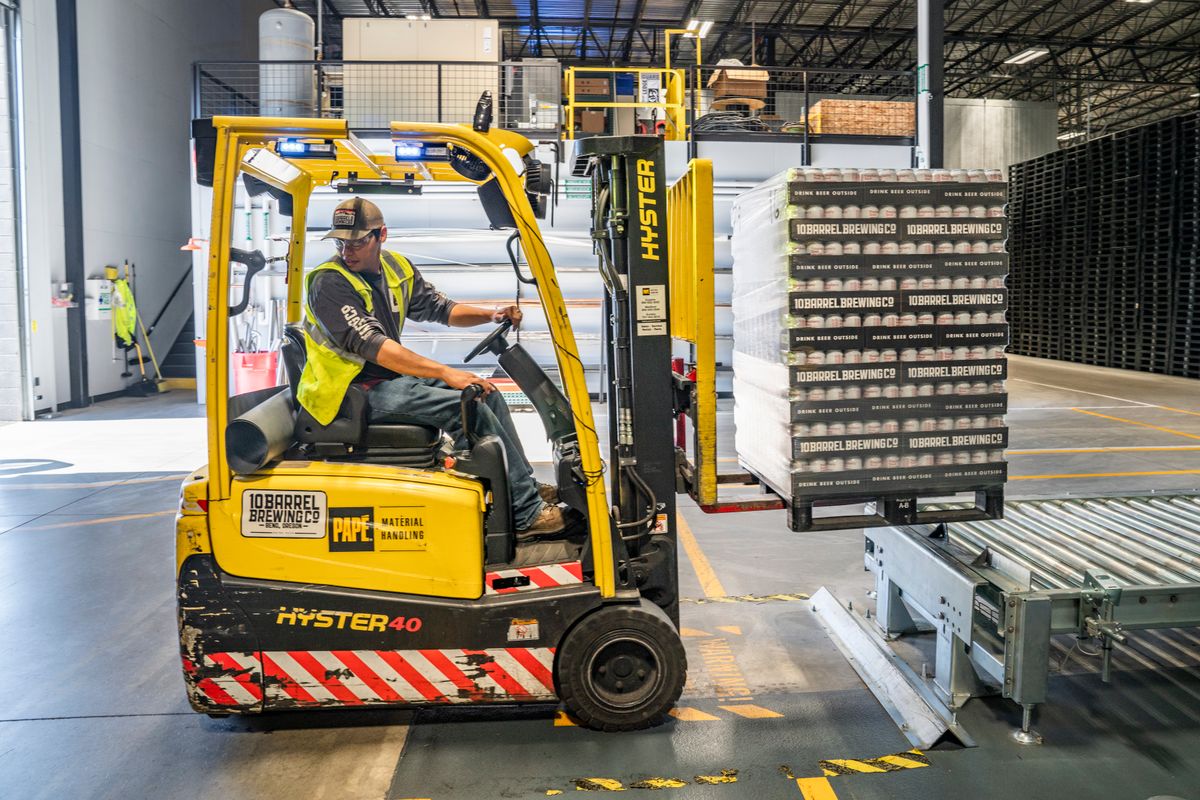
| Design pressure not above 15 psig, whatever the size | Material handling equipment: forklifts, conveyors, excavators, tractors, dumpers, bulldozers |
| Internal diameter, width, height or diagonal not above 6 inches | Manual lifting machinery |
| Water under pressure, design pressure not above 300 psig and design temperature not above 99°C | Cranes with a lifting height not above 9 metres and a maximum working load not above 80 kg |
| Plate or spiral heat exchangers | Pneumatic lifting machinery with a maximum working load not above 500 kg |
| Vessels that are part of a building's chiller package | Dock levellers, tail lifts fitted to vehicles, vehicle-mounted winches |
| Vessels that are components of rotating or reciprocating machines | Vertical conveyors and automated storage and retrieval systems |
| Gas cylinders used to store and transport compressed, dissolved or liquefied gases | Drilling rigs, piling machines, ergonomic manipulators, walkway towers |
The table is a summary. The Second Schedule has ten items and the Third has twelve, and the wording of each matters. In 2026 DOSH published a separate guide on how to read the pressure vessel criteria in the Second Schedule.
The three steps before a machine may run
The sequence is fixed by sections 27C and 27D and by regulation 4. Each step has to be finished before the next one starts, so the order matters for your project timeline.
- Design verification. An application goes to the Director General with the technical documents listed in the Fifth Schedule and the design fee. For plant made in Malaysia, the manufacturer applies and must be a registered competent person. For imported plant, any person may apply. The design, materials, construction and testing must follow a recognised standard.
- Written approval to install. Nobody may install prescribed plant without the Director General's written approval (section 27C). Lifts, escalators, hoists, tower cranes, quay cranes, gondolas, launching gantries, site-built boilers and overhead travelling cranes above 4,000 kg must be installed by a competent person or by the original manufacturer (Seventh Schedule).
- Inspection and certificate. After installation, the person serves written notice on a DOSH officer or a licensed person. The inspection includes a functional test of every safety device. Lifting machinery is also load-tested at the load stated in the design verification. If the plant passes, the certificate is issued on payment of the fee.
Applications are made through DOSH's MyKKP online system. If the plant fails the inspection, the fee is still payable (regulation 5(3)), and no fee under the Regulations is refundable.
Imported and second-hand machinery: check the standard before you buy
This section matters most to foreign-owned factories, because the problem appears after the equipment has already been shipped.
The Fourth Schedule lists the "recognised standards": ASME, API, ANSI, BS, DIN, CEN and CENELEC, ISO, IEC, AS, NZS, Malaysian Standards, the AD Merkblatter rules, TEMA, the Indian Boilers Regulations, the Swedish Pressure Vessel Code and Nippon Kaiji Kyokai. China's GB standards are not named in the list. A boiler or air receiver built only to a GB code may therefore not pass design verification. Ask the manufacturer to build and document the item to one of the listed codes before you place the order.
Imported plant must be new, or must never have suffered deterioration. For used plant, regulation 4(1)(f) asks for five things:
- the record of previous use;
- a record verifying that the plant has never deteriorated from any cause;
- an integrity report on inspection and testing, certified by an authorised inspecting body;
- a report on the remaining life of the plant, certified by an authorised inspecting body;
- the manufacturer's data report.
The First Schedule lists 39 authorised inspecting bodies. They include SIRIM QAS International, Bureau Veritas, DNV, the TÜV group, LRQA and the Shanghai Institute of Special Equipment Inspection and Technical Research. If you are relocating a production line from China, arrange these reports before the equipment leaves the old plant. The engineers who come to install it need the right pass as well: see our guide to foreign engineers installing machinery in Malaysia and the Professional Visit Pass (PVP) Malaysia service.
How much does a Certificate of Fitness cost?
The fees are fixed by the Sixth Schedule. The fee for the first inspection and the fee for each periodical inspection are the same. The table shows the items most factories and commercial buildings have.
| Plant | Band | Fee (RM) |
|---|---|---|
| Steam boiler (heating surface) | Under 5 m² | 300 |
| 10 m² to under 25 m² | 1,050 | |
| 50 m² to under 100 m² | 1,600 | |
| 250 m² and above | 2,400 | |
| Electric boiler, autoclave, economiser | Flat | 300 |
| Pressure vessel (capacity) | Under 0.1 m³ | 140 |
| 0.5 m³ to under 5 m³ | 300 | |
| 15 m³ and above | 700 | |
| Overhead and other cranes (safe working load) | Under 3,000 kg | 350 |
| 5,000 kg to under 10,000 kg | 750 | |
| Mobile crane | Under 25,000 kg / 250,000 kg and above | 550 / 1,000 |
| Tower crane, quay crane | Flat | 1,300 |
| Lift (travel distance) | Under 12 m | 650 |
| 30 m to under 80 m | 1,300 | |
| Escalator, walkalator | Flat | 350 |
| Passenger hoist | Flat | 1,000 |
| Gondola (suspended access equipment) | Flat | 350 |
Design verification is charged once per design: RM300 to RM1,000 for a pressure vessel, RM500 to RM2,500 for a steam boiler, RM300 for an overhead crane, RM5,000 for a lift and RM2,500 for an escalator. An application to alter plant costs RM300.
A worked example. A food factory has one boiler with a 60 m² heating surface, two 1 m³ air receivers, one 5-tonne overhead crane and one passenger lift with 10 metres of travel. The inspection fees are RM1,600 + (2 × RM300) + RM750 + RM650 = RM3,600 for each 15-month cycle. The Government fee is the small part. The real cost is the shutdown: a boiler has to be cooled, opened and cleaned for internal inspection every time.
The 15-month cycle and the periodical inspection
A certificate runs for 15 months from the date of inspection, and the next inspection must be done before it expires. Regulation 6 sets the timing:
- the inspection date may not be earlier than the first day of the twelfth month after the month of the last inspection;
- the officer or licensed person may give at least 14 days' written notice of the visit;
- the owner or occupier may write in to propose a date;
- a steam boiler must be opened for internal inspection every time, and a pressure vessel too unless it was designed not to need one;
- cranes and hoists must be ready for a test at safe working load, and lifts and escalators for a test of all safety devices.
In practice this gives a window of about three to four months at the end of each certificate. If the plant is not ready when the inspector arrives, the inspection can be refused, and a fee is charged for each visit (regulation 7).
Section 27F offers another route. An occupier may apply for a special scheme of inspection for certain classes of plant, which replaces the standard periodical inspection. DOSH has published the Special Scheme of Inspection Regulations 2025 for this. It is mainly of interest to continuous-process plants that cannot shut down every 15 months.
Duties between inspections
The certificate is not the end of the matter. The Regulations add running duties, and several carry their own penalties.
- Maintenance. The owner must keep the plant safe and in good working condition at all times. For lifts, escalators and walkalators, the owner must hold a service agreement with a competent person for a term of at least one year (regulation 8).
- Comprehensive examination every three months. Lifts, escalators, walkalators, tower cranes, passenger hoists, gondolas, quay cranes and launching gantries must be examined by a competent person at least once every three months, or more often if the manufacturer's manual says so. The fine is up to RM100,000 (regulation 14).
- Repair. Give written notice to the officer or licensed person before the repair. Only a competent person may do the work. Under section 27D(8), the certificate terminates when plant is dismantled, repaired or damaged, unless the Director General exempts it.
- Alteration. Changing the design, the safe working pressure, the safe working load or a lift's travel, speed or rated load needs written approval first, then a fresh inspection. The fine is up to RM50,000 (regulation 11).
- Sale, lease, transfer, disposal or disuse. Notify the officer or licensed person within 30 days (regulation 5(5)).
- Relocation. Portable plant keeps its certificate when moved without dismantling. Plant certified for one location needs a new written approval to be installed somewhere else (regulation 4(3)).
- Boiler staff. A steam boiler must be in the charge of a certified steam boiler operator. A boiler of 100 m² or less needs a grade 2 operator. Above 200 m², a steam boiler engineer is required as well (Twelfth Schedule). Electric boilers and autoclaves are exempt from this staffing rule.
- Crane operators. Tower and mobile cranes may be operated only by a competent crane operator, and the occupier must prepare a lifting plan based on a risk assessment. The fine is up to RM100,000 (regulation 15).
- Marking and records. The registration number must be displayed on the plant. Design, installation, inspection, repair and maintenance records must be kept at the workplace in Bahasa Malaysia or English (regulations 18 to 20). Manuals in Chinese only do not meet this rule.
Certificates issued before 1 June 2024
Factories that were running before the repeal hold certificates and registration numbers issued under the FMA. Section 4 of the Repeal Act deals with things done under the repealed Act, and DOSH's briefing material says existing registrations, approvals and certificates of fitness are dealt with under Act 514. We have not reproduced the saving clause here, so do not rely on this paragraph as legal advice. The practical position is simple: keep the existing registration number, and renew by periodical inspection under the 2024 Regulations before the old certificate expires. If a certificate has already lapsed, stop the machine and speak to the state DOSH office first.
Five mistakes we see in foreign-owned factories
- Ordering to the wrong code. The equipment arrives with GB documentation only and cannot be design-verified.
- Installing first, applying later. Written approval comes before installation. Installing without it is an offence under section 27C, with a fine of up to RM100,000.
- Counting one certificate per factory. Each boiler, each receiver and each crane is a separate item with its own number, fee and expiry date.
- Repairing without notice. A weld repair on a vessel ends the certificate. The machine then runs uncertified without anyone noticing.
- Leaving it to the landlord. In a rented factory, the lease should say who holds and renews the certificates for the goods lift and the overhead cranes. An officer who finds an expired certificate will issue the prohibition notice to whoever is operating the plant.
How this fits your factory project
Certificates of Fitness sit near the end of a factory project, after the building is complete and before commissioning. Our end-to-end factory setup guide shows where DOSH falls among the land, environmental, Bomba and licensing steps. Design verification for imported plant is the long item, so start it when the purchase order is signed, not when the container lands.
ONEKEY BIZ handles DOSH Certificate of Fitness registration for factories and commercial buildings: we map your plant against the 2024 Regulations and the two exemption schedules, prepare the design and installation submissions, coordinate the inspection and track every 15-month renewal. Government fees are charged at cost with the official receipt. If you already hold old FMA certificates, our DOSH factory and plant registration service starts with a check of each one. To talk through your equipment list, contact us or WhatsApp +60 12-321 1349.
Frequently asked questions
What is a DOSH Certificate of Fitness?
It is the certificate that a DOSH officer or a licensed person issues after inspecting a steam boiler, pressure vessel or lifting machine. Under section 27D of the Occupational Safety and Health Act 1994, such plant may not be operated without one. The detailed rules are in the Plant Requiring Certificate of Fitness Regulations 2024 [P.U.(A) 99/2024], in force since 1 June 2024.
Which machinery needs a Certificate of Fitness in Malaysia?
Three classes under regulation 3: steam boilers, pressure vessels and lifting machinery. Lifting machinery includes lifts, escalators, walkalators, overhead, mobile and tower cranes, hoists, gondolas and aerial working platforms. The Second and Third Schedules exempt, among others, pressure vessels at or below 15 psig, plate heat exchangers, gas cylinders, forklifts and other material handling equipment.
How long is a DOSH Certificate of Fitness valid?
15 months from the date of inspection (regulations 5(6) and 6(2)(i)). The periodical inspection must be done before it expires, and may not be earlier than the first day of the twelfth month after the month of the last inspection.
How much does a DOSH Certificate of Fitness cost?
The Sixth Schedule sets the inspection fee per item: RM140 to RM700 for a pressure vessel by capacity, RM300 to RM2,400 for a steam boiler by heating surface, RM350 to RM1,200 for an overhead crane, RM650 to RM1,900 for a lift and RM350 for an escalator. The same fee applies at each periodical inspection, and fees are not refundable.
Does a forklift need a PMA or Certificate of Fitness in Malaysia?
No. The Third Schedule of P.U.(A) 99/2024 excludes "material handling equipment", which the Regulations define to include forklifts, conveyors and excavators. The employer must still keep the forklift safe, train the driver and include it in the risk assessment under the general duties of Act 514.
Related services
We handle the process described in this article end-to-end.
- DOSH Factory & Plant Registration (Certificate of Fitness)Register your factory and plant with DOSH under the amended OSHA 1994.
- Department of Environment (DOE) Approval & Official Opinion LetterFind out what environmental approval your project or business needs from DOE.
- Bomba-Certified Fire Extinguisher Supply & InstallationSupply and install certified dry powder fire extinguishers that meet Fire and Rescue Department (Bomba) requirements.
Sources & references
- DOSH — Occupational Safety and Health (Plant Requiring Certificate of Fitness) Regulations 2024 [P.U.(A) 99/2024]
- DOSH — Occupational Safety and Health Act 1994 (Act 514), reprint as at 1 June 2024
- DOSH — Panduan Perincian Kriteria Bejana Tekanan di bawah Jadual Kedua, Peraturan LYMPK (2026)
- DOSH — Occupational Safety and Health (Special Scheme of Inspection) Regulations 2025
- DOSH — Factories and Machinery (Repeal) Act 2022 (Act 835)
This article is general information only, not legal, tax or immigration advice. Policies, thresholds and official fees are set by the relevant Malaysian authorities and may change. Talk to our consultants about your specific situation.