A new shop, a new restaurant, a new office lobby sign. The artwork looks great in Chinese or English, the fabricator is ready, and then the council asks for a document nobody mentioned: a language endorsement from Dewan Bahasa dan Pustaka (DBP). In Malaysia, signboards are regulated twice. DBP checks the Malay. The local council decides whether the sign may go up at all. This guide sets out the actual rules on Bahasa Melayu size and position, what DBP accepts and rejects, what it costs, and what happens when a sign ignores the rules.
Quick answer (as at October 2026): Every business signboard in Malaysia must carry Bahasa Melayu (BM), spelled and used correctly. Where another language appears, PLANMalaysia's 2018 signboard guideline caps its letter height at ¾ of the BM letter height, and DBP's terms (updated 19 August 2026) require BM to be larger, clearer and placed above the other language. Only marks with MyIPO status, or names approved by SSM, are exempt. DBP's Sah Bahasa check costs RM30 per local council for a premise signboard (RM60 for billboards and electronic ads). DBP does not issue the licence. The council does, and council by-laws can carry fines of up to RM2,000 under the Local Government Act 1976.
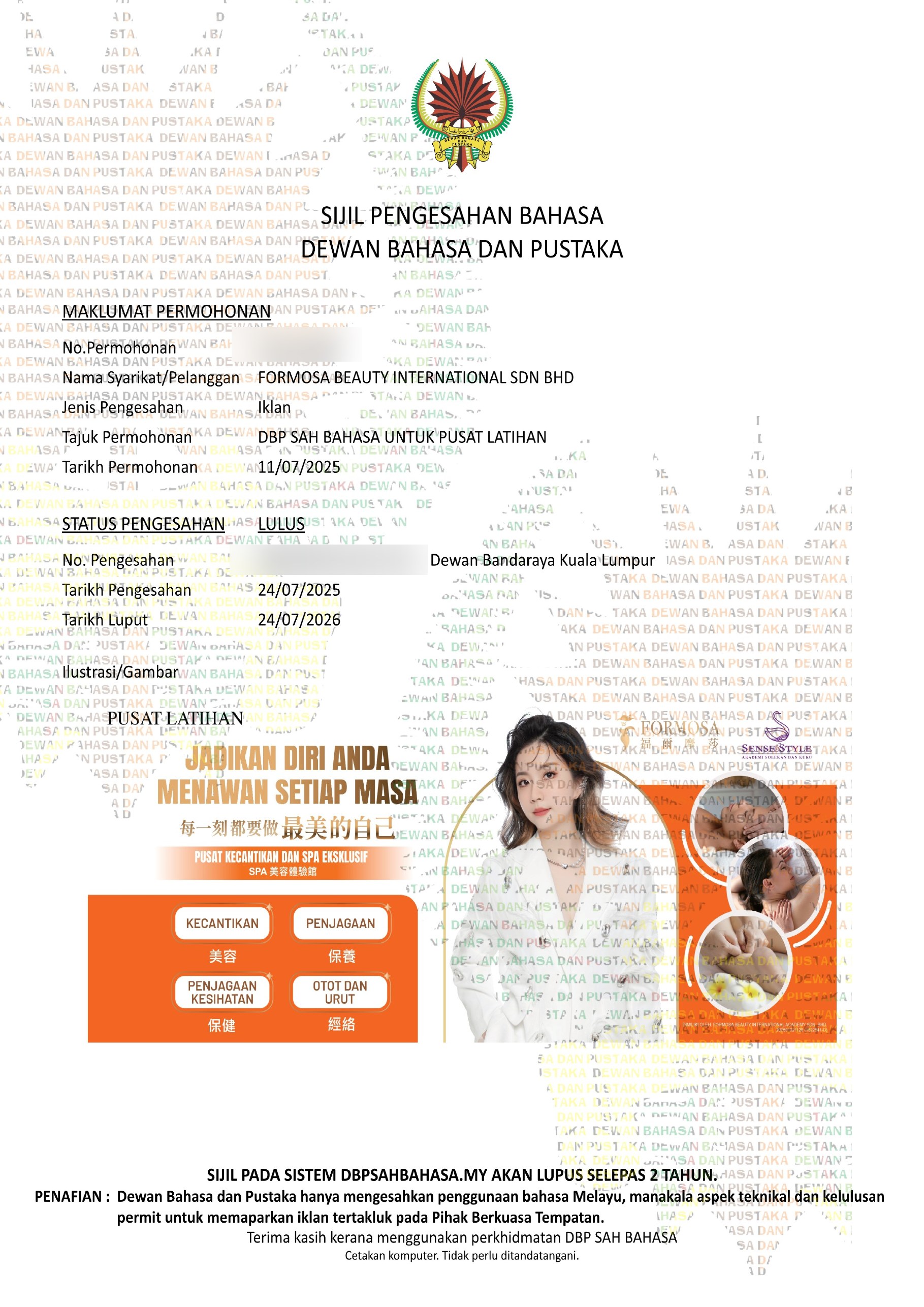
Two gates: DBP checks the language, the council licenses the sign
Foreign owners often assume "DBP approval" is the signboard permit. It is not. DBP's own terms say so directly: its role is to verify the national language in advertisements, and the local authority (PBT) is the body responsible for approving the advertisement licence. In practice you pass through both gates in sequence, and the council will not move until DBP has cleared the wording.
| Body | What it decides | Legal basis | What you get |
|---|---|---|---|
| Dewan Bahasa dan Pustaka (DBP) | Whether the Malay is correct, polite and given priority over other languages | DBP Act 1959 (Act 213); DBP terms and conditions, updated 19 Aug 2026 | Sijil Pengesahan (language endorsement) via DBP Sah Bahasa |
| Local council (DBKL, MBPJ, MBSJ, MBSA, MPKj…) | Whether the sign may be displayed: size, position, structure, fee, renewal | Local Government Act 1976 (Act 171) s.102(c) and each council's advertisement by-laws | Signboard / advertisement licence, usually issued with the premise licence |
| PLANMalaysia | Sets the national design guideline councils and DBP both refer to | Garis Panduan Perancangan Papan Tanda Premis Perniagaan (2018) | No approval. It is the rulebook. |
That is why a DBP signboard approval is the first step in any council signboard application, and why it should happen before the sign is fabricated. A rejected design costs a redesign. A rejected installed sign costs a new sign.
The legal basis: why Malay must come first
The starting point is Article 152 of the Federal Constitution, which makes Malay the national language, together with the National Language Act 1963/67. DBP itself is a statutory body under the DBP Act 1959 (Act 213). The Act was last amended in 1995 and gives DBP no power to fine businesses. That gap is why ministers have repeatedly promised an amendment to give DBP enforcement powers. At the time of writing, enforcement against signboards still sits with the local councils.
The councils' power comes from section 102(c) of the Local Government Act 1976, which lets every local authority make by-laws "to regulate, license, restrict, prevent or remove the exhibition of advertisements". Each council has its own advertisement by-laws. In Kuala Lumpur these are the Advertisements (Federal Territory) By-Laws 1982. Most councils write the language rule into those by-laws or into the conditions of the signboard licence, and they refer to DBP's endorsement as proof of compliance.
DBP's terms say expressly that its rulings follow two national guidelines: the business-premise signboard guideline (2018), approved by PLANMalaysia's planning and development committee, and the outdoor billboard guideline (2009), approved by the Cabinet on 31 October 2008 and by the 61st National Council for Local Government on 2 December 2008.
The numbers: how big Bahasa Melayu must be, and where it goes
You will see "BM must be 30% bigger" repeated online. That figure is not in the national guideline. What the 2018 guideline actually says is that text in another language may be no taller than ¾ of the Malay text. Put the other way round, the Malay must be at least a third taller. DBP's own terms add colour and position: Malay in a bright, clear, readable colour, above the other language.
| Rule | Requirement | Source |
|---|---|---|
| Malay on the main brand | BM must appear in every primary brand name (shop name, product name), alone or with other languages. Exception: proprietary brand names such as TOSHIBA or SAMSUNG. | Guideline 6.1(4)(i); DBP terms item 4 |
| Size of other languages | Letter height no more than ¾ of the BM letter height | Guideline 6.1(4)(ii) |
| Position and colour | BM placed above the other language, in a bright, clear, readable colour, with larger letters | DBP terms items 2 and 5 |
| Business activity | Stated in BM, clearly, at the top left of the sign (e.g. RESTORAN, KEDAI SERBANEKA) | Guideline 6.1(3)(iv) |
| Company name | Must show the company or firm name registered with SSM. If a brand leads the sign, the company name sits below the brand. | Guideline 6.1(3)(ii)–(iii) |
| Text area | Lettering and graphics no more than ⅔ of the signboard height | Guideline 6.1(3)(i) |
| Council permit number | Displayed at the bottom right of the sign | Guideline 6.1(3)(vi) |
| Horizontal sign size | Width of the shop unit, maximum height 4 ft (1.22 m), 0.5 ft clear on each side, mounted on the signboard beam, never above roof level | Guideline 6.1(1)–(2) |
| Projecting sign | Only from the 2nd floor up, at least 2.6 m above street level, not blocking views or walkways | Guideline 6.1(2)(b) |
| Banners | Cloth banners may not serve as a permanent premise signboard | Guideline 6.1(1)(iii) |
These are the national baseline for terrace shop lots. Councils can and do add their own conditions, for example on illumination, heritage zones or shopping-mall frontages, so treat the table as the minimum, not the whole list.
Brand names, trademarks and the MyIPO exception
The most common question from Chinese and foreign brands is whether their brand must be translated. DBP's answer depends on registration status, not on how famous the brand is.
- Registered with SSM or with MyIPO status. If the foreign-language name is approved by SSM, or the mark has Registered, Protected, Published or Accepted status at MyIPO, DBP can accept it as it is. The mark on the sign must match the mark as filed exactly.
- Neither. The words must be translated into Malay, or shown bilingually with Malay taking priority in letter size, colour and position.
- Slogans and extra descriptions. The same test applies. An unregistered English tagline needs a Malay version that is larger and placed above it.
The 2018 guideline is more relaxed here: it says trademarks, logos, taglines and slogans placed on a signboard need not be translated, provided their letters are no taller than ¾ of the main brand lettering. In practice DBP applies its own, stricter test, and DBP's endorsement is what the council asks for. So plan on the stricter rule. This is also a practical reason to file your mark early. A pending application that has reached Accepted or Published status at MyIPO already counts. Our guide to trademark registration in Malaysia explains those stages and the timelines.

How to apply on DBP Sah Bahasa, step by step
DBP runs the language check online through its Sah Bahasa portal (dbpsahbahasa.my). The applicant registers an account, uploads the artwork, pays online and downloads the endorsement once approved.
- Register and activate an account on DBP Sah Bahasa, in the company's name.
- Prepare the artwork: a coloured design with exact dimensions, every word that will appear, and the SSM-registered name as it will be shown. If you rely on a trademark, have the MyIPO record ready.
- Choose the category and the council. A shop signboard is a papan tanda application. Billboards, pillar ads and electronic screens are iklan. The endorsement is issued for the use and council you applied for.
- Pay online. Cash is not accepted on the portal.
- Respond to corrections. If DBP does not approve, you amend the design and resubmit through the "kemas kini" (update) button.
- Download the certificate (sijil pengesahan) and attach it to the council's signboard or premise licence application.
| Item | Detail |
|---|---|
| Premise signboard (papan tanda) | RM30 per local council. Also covers banners, buntings, posters, vehicle wraps, notices, labels and leaflets. |
| Advertisement (iklan) | RM60 per local council. Outdoor billboards, pillar ads, electronic ads. |
| Document review | Quoted on request |
| If rejected | Fee not refunded. Resubmissions through "kemas kini" are free and unlimited. |
| Overpayment / underpayment | Overpayment goes to a prepaid balance (no cash refund). Underpayment must be settled before the certificate can be printed. |
| Use of certificate | Only for the use applied for. It may not be sold, lent, transferred or altered. |
| Processing time | DBP does not publish a fixed service standard on the portal. In our experience a clean design clears in about 3 working days. |
| Help desk | Enforcement Division, Level 25, Menara DBP, Kuala Lumpur · 03-2147 9100 / 9200 |
Because the fee is per council, a chain opening in Kuala Lumpur, Petaling Jaya and Shah Alam files three endorsements, one per council, even with identical artwork. If you would rather not deal with the portal, our DBP signboard language approval service pre-checks the Malay wording and layout against DBP's terms, then files and follows up for you.
After DBP: the council signboard licence
The DBP certificate is an attachment, not the finish line. In most councils the signboard is licensed together with the premise: DBKL handles both through its eLesen system, and the Selangor councils run their own portals. The council looks at things DBP does not, such as structure, size, position, illumination, whether the sign blocks windows or neighbouring signs, and heritage-zone controls. It then charges its own signboard fee, usually calculated by area.
The order that saves money is always the same: artwork → DBP endorsement → council licence → fabrication and installation. For the council side in detail, see our guides to the DBKL business licence in Kuala Lumpur and to council business premise licences across Malaysia.
Penalties and enforcement
Because DBP cannot fine, enforcement comes from the council under its by-laws. Section 104 of the Local Government Act 1976 caps what a by-law can impose: a fine of up to RM2,000, up to one year's imprisonment, or both, plus up to RM200 for each day a continuing offence carries on after conviction. Most cases never reach court. Councils usually issue a compound and a notice to correct or remove the sign.
| Consequence | Detail |
|---|---|
| Licence refused or delayed | No DBP endorsement means the council will not process the signboard part of the application. With a composite licence, that can hold up the whole premise licence. |
| Compound and notice | Example: on 13 October 2024 DBKL compounded five premises in Bukit Bintang for signs that did not give BM prominence, and gave them 14 days to take the signs down. |
| Prosecution under by-laws | Up to RM2,000 and/or 1 year, plus up to RM200 per day for continuing offences (Act 171 s.104 ceiling) |
| Removal | Councils may remove unlicensed signs. The cost of removal and a replacement sign usually far exceeds the fine. |
| Renewal blocked | A sign that no longer matches the approved artwork can stop the annual signboard licence renewal. |
The mistakes we see most often
- Chinese or English larger than the Malay. This is the most common reason for rejection and the most common target of council enforcement.
- Malay placed below the foreign language. Even with the right size, DBP wants Malay on top.
- Machine-translated Malay. DBP checks spelling, terminology and grammar, and rejects wording that is impolite or has a negative connotation. A literal translation of a Chinese shop name often fails on all three.
- Missing business activity. A sign that shows only a brand, with no BM description of what the shop does, does not meet the guideline.
- Brand not yet filed at MyIPO. Without MyIPO status or SSM approval, the foreign-language brand has to be translated or made bilingual.
- Fabricating first. Paying for a lightbox and then redesigning it after rejection is the most expensive way to learn the rules. Our signboard design and fabrication service works from DBP-cleared artwork for this reason.
- One endorsement for every outlet. The fee and the certificate are per council. A second outlet under a different council needs its own.
Name changes, rebrands and renewals
The endorsement covers the artwork you submitted. Change the artwork and you need a new one. Common triggers:
- Company name change. The SSM-registered name on the sign must match the new name. Our guide to what to update after a company name change lists the signboard alongside bank, LHDN and licences.
- Rebrand or new slogan. New wording, new endorsement.
- New outlet or move. A different council means a new endorsement, and the premise licence starts again.
- Council renewal. Some councils ask for a current endorsement when renewing, especially if the sign has changed. In that case a DBP signboard re-approval comes before the licence renewal.
A short checklist before you send artwork to the fabricator
- Is there a Malay line on the primary brand, or is the brand a registered or proprietary mark?
- Is every non-Malay line no taller than ¾ of the Malay, and placed below it?
- Is the business activity written in Malay at the top left?
- Does the SSM-registered company name appear, below the brand?
- Does all lettering fit within ⅔ of the signboard height, on a board no taller than 1.22 m (for terrace lots)?
- Is there space at the bottom right for the council permit number?
- Has DBP issued the endorsement for this council?
If any answer is "not sure", fix it on the artwork. ONEKEY BIZ handles the Malay wording, the DBP Sah Bahasa filing and the council licence as one job, for shops and offices across Kuala Lumpur and Selangor. Talk to us before you fabricate, or WhatsApp +60 12-321 1349.
Frequently asked questions
How big must Bahasa Melayu be on a signboard in Malaysia?
Under PLANMalaysia's 2018 business-premise signboard guideline, text in any other language may be no taller than ¾ of the Malay text, so the Malay must be at least a third taller. DBP's terms (updated 19 August 2026) also require the Malay to be in a clear, readable colour and placed above the other language. The often-quoted '30% bigger' figure is not in the guideline.
What is DBP signboard approval and how much does it cost?
It is Dewan Bahasa dan Pustaka's check that the Malay on your sign is correct and given priority, done online through DBP Sah Bahasa. The fee is RM30 per local council for a premise signboard and RM60 per council for billboards, pillar and electronic advertisements. The fee is not refunded if the design is rejected, but resubmissions are free.
Does my brand name have to be translated into Malay?
Not if the foreign-language name is approved by SSM or the trademark has Registered, Protected, Published or Accepted status at MyIPO, and the sign shows it exactly as filed. Otherwise DBP requires a Malay translation or a bilingual sign with the Malay larger and on top. Proprietary brands such as TOSHIBA or SAMSUNG are also exempt.
Is DBP approval the same as a signboard licence?
No. DBP only verifies the language; the local council (DBKL, MBPJ, MBSJ and so on) issues the signboard licence, usually together with the premise licence. The DBP certificate is an attachment to the council application, so get it before fabricating the sign.
What is the fine for a signboard without proper Bahasa Melayu?
Enforcement is by the council under its advertisement by-laws. Section 104 of the Local Government Act 1976 caps by-law penalties at RM2,000 and/or one year's imprisonment, plus up to RM200 per day for a continuing offence. In practice councils issue compounds and removal notices; in October 2024 DBKL compounded five Bukit Bintang premises and gave them 14 days to remove their signs.
Related services
We handle the process described in this article end-to-end.
- DBP Signboard Language Approval (Sah Bahasa)Dewan Bahasa dan Pustaka endorsement of your signboard wording — required before the council issues a signboard licence.
- MBSJ Business Licence Application (Majlis Bandaraya Subang Jaya)Business premise licence with Subang Jaya City Council (MBSJ).
- MBSJ Business Licence Renewal (Majlis Bandaraya Subang Jaya)Renew your existing MBSJ (Subang Jaya) business licence.
Sources & references
This article is general information only, not legal, tax or immigration advice. Policies, thresholds and official fees are set by the relevant Malaysian authorities and may change. Talk to our consultants about your specific situation.