
Quick answer
A Sdn. Bhd. increases its paid-up capital by allotting new shares. Directors may only allot shares with prior shareholder approval (Companies Act 2016, s.75), and the company must lodge a return of allotment with SSM (s.78). Licences often set capital floors — for example CIDB G3 needs RM50,000 and a foreign-owned WRT licence RM1 million — so the increase is usually done before those applications.
Last reviewed: · Reviewed by:ONEKEY BIZ compliance team
01
Overview
Paid-up capital is the amount shareholders have actually paid the company for its shares. The Companies Act 2016 no longer has an authorised-capital ceiling, so increasing it simply means the company issues (allots) new shares and receives payment for them — in cash, or in some cases by converting a shareholder's loan to the company or by other non-cash consideration.
The process is statutory. Under Section 75 directors cannot allot shares without prior approval from shareholders, and under Section 78 the company must lodge a return of allotment with SSM after the shares are issued. The register of members and share certificates must then reflect the new holdings.
Most companies do this because a regulator or counterparty asks for it: CIDB grades carry capital floors (RM50,000 for G3, higher for G4–G7), a foreign-owned company in distributive trade needs RM1 million for a WRT licence, ESD registration for employment passes looks at paid-up capital, and banks and tenders compare it against project size. Getting the order right — capital first, then the application — avoids a rejected licence.
Who needs this
- Contractors meeting CIDB grade capital requirements
- Foreign-owned companies preparing a WRT or ESD application
- Companies bringing in a new investor for cash
- Companies converting a director's or shareholder's loan into equity
02
Documents you need to prepare
Allotment details
- Number of new shares and price per share
- Name, IC / passport and address of each subscriber
- Form of consideration: cash, or loan capitalisation / non-cash
Proof of consideration
- Bank statement showing the capital injected into the company account
- For loan capitalisation: loan agreement or director's advance records and accounts
Company
- Current register of members
- Constitution, if any (checked for pre-emption rights)
- If existing shareholders have pre-emption rights under the constitution, they must be offered the shares first or waive the right.
- Non-cash consideration needs supporting documents; we tell you exactly what applies to your case.
03
How to get it done with ONEKEY BIZ
- 1Target & structure Day 1
We confirm the capital you need and how the new shares will be split.
- 2Shareholder approval Day 1–2
We draft the shareholders' resolution authorising the allotment.
- 3Payment in Day 2–4
Subscribers pay into the company account, or loan capitalisation is documented.
- 4Allotment & return Day 4–6
Directors allot; we lodge the return of allotment with SSM.
- 5Registers & certificates Done
Register of members updated and new share certificates issued.
You do
- Decide the new capital and who subscribes
- Transfer the funds or provide loan records
- Sign the resolutions
We do
- Check pre-emption rights and licence targets
- Draft the resolutions and allotment documents
- Lodge the return of allotment
- Update registers and issue share certificates
04
What you receive
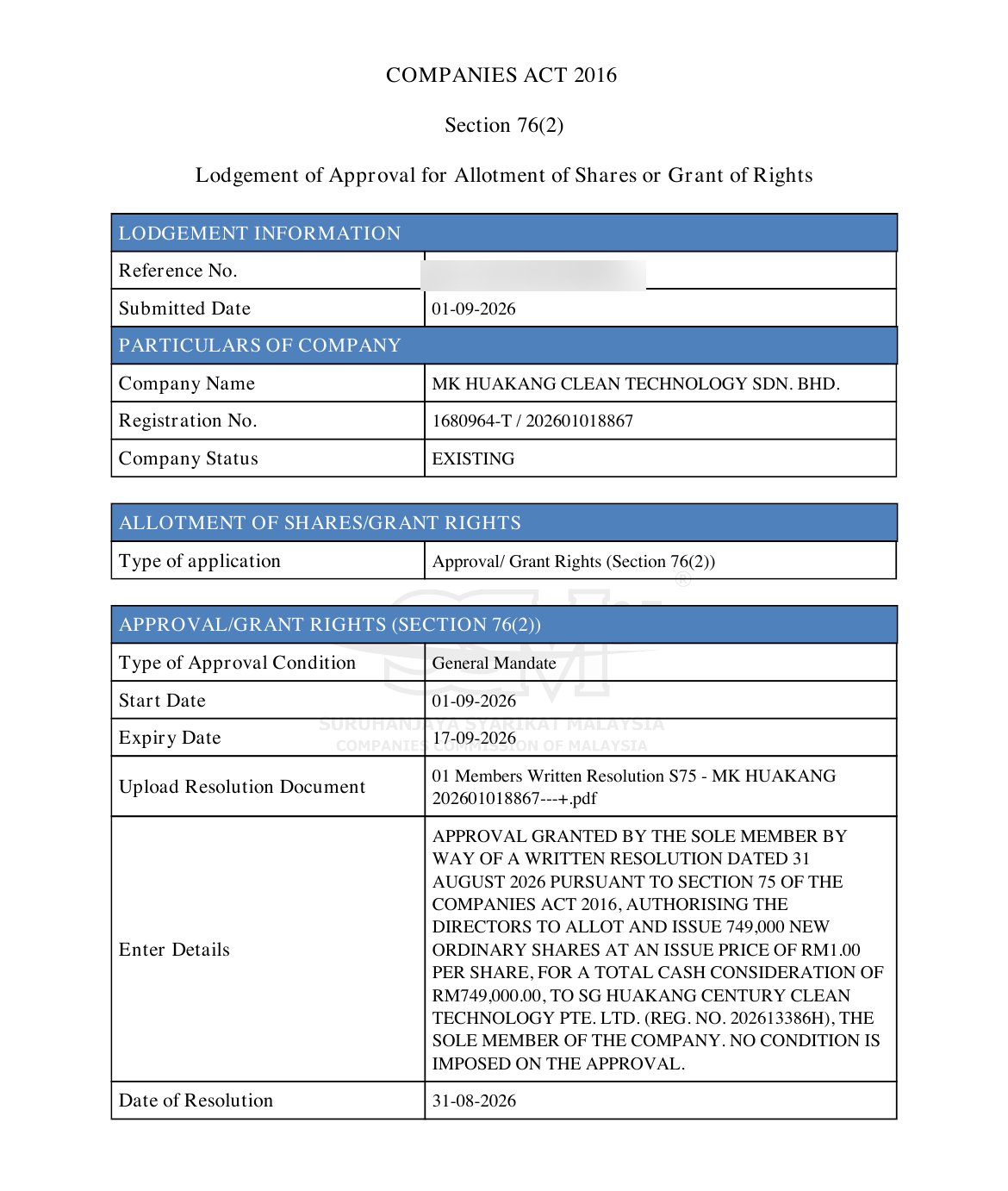
SSM record of the new shares issued and the updated paid-up capital.
Approval and allotment resolutions, signed.
Certificates for each subscriber's new shares.
Showing every shareholder's new holding and the company's total paid-up capital.
Real clients we've done this for
Official sources
Frequently asked questions
Is there a minimum paid-up capital for a Sdn. Bhd.?
The Act has no general minimum, but licences and agencies set their own floors, such as CIDB grades and WRT.
Can I convert my director's loan into shares?
Yes, if the loan is properly recorded in the accounts; it is allotment for non-cash consideration and needs supporting documents.
Do existing shareholders lose percentage?
Only if the new shares are not allotted pro rata. We model the before-and-after shareholding with you first.