As of the evening of 21 July 2026, Malaysia's new Corporate Registry System (CRS) — the platform that replaced MyCoID as the single gateway to register a company, lodge documents and transact with the Companies Commission of Malaysia (SSM) — is still not working reliably. Nearly a month after the old system was switched off, and a week after SSM declared the CRS "restored," our own team logged in to the SSM4U portal at 5:58pm today and was met first with a standing maintenance notice and, moments later, an error page reading "Oops! It looks like we are having some technical problem." We are publishing our own screenshots below, unedited except for masking a name for privacy, because this is not a rumour or a second-hand complaint — it is what every company secretary in the country is living through right now, and it is quietly hurting foreign investors who have no way of knowing the cause.
A month of launches that did not launch
The pattern matters, because it is the pattern — not any single outage — that has paralysed the industry. Drawing on SSM's own notices and reporting by Sin Chew Daily (20 July 2026), the sequence over the past month runs like this:
| Date | What happened |
|---|---|
| 23 June 2026 | The old MyCoID system was fully shut down |
| 30 June 2026 | CRS was scheduled to go live — the launch failed |
| Early July | SSM acknowledged the system conversion had failed; counters and MyCoID were temporarily reopened |
| 7–14 July | Systems closed again for maintenance |
| 14 July 2026 | CRS "officially launched" |
| 17 July 2026 | SSM announced CRS would restore at 11:00am and thereafter run only within a fixed daily window, with maintenance every night |
| 21 July 2026 | System still returning errors on login (our first-hand screenshots below) |
Read down that column and the problem is obvious: a go-live date announced, missed, re-announced, missed again, and finally declared "done" — followed immediately by a notice that the "working" system now needs nightly repairs and shortened operating hours. Each of those announcements set an expectation that secretary firms passed on to their clients in good faith, and each reversal made those firms look, to a client who cannot see behind the curtain, as if they had failed to deliver.
What we saw today — first-hand
At 5:58pm on 21 July 2026 our team signed in to the SSM4U main page. The portal displayed the official "MAKLUMAN CRS" notice confirming the system had "resumed operations from 11:00am, 17 July 2026," alongside a Scheduled Maintenance block stating that the CRS portal now undergoes maintenance every day from 10:00pm to 6:00am and advising customers to transact outside those hours.
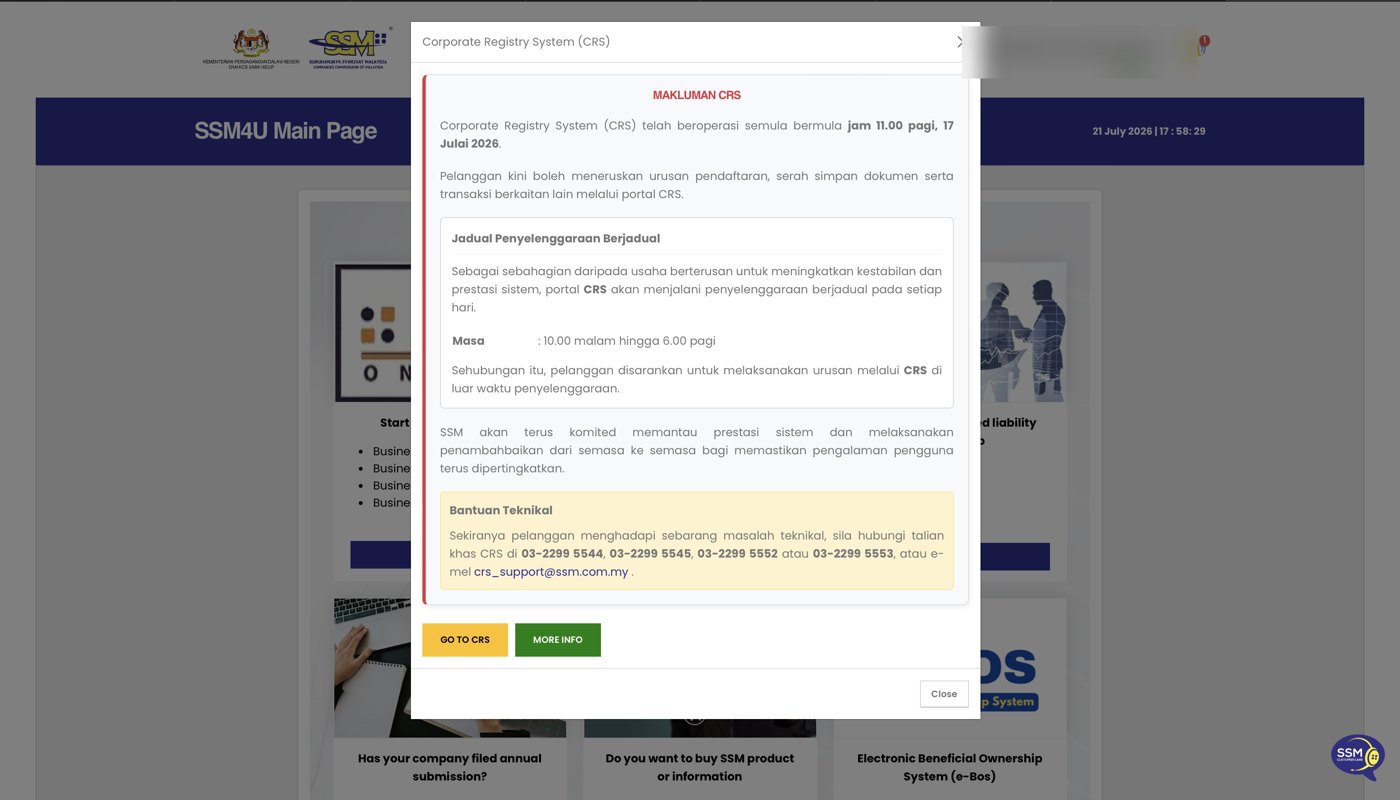
We were logged in inside the permitted operating window — 5:58pm is nowhere near the 10:00pm maintenance cut-off. Yet moments later, attempting to proceed, the same session returned a full-screen failure: "Oops! It looks like we are having some technical problem. Please try again later."
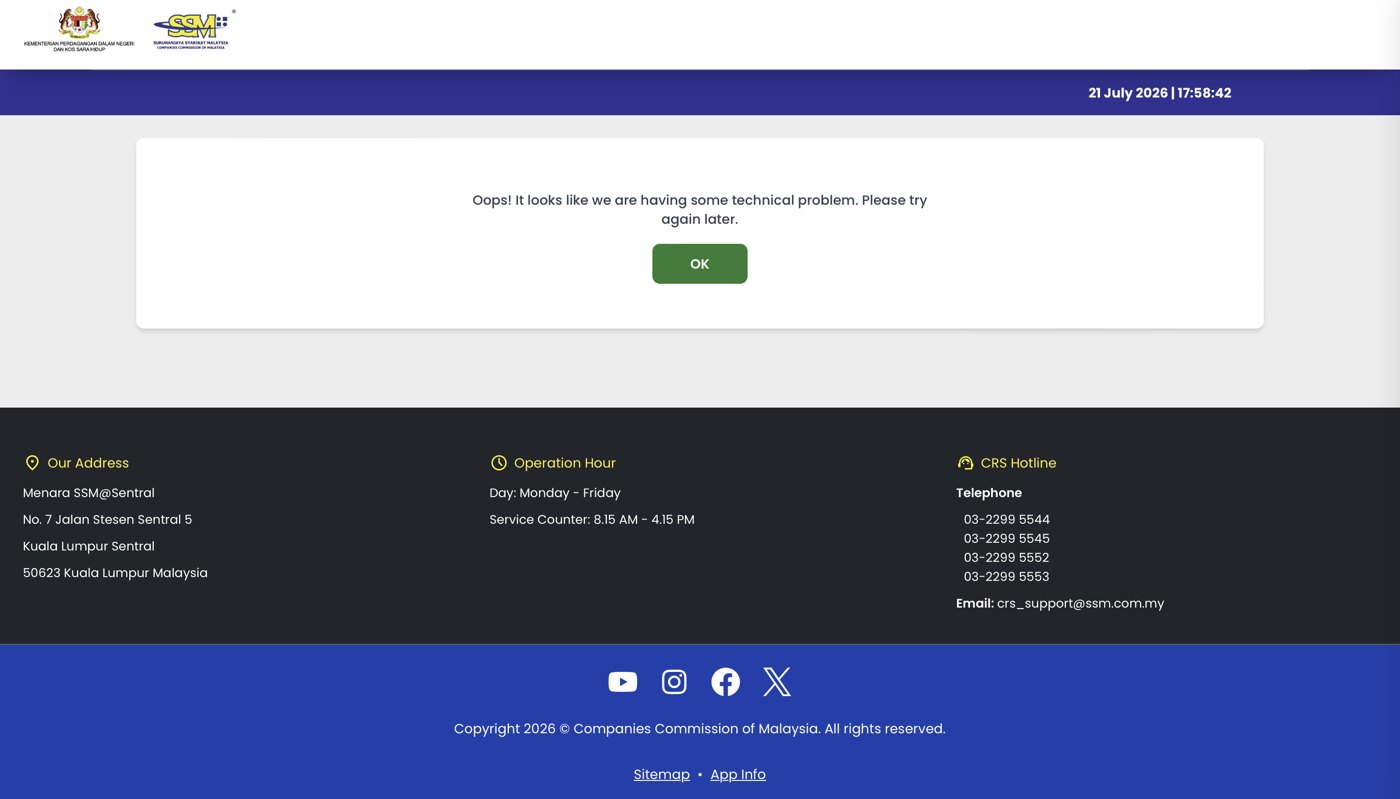
This is the gap between what has been announced and what is actually happening. "Restored" and "operating" do not match a login that fails during business hours. We are documenting it precisely because the discrepancy is being invisibly absorbed by the firms at the front line.
What is actually broken
Beyond intermittent access, the substantive functions that businesses depend on have been impaired. Per the same reporting, the concrete failures include:
| Function | Status / impact |
|---|---|
| System access | Constant crashes, errors and timeouts |
| MBRS (Malaysian Business Reporting System) | Reported unavailable — affecting annual returns and financial-statement filing |
| Acknowledgement Receipt | Function reported missing for document submissions |
| Proof of filing | Users reportedly having to pay RM15–25 per receipt via e-Info / MyData to obtain proof |
| New company registration | Reported halted — new incorporations severely impaired |
| Downstream | Bank accounts, licensing, tenders and corporate financing all affected |
The system reportedly cost RM43.62 million to build. When the acknowledgement receipt — the basic proof that a document was lodged — is missing and firms must pay to extract evidence of their own filings, the tool that is supposed to reduce friction is instead manufacturing it. We covered the earlier stages of this saga in our 17–18 July restoration & daily-maintenance report and our CRS "is it live and safe" verification guide.
The whole industry is stuck — and it is not the secretaries' fault
This is the part that matters most for our clients to understand. Company secretaries cannot register a company, lodge a return or produce a filing receipt through a door that will not open. The frustration is now organised: within a single day on 19 July 2026, 440 company secretaries reportedly signed an open letter addressed to SSM, the Ministry of Domestic Trade and Cost of Living, and the system vendor — a rare, collective signal of just how blocked the profession is. By the report's deadline, the Ministry and SSM had not responded.
Why this hits foreign investors hardest
For a foreign company entering Malaysia, SSM is the first government touchpoint — and everything else is downstream of it. Without a registered company you cannot do any of the things that actually constitute "setting up":
- You cannot open a corporate bank account — banks need the company's registration and constitutional documents.
- You cannot inject paid-up capital in the normal way, because there is no company bank account to receive it.
- You cannot lease a factory or office in the company's name, sign supplier contracts, or apply for the licences and work passes that all presuppose a live entity.
When the registry stalls, a foreign investor does not experience "a government IT problem." They experience their entire Malaysian launch grinding to a halt — capital sitting idle, a signed lease slipping, a hiring plan on hold — and, worst of all, a suspicion that the local firm they engaged is simply not on top of things. That misattribution is the quiet damage of this episode: a systemic failure at a public agency being silently charged to the private firms doing their best to work around it.
What we are doing, and what we advise
We cannot fix a national system, but we can protect our clients' position while it stabilises:
- File within the stable window. The portal is meant to operate roughly 6:00am–10:00pm daily (maintenance 10:00pm–6:00am); we submit the moment access is stable and avoid the maintenance edges.
- Keep evidence. We retain timestamped screenshots of every attempt, error and successful lodgement — so there is a clean record if deadlines are questioned.
- Watch the deadlines that do not pause. Statutory clocks — the Section 68 annual return, Section 58 changes and others — do not stop because the portal is down. We are prioritising anything with a looming deadline and preparing filings so they go through the instant the system allows.
- Communicate proactively. Rather than let clients wonder, we tell them plainly when a delay is CRS-driven.
The bottom line
Nearly a month on from the MyCoID shutdown, and days after being declared "restored," Malaysia's RM43.62 million CRS was still returning errors during operating hours when we logged in on 21 July 2026 — as our screenshots show. Company secretaries across the country are blocked from doing routine, statutory work through no fault of their own, and foreign investors are the ones who ultimately pay: stalled bank accounts, idle capital, delayed leases, and an unfair suspicion that their local advisers are the problem. SSM is the first door into doing business in Malaysia; when that door is jammed, the whole entry stalls. We will keep filing the moment the system allows, keep the evidence, and keep our clients honestly informed. If you are a foreign investor worried about a stalled registration or a looming deadline, talk to our team — we will tell you exactly where your matter stands and what we are doing about it.
Frequently asked questions
Is the SSM CRS system working now (21 July 2026)?
Not reliably. SSM's own notice says the CRS resumed operations from 11:00am on 17 July 2026 and now runs with nightly maintenance from 10:00pm to 6:00am. But when our team logged in to SSM4U at 5:58pm on 21 July 2026 — well inside the stated operating window — the session returned a full-screen error: 'Oops! It looks like we are having some technical problem. Please try again later.' We have published the screenshots. In practice, access remains intermittent and several core functions are still impaired.
What is broken in the CRS system?
According to reporting by Sin Chew Daily (20 July 2026), the failures include constant crashes/errors/timeouts on access; the MBRS (Malaysian Business Reporting System) being unavailable, affecting annual returns and financial-statement filing; a missing Acknowledgement Receipt function for submissions, with users reportedly having to pay RM15–25 per receipt via e-Info/MyData to obtain proof; and new company registrations being halted — with downstream effects on bank accounts, licensing, tenders and corporate financing. The system reportedly cost RM43.62 million to build.
If my company filing is delayed, is my secretary firm at fault?
In the vast majority of cases right now, no. Company secretaries cannot register a company, lodge a return or produce a filing receipt through a government portal that is down or erroring during operating hours. On 19 July 2026 a reported 440 company secretaries signed an open letter to SSM, the Ministry and the vendor over exactly this paralysis. A responsible firm files the moment the system is stable and keeps timestamped evidence of every attempt — the delay is systemic, not a matter of your case being deprioritised.
Why does the CRS outage hurt foreign investors the most?
Because SSM is the first government touchpoint for a foreign company, and everything else is downstream of company registration. Without a registered company you cannot open a corporate bank account, inject paid-up capital in the normal way, or lease a factory or office in the company's name, nor apply for the licences and work passes that presuppose a live entity. When the registry stalls, a foreign investor's entire market entry stalls with it — and, unfairly, they often blame their local secretary firm for a failure that lies with the public system.
Related services
We handle the process described in this article end-to-end.
- Sdn. Bhd. IncorporationRegister a private limited company (Sdn. Bhd.) with SSM end-to-end.
- Annual Return (Section 68)Lodge your company’s yearly annual return with SSM on time.
- Appointment / Resignation of DirectorUpdate your board — appoint or resign directors (Section 58/201).
Sources & references
This article is general information only, not legal, tax or immigration advice. Policies, thresholds and official fees are set by the relevant Malaysian authorities and may change. Talk to our consultants about your specific situation.