If you have tried to lodge a company document with SSM in the past few weeks, you have run straight into Malaysia's biggest corporate-registry change in years. The old MyCoID and e-Secretary systems are gone, replaced by the new Corporate Registry System (CRS). Business owners are searching for "MyCRS", asking three very reasonable questions: is the system actually live yet, is it safe to log in and use, and has the government officially announced any of this? This guide answers all three from SSM's own published sources — and clears up a naming confusion that could send you to the wrong website.
First, the name: it is "CRS", not "MyCRS"
The single most important thing to get right is the name. SSM's new platform is officially the Corporate Registry System (CRS). There is no official SSM portal literally called "MyCRS". The "My-" habit comes from the old system, MyCoID — so many people assume the replacement must be "MyCRS". It is not.
This matters for your security. A separate service at mycrs.posdigicert.com.my does exist, but it is not the registry — it is POS Digicert's certificate-request system, used to obtain the digital certificate (Digital ID) that authenticates you in the SSM ecosystem. It is a legitimate, licensed certificate authority, but it is a different tool for a different job. Meanwhile, third-party "login aggregator" pages invent addresses like mycrs.gov.my that look official but are not. If you go looking for "MyCRS", you can easily land somewhere that is not SSM. Search for CRS via SSM4U instead.

Question 1: Is the CRS actually live?
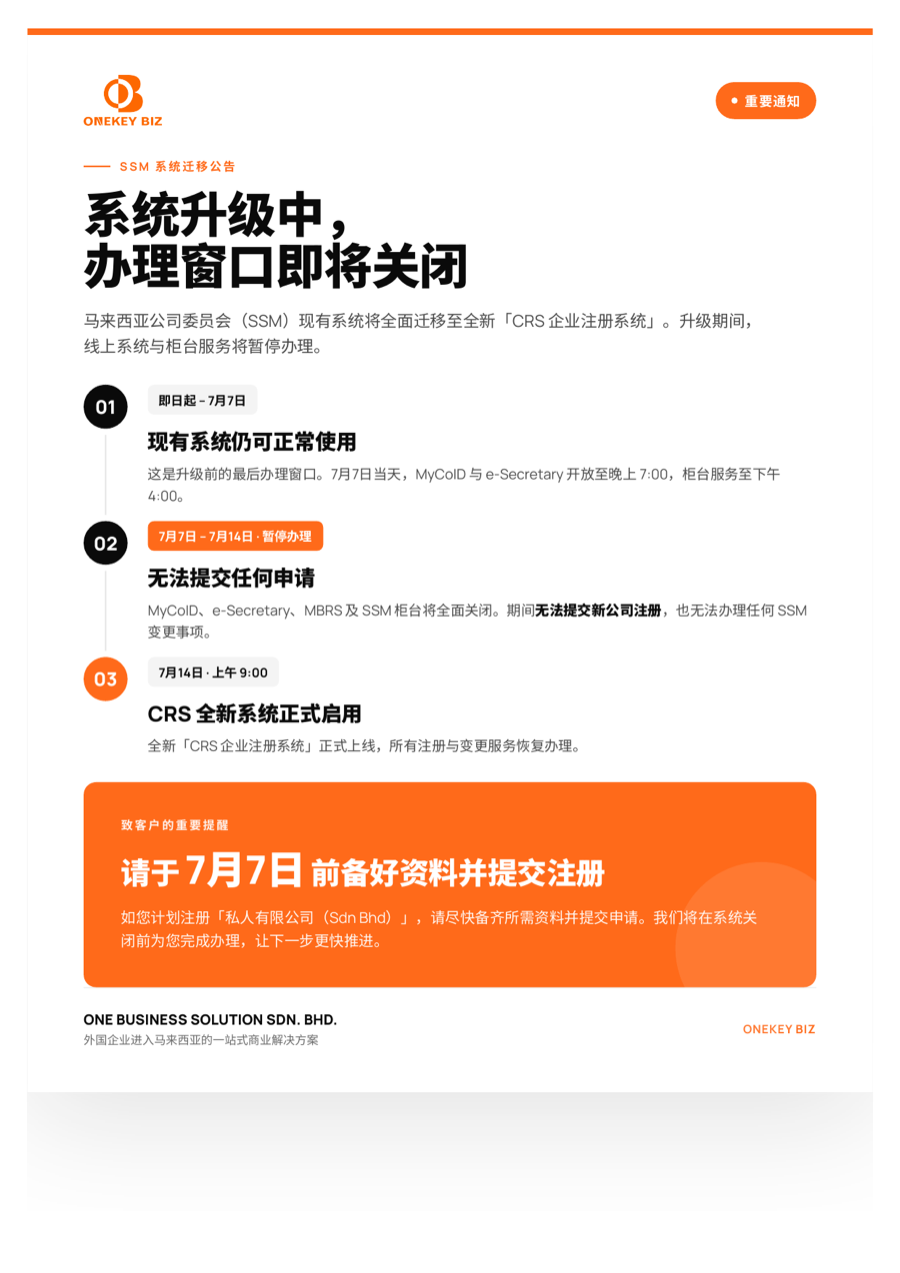
Yes. According to SSM's official CRS FAQ, the system is being rolled out in three phases. Phase 1 — the lodgement of statutory company documents — was scheduled to commence on 30 June 2026. The cutover from the old systems then ran through a transition and migration window into mid-July 2026, and SSM's own launch materials cite 14 July 2026. As of that date the CRS is operational and is the platform you must use; the legacy systems are switched off.
Critically, SSM has confirmed that MyCoID and e-Secretary are fully replaced and are no longer available now that CRS is operational. There is no parallel "old system" to fall back on. If you incorporate a company, update company information, or lodge a statutory document today, it goes through CRS.
What Phase 1 of CRS actually covers
Phase 1 is not a stripped-down launch — it already carries the core company services a foreign investor needs. According to SSM, Phase 1 provides:
| Category | Services available in CRS Phase 1 |
|---|---|
| Formation & names | Name Search, Incorporation, Relodgement, Extension of Time, Rectification |
| Ongoing administration | Company Information Update, Corporate Administration, Charges, Corporate Intermediaries Registration, Compound, Over the Counter |
| Exit & insolvency | Initiate Striking Off, Receivership, Winding Up, Judicial Management, Corporate Voluntary Arrangement, Asset Management |
| Other | Interest Scheme, BizTrust, Appeal to Minister, Court Order |

Two operational points from SSM's FAQ are worth knowing: the Maker–Checker function is available (so a preparer and an approver can be separated), and Express Filing is not available through CRS. Applications can be saved as drafts, but drafts are retained for only seven days. Lodgement fees are unchanged — the existing fee schedule still applies.
Question 2: Is the CRS safe to use?
Yes — provided you access it the way SSM designed it, and only through the official channel. The safety of using CRS comes down to three things: the right URL, a verified account, and sensible filing discipline.
Use only the official portal
SSM's FAQ is explicit: CRS is accessed through the SSM4U portal. You log in to SSM4U, and reach CRS from there. The genuine addresses are:
| Purpose | Official address | Status |
|---|---|---|
| SSM main website | www.ssm.com.my | ✅ Official |
| SSM4U login portal | www.ssm4u.com.my | ✅ Official |
| CRS platform | crs.ssm4u.com.my | ✅ Official (via SSM4U) |
| "MyCRS" certificate system | mycrs.posdigicert.com.my | ⚠️ Separate — digital certificate only, not the registry |
| "mycrs.gov.my" / aggregator pages | various third-party sites | ❌ Not official — do not enter credentials |
Accounts are identity-verified
CRS is not an anonymous system — and that is part of what makes it safe. Access is granted only to authorised users: company secretaries, directors, lawyers, liquidators and other eligible categories. Each account allows only one active login session at a time. For new users, SSM requires in-person identity verification at an SSM counter before the account is activated — a deliberate anti-fraud step. Existing SSM4U users keep the same account and password.
How to get onto CRS — existing vs new users
- If you already have an SSM4U account (most active company secretaries and directors do): log in at ssm4u.com.my with your existing credentials and open CRS from the portal. First, make sure your SSM4U profile details are up to date and accurate.
- If you are a new user: register for an SSM4U account, then attend any SSM counter for identity verification. Once verified and activated, you can access CRS.
- Before you needed the old system's records: SSM advised users to download and keep copies of documents previously lodged through MyCoID before it was discontinued. If you have not done this, request certified copies through CRS or SSM e-Info.

For most foreign-owned companies, the practical answer is simpler still: your appointed company secretary is the authorised user who operates CRS on the company's behalf. See our guides on the company secretary's role and Sdn Bhd incorporation under CRS.
Question 3: Has the government officially announced it?
Yes — comprehensively, and through official channels you can verify yourself. This is the best defence against fake portals: cross-check everything against SSM's own publications.
| Official source | What it confirms |
|---|---|
| SSM official CRS page (ssm.com.my) | The dedicated CRS information hub, launch materials and user manuals |
| SSM CRS FAQ (PDF on ssm.com.my) | Phases, go-live date, access method, fees, payment and support |
| SSM official Facebook page | Launch announcements and transition notices |
| SSM Customer Care | 03-7721 4000 · enquiry@ssm.com.my (Mon–Fri, 9:00am–5:30pm) |
SSM also advises users to check its official website, the CRS portal, the SSM4U portal and their email regularly for the latest updates. Notifications about your own transactions and any queries from SSM arrive through CRS, SSM4U and email — so keep the email on your SSM4U profile current and monitored.
Payment and support — the practical details
Inside CRS, lodgement fees remain the same as before. Payment is accepted by credit card (Visa/Mastercard), debit card (Visa/Mastercard) and internet banking; both locally and internationally issued Visa/Mastercard are accepted, which helps foreign directors paying from abroad. Payment status shows on screen and on the CRS dashboard, with a confirmation email once received. Note that payments are not refunded if an application is withdrawn, and an application can only be withdrawn before approval — so check your filing carefully before you pay.
What foreign companies should do now
The transition is not optional, and the old systems are gone. Practical priorities:
- Confirm your company secretary is CRS-ready — a verified SSM4U account and an up-to-date profile.
- Retrieve historical documents lodged under MyCoID if you have not already saved them.
- Bookmark the real addresses (ssm.com.my / ssm4u.com.my) and ignore "MyCRS" search results that lead elsewhere.
- Plan deadline-sensitive filings early through the settling-in period.
- Verify before you trust — cross-check any instruction against SSM's official FAQ or Customer Care.
The bottom line
Yes, SSM's Corporate Registry System is live; yes, it is safe to use — as long as you reach it only through the official SSM4U portal and treat "MyCRS" search results with caution; and yes, the government has announced it fully through SSM's website, FAQ and official social channels. The real risk in a big registry migration is not the system itself — it is confusion around the name and the rush of people looking for a login, which is exactly the environment where fake portals thrive. Stay on ssm.com.my and ssm4u.com.my, let your company secretary drive the filings, and verify anything unusual against SSM Customer Care.
ONEKEY BIZ handles SSM company incorporation, information updates and statutory lodgements through the official CRS on our clients' behalf. Talk to our team or explore our company setup and secretarial services.
Frequently asked questions
Is the SSM CRS (people call it “MyCRS”) actually live?
Yes. Per SSM's official FAQ, CRS is rolled out in three phases; Phase 1 (lodgement of statutory company documents) was scheduled to commence on 30 June 2026, and after the transition and migration window the system became operational in mid-July 2026 (SSM's launch materials cite 14 July 2026). MyCoID and e-Secretary have been fully replaced and are no longer available — CRS is now the system you must use.
Is CRS safe to use, and what is the difference between CRS and “MyCRS”?
CRS is safe if you access it only through the official SSM4U portal — log in at ssm4u.com.my and open CRS (crs.ssm4u.com.my) from there. There is no official SSM portal literally named “MyCRS”. The site mycrs.posdigicert.com.my is POS Digicert's separate digital-certificate request system, not the registry, and pages such as mycrs.gov.my on aggregator sites are not official — never enter your SSM4U credentials there. New CRS users must complete in-person identity verification at an SSM counter before activation.
Has the Malaysian government officially announced the CRS?
Yes. SSM has published a dedicated CRS page on ssm.com.my, an official CRS FAQ (PDF), user manuals, and launch/transition announcements on its official Facebook page. You can verify anything by cross-checking these sources or contacting SSM Customer Care at 03-7721 4000 or enquiry@ssm.com.my (Mon–Fri, 9:00am–5:30pm).
What should a foreign-owned company do now that CRS is live?
Make sure your company secretary has a verified SSM4U account with an up-to-date profile, since the secretary is the authorised user who operates CRS for the company. Retrieve and keep copies of documents previously lodged via MyCoID, bookmark the real addresses (ssm.com.my / ssm4u.com.my), plan any deadline-sensitive filings early during the settling-in period, and verify any unusual instruction against SSM's official FAQ or Customer Care. Lodgement fees are unchanged and Express Filing is not available in CRS.
Related services
We handle the process described in this article end-to-end.
- Sdn. Bhd. Company Incorporation in MalaysiaRegister a private limited company (Sdn. Bhd.) with SSM end-to-end.
- Annual Return Filing (Section 68) for Sdn. Bhd.Lodge your company’s yearly annual return with SSM on time.
- Appointment & Resignation of DirectorsUpdate your board — appoint or resign directors (Section 58/201).
Sources & references
This article is general information only, not legal, tax or immigration advice. Policies, thresholds and official fees are set by the relevant Malaysian authorities and may change. Talk to our consultants about your specific situation.