In July 2026, Malaysia's Companies Commission (Suruhanjaya Syarikat Malaysia, SSM) permanently switched off MyCoID and launched its successor — the Corporate Registry System (CRS). For any foreign company planning to incorporate a Sdn Bhd, change directors, transfer shares or lodge annual returns, this is the single most consequential change to Malaysia's corporate infrastructure in years. This guide tells you exactly what changed, why it matters for foreign investors, and what you must do right now to stay compliant Updated 31 August 2026 with where the system actually stands two months on: what the nightly maintenance window really was and when it ended, which filings never went through the CRS at all, the close of the MBRS 2.0 penalty-waiver window, and what SSM has — and has not — said about Phases 2 and 3.
Key Takeaways
- MyCoID is gone permanently. Since the CRS opened at 9.00 am on 14 July 2026, all Sdn Bhd incorporations, director changes, share transfers and statutory filings are processed through the new CRS platform on SSM4U.
- Three-phase rollout. Phase 1 (live now) covers statutory document lodgement. Broader CRS functions follow in later phases.
- The MBRS 2.0 penalty waiver ran 1 July – 31 August 2026 and has now closed. Filings still outstanding after that date fall back under the standard late-lodgement penalties in Practice Directive 1/2017.
- Beneficial ownership remains mandatory and is now embedded in CRS. The e-BOS module has migrated to the new platform; every change in ultimate ownership must still be reported promptly.
- New company secretary rules (effective January 2026). Licensed secretaries must now complete mandatory AML/CFT training, raising the compliance bar for the professionals you rely on.
- Foreign investors are fully eligible to incorporate 100% foreign-owned Sdn Bhds, but must appoint at least one Malaysia-resident director and a licensed company secretary — both of whom now operate through CRS.
1. What Is the Corporate Registry System (CRS) and Why Did SSM Build It?
The CRS is not just a cosmetic upgrade. SSM describes it as a core pillar of its digital transformation agenda — a ground-up rebuild of Malaysia's corporate registry infrastructure. The legacy MyCoID portal, which had served since the early 2000s, was never designed to handle the volume, complexity and cross-agency integration that Malaysia's modern regulatory environment demands. MyCoID could incorporate companies, but it could not natively communicate with e-Secretary, with MBRS, with e-BOS (the beneficial ownership module) or with other SSM tools. Companies and their secretaries had to navigate multiple separate portals, each with separate logins and data silos.
The CRS changes all of this by bringing every statutory function into a unified platform accessed through the SSM4U portal. According to SSM's official CRS FAQ, the system consolidates MyCoID, e-Secretary and over-the-counter statutory document lodgement services into a single digital environment. Once all three phases are live, the CRS will also incorporate MBRS (financial statements and annual returns), e-BOS (beneficial ownership), MyLLP, EzBiz and the BizCodEX and BizAi tools previewed at the SSM National Conference 2026.
This matters enormously for a foreign company. When you incorporate in Malaysia today, you are entering an ecosystem — not just filing a single document. Your company ID connects you to LHDN (tax), EPF, SOCSO, EIS and HRDF. The CRS is built to make those connections smoother. Fewer portals mean fewer login credentials, fewer reconciliation errors and faster government processing times.

2. The CRS Transition Timeline: What Closed, When, and What Reopened
To execute the migration, SSM implemented a phased shutdown of its legacy systems in mid-June 2026. Understanding this timeline is essential because filings that fell inside the blackout window may carry compliance implications — and because the post-migration penalty-waiver window is time-limited.
| Date / Deadline | System / Location Affected | What Closed |
|---|---|---|
| 18 June 2026 (4.00 pm) | SSM state office counters — Kedah, Terengganu, Kelantan | Over-the-counter statutory document submissions |
| 19 June 2026 | SSM HQ + Selangor, Penang, Melaka, N. Sembilan, Perlis, Sabah, Sarawak counters; also MyCoID & e-Secretary online | All counter services + MyCoID + e-Secretary submissions |
| 23 June 2026 (10.00 pm) | MBRS, e-BOS, MyLLP, e-Secretary, EzBiz | All remaining legacy online platforms closed |
| 30 June 2026 (announced) | CRS (Phase 1) go-live date originally announced by SSM — not met | All statutory document lodgements resume on the new platform |
| 1 July – 31 August 2026 | MBRS 2.0 (now under CRS) | Late-submission penalty waiver window — companies affected by the CRS migration peak period may submit overdue documents without penalty |
If your company had a statutory filing due between 18 and 30 June 2026 — an annual return, a director change notification, a share transfer or a new incorporation — those documents could not be submitted during the blackout. SSM confirmed that outstanding submissions would be queued for lodgement once the CRS went live. This means those documents, if lodged promptly once the CRS opened, were not automatically treated as late. The waiver window that covered them has since closed — see the status update below.
The MBRS 2.0 Penalty Waiver: Read the Fine Print
SSM's official announcement on its website states that the late-submission penalty waiver under Practice Directive 1/2017 runs from 1 July 2026 to 31 August 2026. This waiver specifically covers companies affected by the MBRS 2.0 and CRS transition peak period. It is not a blanket amnesty: filings that were already overdue before the transition window began are not covered. The waiver applies to statutory documents — primarily annual returns and financial statements — that fell due during the migration window.
That window has now closed. If your annual return anniversary fell in mid-June 2026 and the lodgement was made inside the waiver period, no late-lodgement fee should have been charged — worth verifying against your secretary's receipts rather than assuming. If a filing is still outstanding today, the waiver no longer covers it and the standard Practice Directive 1/2017 penalties apply, which escalate with the length of the delay. Lodge it now rather than at the next anniversary: the penalty is calculated on how late the document is, not on when you noticed.
Where the CRS Actually Stands — Status Update, 16 September 2026
Two months of live operation have answered questions that could not be answered at launch. Four of them matter to every foreign-owned company, and two of them are still widely reported incorrectly — including the launch date itself. The CRS did not go live on 30 June 2026. That was the announced date; SSM missed it, the legacy systems stayed closed in the meantime, and the CRS actually opened on SSM4U at 9.00 am on 14 July 2026. A lot of commentary written in June — ours included — still carries the announced date as though it happened.
| Date | What happened |
|---|---|
| 30 June 2026 | Announced go-live date for CRS Phase 1 — not met; legacy systems stayed dark |
| 14 July 2026, 9.00 am | CRS Phase 1 actually opens on SSM4U; MyCoID 2016 and e-Secretary permanently retired |
| 15–17 July 2026 | SSM takes the CRS down for main-systems maintenance after high traffic |
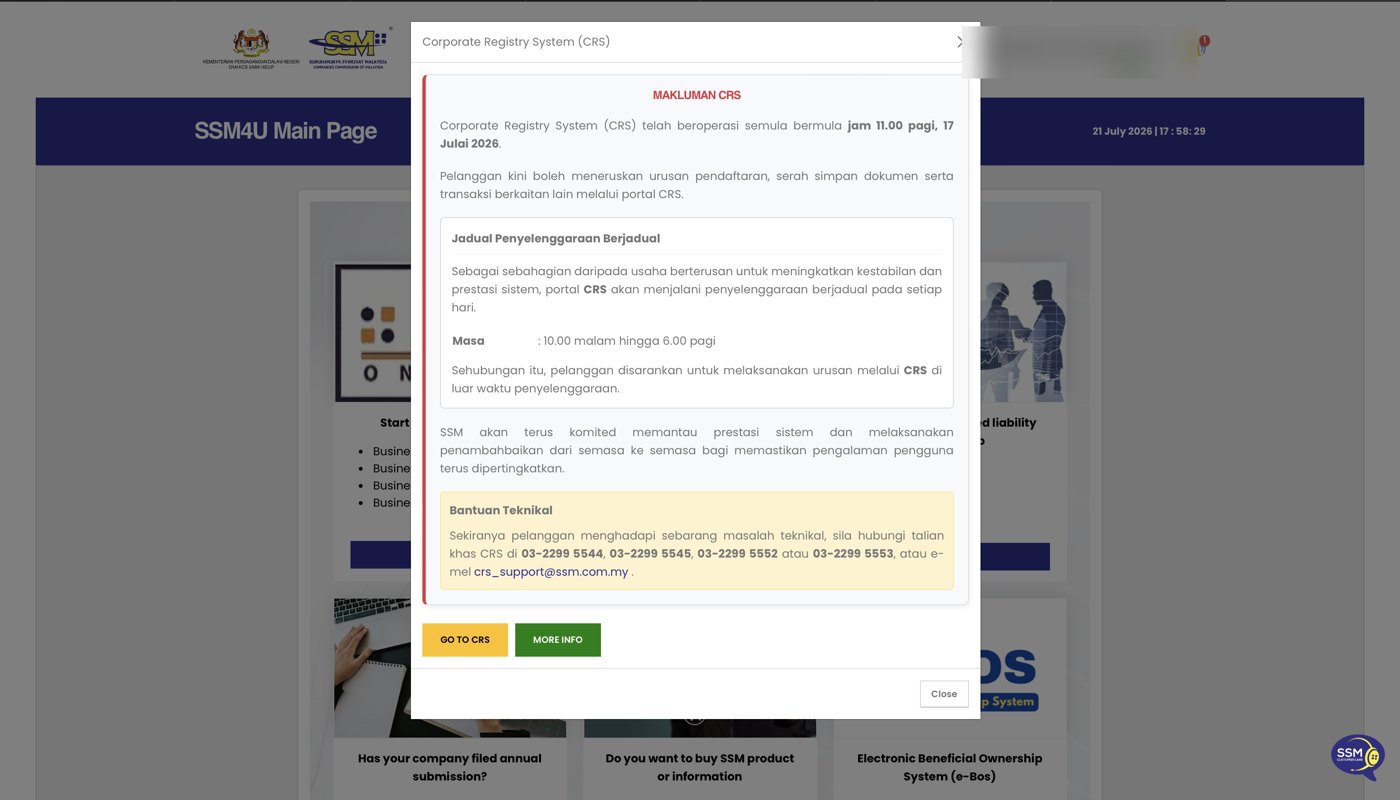
| 17 July 2026, 11.00 am | CRS resumes operation, with a nightly maintenance window announced |
| 17 July – 2 August 2026 | Nightly maintenance 10.00 pm – 6.00 am — a defined stabilisation period, not a permanent schedule |
| 31 August 2026 | MBRS 2.0 late-lodgement penalty waiver window closes |
| As at 16 September 2026 | Phase 1 is live and has run without a further announced outage since early August. SSM has still published no scope or timetable for Phase 2 or Phase 3. |
The nightly 10pm–6am window was temporary, and a lot of guidance has not caught up. SSM's own announcement gave it an end date of 2 August 2026. Advice written during the July disruption — including our own reporting at the time, when we described losing a third of every working day — described a stabilisation period that has since ended. If your secretary is still planning your filing calendar around a nightly blackout, that constraint no longer applies as an announced schedule. For the day-by-day record of that period, see our contemporaneous notes on the 15–17 July maintenance notice, the 17 July restoration and what we were still seeing on 21 July.
Your Annual Return and Financial Statements Do Not Go Through the CRS
This is the most consequential misunderstanding we encounter, and it comes from the reasonable assumption that a system replacing MyCoID replaced everything. It did not. SSM's own CRS FAQ is explicit: annual returns and financial statements continue to be lodged through MBRS, which remains in operation after the CRS went live. The CRS Phase 1 scope is statutory document lodgement — incorporations, director and secretary changes, share transfers, registered office changes, beneficial ownership updates. If your secretary told you the annual return would be "handled in the new system", ask specifically which system, because the deadlines and the penalty regime attach to MBRS.
Check What Migrated, Especially Your BO Register
e-BOS was one of the systems folded into the transition, and any submission that was in flight around the 23–30 June cutover is worth re-verifying rather than assuming it landed. Pull the beneficial ownership register from the CRS and compare it line by line against your statutory register of members. A discrepancy created by a migration gap looks exactly like a discrepancy created by non-disclosure, and the burden of explaining it falls on the company. On whether the platform itself is genuine and safe to transact on — a question we were asked repeatedly during the launch — see our separate verification note on whether the CRS (often miscalled "MyCRS") is live, safe and officially announced.
Two Months On: What Has Settled, and What Has Not
The stabilisation narrative is over. Since the nightly maintenance window ended on 2 August 2026 SSM has not announced a further scheduled outage, and routine Phase 1 lodgements — incorporations, director and secretary changes, share transfers, registered office changes — are being processed through SSM4U in normal turnaround. Plan your filing calendar on ordinary working hours again.
What has not moved is the scope question. SSM has published nothing on Phase 2 or Phase 3: no list of services, no dates. Treat any adviser's claim that a particular filing "will move to CRS soon" as unsourced until SSM says so on its own CRS page. The practical rule for the rest of 2026 is unchanged — confirm with your secretary which platform each specific filing goes through, because the deadline and the penalty attach to the platform, not to the brand name.
3. What Does Phase 1 of the CRS Cover? A Practical Breakdown for Foreign Companies
Phase 1 of the CRS, which opened on 14 July 2026, covers the lodgement of statutory company documents. In practical terms for a foreign-owned Sdn Bhd, this includes the following categories of filing:
- New company incorporation (previously handled by MyCoID) — the full incorporation workflow, including name reservation, submission of the company constitution, Section 201 statutory declaration, director particulars and the initial beneficial ownership register.
- Director and officer changes — appointment and resignation of directors (Section 58 notifications), appointment of company secretary (Section 236), and changes to registered address.
- Share-related changes — allotment of shares, transfer of shares, increase of authorised share capital.
- Company name changes — applications that previously went through MyCoID's name-change module.
- Striking off (Section 550) — applications to wind down and deregister a company.
- Beneficial ownership updates — notifications of changes in ultimate beneficial owners, previously managed through the standalone e-BOS module.
- Annual return and financial statement lodgement — previously handled via MBRS mPortal, now integrated into CRS.
The one notable change in process is the removal of the Express Filing feature. SSM's official CRS FAQ confirms that Express Filing is not available in the new system. Under MyCoID, companies could pay a premium to jump the queue for faster processing. That option no longer exists — all applications move through the standard queue on CRS. Plan your incorporation and statutory filing timelines accordingly, particularly if you have business milestones (bank account opening, Employment Pass applications, licence applications) that depend on having a registered company number in hand.
Accessing CRS: SSM4U Account and Identity Verification
The CRS is accessible exclusively through the SSM4U portal. If you or your company secretary already have an SSM4U account, the same credentials carry over — there is no need to re-register. New users, however, must register for an SSM4U account and then complete physical identity verification at any SSM branch counter before they can access the CRS. Draft applications in CRS are retained for seven days before they expire.
For a foreign investor based outside Malaysia, this identity-verification step is the key practical reason why appointing a licensed Malaysian company secretary is essential. Your company secretary holds an active, verified SSM4U account and can lodge all CRS documents on your behalf without requiring your physical presence in Malaysia.
4. Beneficial Ownership Under CRS: What Foreign Shareholders Must Understand
One of the most consequential compliance obligations embedded in the CRS — and one that catches many foreign investors off guard — is beneficial ownership (BO) reporting. SSM introduced its Guideline on Beneficial Ownership Transparency in March 2020, and the Companies Amendment Act 2024 has since strengthened and codified these obligations.
Who Is a Beneficial Owner?
SSM defines a beneficial owner as any individual who:
- Holds more than 25% of the shares in a company, directly or indirectly;
- Holds more than 25% of the voting rights, directly or indirectly; or
- Has the right to appoint or remove a majority of directors, or otherwise exercises significant control over the company.
This applies regardless of whether the shares are held in the investor's own name, through another company, through a trust, or through a nominee arrangement. For foreign companies — particularly those from China, Taiwan, Hong Kong or Singapore where holding structures and nominee shareholding are common — this rule is critically important. The nominee shareholder (legal owner) and the beneficial owner are different people, and SSM requires the beneficial owner to be identified and recorded.
What You Must File and When
Every company incorporated in Malaysia must:
- Take reasonable steps to identify, obtain and verify BO information at incorporation;
- Maintain a Register of Beneficial Owners at the company's registered office;
- Keep the BO register accurate and up to date at all times;
- Notify SSM of any change in BO information through the CRS (via the e-BOS module) promptly upon any change;
- Provide BO information to SSM, LHDN or any law enforcement authority upon request.
Under the Companies Amendment Act 2024, the BO information is now also cross-referenced with annual return data. A discrepancy between your annual return and your BO register — for example, a share transfer that was not reflected in the BO register — can trigger SSM scrutiny. Given that SSM's enforcement activity has increased and that the new CRS platform creates an integrated data environment, regulatory cross-checking is more automated than ever before.
| Obligation | Trigger | How to File (Post-CRS) | Consequence of Non-Compliance |
|---|---|---|---|
| Initial BO Register setup | At incorporation | Via CRS (e-BOS module) through company secretary | Criminal liability; company and officers |
| Update BO Register | Any share transfer, new investor, change in control | Notify SSM via CRS promptly | Fines; SSM investigation; cross-reference flag on annual return |
| Respond to SSM / LHDN / enforcement authority request | Upon demand | Provide BO information from register | Criminal offence if withheld |
| Annual cross-check | Annual return filing | Company secretary verifies BO register against annual return | Discrepancy triggers SSM inquiry |

5. Incorporating a Sdn Bhd Under CRS in 2026: Step-by-Step for Foreign Investors
For a foreign company or individual incorporating a new Sdn Bhd today, the process runs through the CRS. Here is the end-to-end workflow as it operates on the CRS today:
Step 1 — Engage a Licensed Company Secretary (Day 0)
Before anything else, engage a licensed company secretary who holds a valid SSM practising certificate and an active SSM4U/CRS account. Since you as a foreign investor cannot directly access the CRS without physical identity verification at an SSM counter in Malaysia, your company secretary is your authorised CRS agent. Look for our Sdn Bhd incorporation service, which bundles company secretary appointment, CRS filing and beneficial ownership register setup into a single end-to-end package.
Step 2 — Company Name Reservation via CRS (Day 1–2)
Your company secretary conducts a name search on CRS (previously on MyCoID). If the name is available and compliant with SSM's naming guidelines, it is reserved — typically for 30 days. If the proposed name includes controlled words (e.g., "Malaysia," "National," a state name, a regulated professional term, or a trademark), a Super Form with authorisation from the relevant authority must be submitted alongside the application.
Step 3 — Document Preparation and Digital Signing (Days 2–5)
Your company secretary prepares the full suite of incorporation documents:
- Company Constitution (or adoption of the model constitution under the Companies Act 2016);
- Section 201 Statutory Declaration;
- Section 236 Company Secretary Appointment;
- Director consent (Form 48A equivalent under the new CRS) — confirming each director is not bankrupt and has not been convicted of any relevant offence;
- Initial Register of Beneficial Owners — identifying every individual who holds more than 25% directly or indirectly;
- Proof of director identity (passport copies for foreign directors).
Foreign founders do not need to travel to Malaysia at this stage. Digital signing is accepted for the documents listed above. Your company secretary submits everything through CRS on SSM4U.
Step 4 — CRS Submission and Issuance (Days 5–8)
Once documents are submitted, SSM issues the Notice of Registration and Certificate of Incorporation — typically within one to three working days of a complete application. The CRS dashboard allows real-time application status tracking. Note: the Express Filing option available under MyCoID has been removed in the CRS.
Step 5 — Post-Incorporation Compliance Setup (Days 8–30)
Post-incorporation steps have not changed in substance, but they now all flow through the CRS or its connected systems:
- Section 58 Notification: Company secretary must notify SSM of the director's appointment within 14 days via CRS;
- Registered address confirmation;
- Company seal and share certificate issuance;
- BO Register entry and lodgement via CRS e-BOS module;
- Tax registration with LHDN (the MyCoID number linking — now via CRS company number — connects you to EPF, SOCSO, EIS and HRDF);
- Corporate bank account opening (requires Certificate of Incorporation and director's particulars);
- First annual return: due within 30 days of your anniversary of incorporation each year, lodged via MBRS (which is now part of the CRS ecosystem).
6. Cost and Timeline Reference for Foreign Investors
The CRS has not changed the government fee schedule for statutory filings. The underlying fees are set by SSM under the Companies Act 2016. The table below reflects the applicable government fees for the most common transactions for a foreign-owned Sdn Bhd:
| Transaction | Government Fee (SSM) | Typical Processing Time (CRS Phase 1) |
|---|---|---|
| Company name reservation | RM 30 | 1–2 working days |
| New company incorporation (Sdn Bhd) | RM 1,010 (for first RM 400,000 paid-up capital) | 1–3 working days (after complete submission) |
| Annual return lodgement (Section 68) | RM 50–RM 150 (varies by share capital) | Same-day to 2 working days |
| Director change (Section 58 notification) | RM 20 per lodgement | 1–2 working days |
| Share transfer (Section 105) | RM 20 per lodgement | 1–3 working days |
| Company name change | RM 200 | 3–5 working days |
| Striking off application (Section 550) | RM 200 | 3–6 months (SSM processing) |
Note: The CRS FAQ confirms that the current lodgement fees remain applicable under Phase 1. No additional platform fee has been introduced. Professional fees charged by your company secretary or service provider are separate from the above government fees and vary by firm.

7. Worked Example: A Chinese Tech Company Setting Up a Sdn Bhd in July 2026
Let us trace a realistic scenario to make the above concrete. Scenario: A technology company based in Shenzhen, China — let's call it Shenzhen AI Co., Ltd — wants to establish a wholly foreign-owned subsidiary in Kuala Lumpur to serve Southeast Asian markets and apply for an Employment Pass for its regional director.
Ownership Structure and Beneficial Ownership
Shenzhen AI Co., Ltd will hold 100% of the shares in the new Malaysian entity. However, the Malaysian Sdn Bhd must identify the individual beneficial owners of Shenzhen AI Co., Ltd — specifically any person who holds more than 25% of Shenzhen AI Co., Ltd's equity. If the founder of Shenzhen AI Co., Ltd holds 60% of its shares, that founder must be recorded in the Malaysian subsidiary's BO Register as the ultimate beneficial owner. This information is filed with SSM via the CRS e-BOS module at incorporation.
Director Requirements
At least one of the Malaysian Sdn Bhd's directors must be ordinarily resident in Malaysia. Shenzhen AI Co., Ltd's regional director will initially hold a Professional Visit Pass (PVP) while the Employment Pass application is pending. In the interim, a Malaysia-resident director — often a nominee director provided by a professional firm — is appointed to satisfy this requirement. The resident director appointment is filed via CRS within 14 days.
Paid-Up Capital
For Employment Pass purposes, the Malaysian Immigration Department typically requires a minimum of RM 500,000 in paid-up capital for companies in regulated sectors, or RM 250,000 or more in most service sectors. Shenzhen AI Co., Ltd opts for RM 500,000 to maximise EP eligibility. This paid-up capital figure is declared in the incorporation documents filed on CRS and should be verified with an accountant before submission.
Timeline
Filing on 28 July 2026 (after the CRS opened on 14 July and the mid-July congestion eased): name reserved on Day 1, documents prepared and signed by Day 4, submitted on Day 5, Certificate of Incorporation issued by Day 7, BO register lodged by Day 9, corporate bank account application initiated by Day 10. Employment Pass application ready to submit by Week 4 (once the bank account is opened and initial paid-up capital is deposited).
8. Common Mistakes Foreign Investors Make — And How CRS Changes the Risk Equation
The shift from MyCoID to CRS changes not just the interface but also the underlying compliance risk environment. Here are the most common errors foreign investors make, and how they are amplified (or mitigated) under the new platform:
- Mistake 1: Assuming the BO Register is optional or a one-time task. Under the CRS's integrated data environment, your BO register is now live and cross-referenced automatically against annual return data and share transfer filings. A share transfer lodged in CRS that is not immediately reflected in a BO update creates an immediate discrepancy flag. Always instruct your company secretary to file BO updates simultaneously with any share-related filing.
- Mistake 2: Missing the 30-day company secretary appointment rule. Under Section 235 of the Companies Act 2016, a company secretary must be appointed within 30 days of incorporation. The position must never be vacant for more than 30 days. With the CRS, any vacancy gap is visible in SSM's records. Non-compliance can result in penalties for both the company and its directors.
- Mistake 3: Not accounting for the SSM4U identity verification step. Foreign investors often try to register directly on SSM4U and access CRS, only to discover that they need to physically visit an SSM counter in Malaysia for identity verification before their account can be activated. This can delay an incorporation by one to two weeks. The solution: appoint a licensed company secretary in Malaysia before you begin, and let them handle the CRS filing on your behalf from the outset.
- Mistake 4: Relying on Express Filing timelines. Express Filing no longer exists in CRS. If your business timeline is tight — for example, you need the company registered before a commercial agreement signing or before an Employment Pass application — build in extra buffer days compared to the old MyCoID Express Filing expectation.
- Mistake 5: Assuming the penalty waiver is still open. The MBRS 2.0 waiver ran from 1 July to 31 August 2026 and has closed. Any filing still outstanding now attracts the standard late-submission penalties under Practice Directive 1/2017, which escalate with the length of the delay and can be substantial for older documents. The fix is to lodge immediately, not to wait for the next anniversary.
- Mistake 6: Assuming CRS covers everything from Day 1. Phase 1 covers statutory document lodgement. Further functionality — potentially including more financial reporting integration, BizCodEX and BizAi tools — will roll out in subsequent phases. Keep an eye on SSM's official announcements for Phase 2 timelines.
9. What You Should Do Right Now — And How ONEKEY BIZ Can Help
Whether you are a new foreign investor considering a Sdn Bhd incorporation in Malaysia, or an existing company that needs to regularise post-migration filings, the immediate priority list is clear:
- If you have outstanding filings (annual returns, director changes, BO updates, share transfers): Contact your company secretary immediately. Confirm whether any filings fell within the blackout window that ran from mid-June until the CRS opened on 14 July 2026. Lodge any outstanding documents now — the MBRS 2.0 waiver closed on 31 August 2026, and the penalty for a late document grows with every month it stays unlodged. Confirm separately which of them go through MBRS rather than the CRS.
- If you are incorporating a new Sdn Bhd: Start the process now. Engage a licensed company secretary who is already live on CRS and SSM4U. Prepare your director's passport, intended paid-up capital, registered office address and beneficial owner details in advance.
- If you have a nominee shareholding or holding company structure: Review your BO register immediately. Under the CRS's integrated data environment, any inconsistency between the legal share register and the BO register is increasingly likely to be flagged automatically during annual return cross-referencing.
- If you are changing company secretary providers: Ensure the outgoing secretary formally resigns via board resolution and that a Section 58 notification for both the resignation and the new appointment is filed in CRS within 14 days. During the transition, verify that all statutory registers and minute books have been properly handed over before the outgoing secretary's SSM4U access is relinquished.
ONEKEY BIZ's Sdn Bhd incorporation service is delivered by licensed company secretaries who are fully onboarded to CRS and SSM4U. We handle the complete end-to-end process: company name reservation, constitution preparation, director and BO register setup, CRS submission, post-incorporation BO lodgement, and ongoing statutory compliance — all in one engagement. Our team serves clients across China, Taiwan, Hong Kong and Singapore who are entering the Malaysian market, and we work in English and Mandarin.
If you are unsure where to start, or if you have a specific scenario — a WFOE structure, a joint venture, an existing Hong Kong holding company that will be the shareholder — contact our team directly for a no-obligation consultation. We will map out the exact CRS filing sequence, the correct paid-up capital level for your intended activities, and the beneficial ownership structure that keeps you compliant from Day 1.
Frequently asked questions
What is SSM's Corporate Registry System (CRS) and how is it different from MyCoID?
The CRS is SSM's brand-new, fully integrated digital corporate registry platform that went live on 30 June 2026. Unlike MyCoID — which only handled company incorporation — the CRS consolidates MyCoID, e-Secretary, over-the-counter statutory document lodgements and other functions into a single platform accessed through the SSM4U portal. It is being rolled out in three phases, with Phase 1 covering statutory document lodgement. MyCoID will not be restored; the CRS is its permanent replacement.
Does the CRS launch affect my ability to incorporate a Sdn Bhd as a foreign investor?
Yes, but positively. Now that the CRS is live, new Sdn Bhd incorporations are processed through the CRS on SSM4U rather than MyCoID. If your application was caught in the transition blackout window (18–30 June 2026), your company secretary would have queued it for submission on 30 June. Going forward, all incorporation filings, director changes, share transfers and annual returns are handled through the single CRS platform. New users who do not yet have an SSM4U account must register and complete identity verification at any SSM counter before they can access CRS — your appointed company secretary can handle this on your behalf.
What is the MBRS 2.0 late-submission penalty waiver and who qualifies?
SSM announced a waiver of late-submission penalties under Practice Directive 1/2017 for the period 1 July 2026 to 31 August 2026 for companies affected by the CRS migration peak period. This waiver applies to statutory documents that could not be lodged on time due to the system transition. Companies are strongly encouraged to use this window to regularise any outstanding filings. The waiver does NOT apply to documents that were already overdue before the CRS transition window.
As a foreign shareholder, do I need to declare beneficial ownership in the new CRS?
Yes. All companies incorporated in Malaysia — including those with 100% foreign ownership — must maintain a Register of Beneficial Owners (BO Register) and lodge changes with SSM. Under SSM's Guideline on Beneficial Ownership Transparency (updated in line with the Companies Amendment Act 2024), any individual who holds more than 25% of shares directly or indirectly, or who exercises significant control, must be identified and recorded. This information is filed through the e-BOS module, which has been migrated into the new CRS platform. Your licensed company secretary manages this filing.
Related services
We handle the process described in this article end-to-end.
- Sdn. Bhd. Company Incorporation in MalaysiaRegister a private limited company (Sdn. Bhd.) with SSM end-to-end.
- Annual Return Filing (Section 68) for Sdn. Bhd.Lodge your company’s yearly annual return with SSM on time.
- Appointment & Resignation of DirectorsUpdate your board — appoint or resign directors (Section 58/201).
Sources & references
This article is general information only, not legal, tax or immigration advice. Policies, thresholds and official fees are set by the relevant Malaysian authorities and may change. Talk to our consultants about your specific situation.