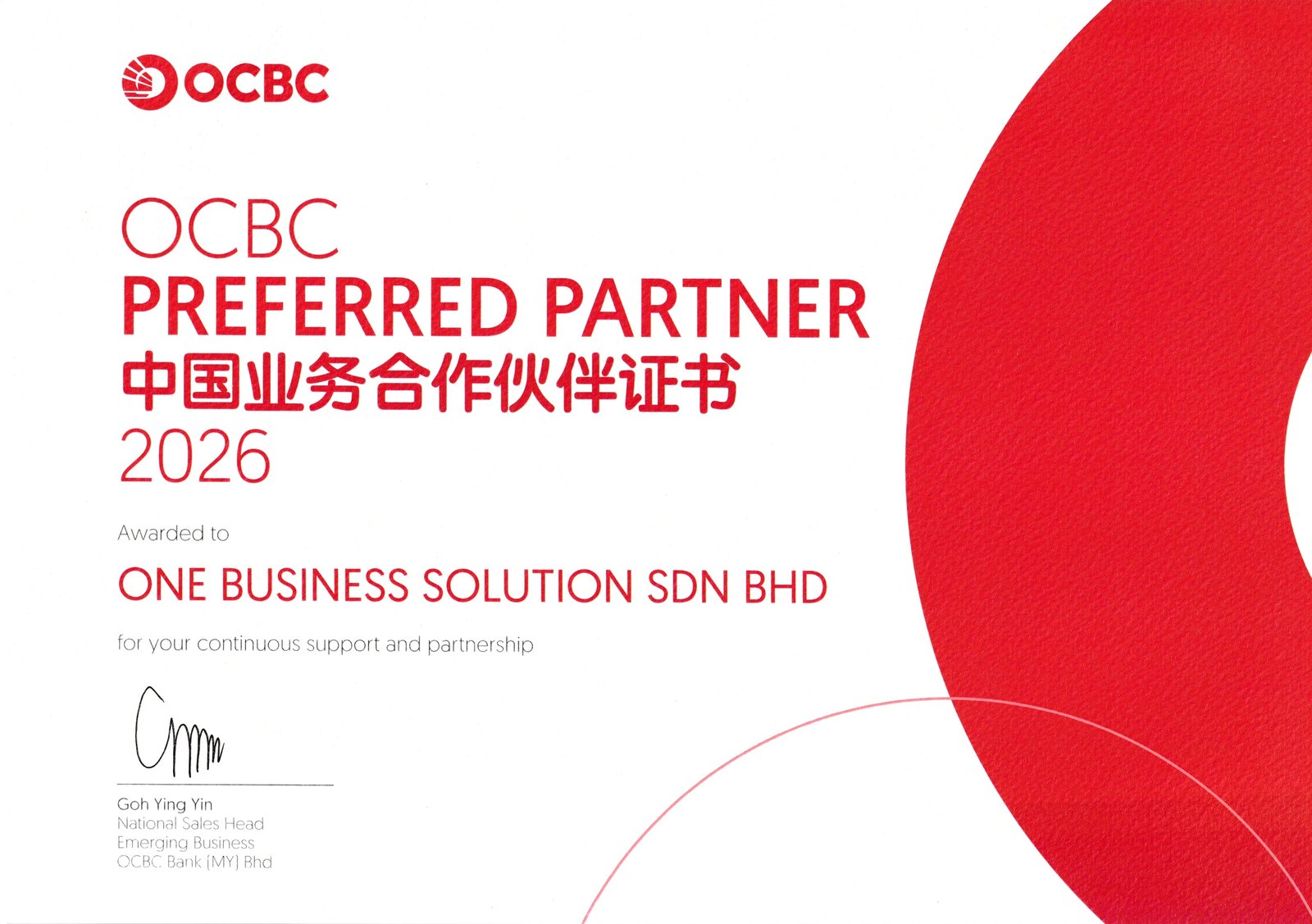
OCBC Bank (Malaysia) Berhad has named ONE BUSINESS SOLUTION SDN. BHD. — ONEKEY BIZ — an OCBC Preferred Partner for China Business 2026. We are glad to have it, and we want to be precise about what it is. It is not a prize we entered, and it is not a badge we designed for ourselves. It is a bank's own written acknowledgement, signed by its National Sales Head for Emerging Business, that the files we submit on behalf of Chinese-owned Malaysian companies arrive in a form the bank can actually work with. For a client only one consequence of that matters, and it is a practical one: through the first half of 2026, every corporate account we submitted was opened within about a month of incorporation — and for most of our China-based clients, without anyone boarding a flight to Malaysia.
What the certificate says
The document is titled OCBC Preferred Partner · 中国业务合作伙伴证书 2026. It is awarded to ONE BUSINESS SOLUTION SDN. BHD. "for your continuous support and partnership", and it is signed by Goh Ying Yin, National Sales Head, Emerging Business, OCBC Bank (M) Berhad.
Three words in it are doing real work. China business — the recognition is category-specific, not general. Continuous — it describes a relationship already running, renewed for 2026, rather than a one-off introduction. And partner — the bank's own word for a counterparty whose submissions it is willing to stand behind internally.
Why a bank's opinion is worth more than our own
Almost every claim a corporate services firm makes about itself is unfalsifiable. "Experienced", "professional", "one-stop" — none of it can be checked, and all of it is written by the firm making the claim. A bank recognition is a different class of statement, because the bank has money and a regulator on the line and no incentive whatsoever to be generous.
It also lands on the exact part of the process where foreign investors get stuck. Incorporating a Sdn. Bhd. with SSM is procedural: the requirements are published, the outcome is predictable, and a complete application is approved. Opening the bank account is not procedural — it is discretionary. A bank is running anti-money-laundering and counter-financing-of-terrorism obligations of its own, and it is entitled to decline a file it does not understand. Almost every "we registered the company but still cannot operate" story we are asked to rescue is a banking story, not a registration story.
Who OCBC is
Some context, because "OCBC" is better known in Singapore and Greater China than it is to a first-time investor in Malaysia.
| Detail | |
|---|---|
| Group | Oversea-Chinese Banking Corporation (华侨银行), formed in 1932 from the merger of three local banks — Singapore's longest-established bank |
| Scale | The second-largest financial services group in Southeast Asia by assets |
| Ratings | Aa1 (Moody's), AA- (S&P and Fitch); consistently listed among Global Finance's World's Safest Banks |
| In Malaysia | OCBC Bank (Malaysia) Berhad — locally incorporated in 1994, one of the country's largest foreign banks by assets, loans, deposits and network; around 46 branches, including Islamic branches under OCBC Al-Amin Bank Berhad (established 2008) |
| In China | First presence in 1925 (Xiamen); locally incorporated in Shanghai in 2007. Today OCBC Bank (China) Limited is headquartered in Shanghai with branches and sub-branches across 14 mainland cities |
That last row is the one that changes a Chinese client's experience of Malaysia, and we will come back to it.
What actually goes wrong for Chinese-owned applicants
The refusals and the six-month stalls are rarely about the client being unsuitable. They are about a file that does not answer the questions the bank is obliged to ask, in the order it asks them.
| What the bank sees | Why it stalls | What the file should have contained |
|---|---|---|
| An ownership chain ending at an offshore holding company | Ultimate beneficial ownership cannot be established from the documents on the table | The full chain to the natural persons, with each layer evidenced — the same disclosure your Malaysian company already owes SSM |
| A newly registered company with no operating history | Nothing on file explains what the business will actually do, with whom, in what volumes | A short, specific business profile: customers, suppliers, expected first-year flows, and where the money comes from |
| A registered address with no substance | The address looks like a mailbox and the bank cannot verify occupation | A registered office backed by a tenancy agreement stamped by LHDN, plus utilities or signage where applicable |
| Chinese-language corporate documents | They cannot be read into the bank's own records | Certified translations, prepared to the standard the bank accepts, before submission rather than after a rejection |
| Directors and signatories who are all overseas | Identity verification and specimen signatures cannot be completed | An agreed verification route settled before the application, not improvised after it |
| Source of funds described in one line | The AML file is incomplete, so the case cannot be recommended internally | Documented source of capital, consistent with the shareholders' own profiles and with any China ODI filing |

Doing it from inside China
The single most common assumption we correct is that opening a Malaysian corporate account requires a trip to Malaysia. For a large share of our clients it does not, and the reason is simply where OCBC already is.
Because OCBC operates a locally incorporated bank in mainland China as well as in Malaysia, a director sitting in Shanghai, Chengdu or Guangzhou is not a stranger walking into a foreign branch. There is an established route for identity verification and document sighting through the group's own network, and where that route is available the director completes their part at an OCBC branch in their own city — no visa, no flight, no hotel, no week away from the business.
| Region | Cities in OCBC's mainland network |
|---|---|
| Beijing–Tianjin–Hebei & north | Beijing, Tianjin, Qingdao |
| Yangtze River Delta & belt | Shanghai (headquarters), Suzhou, Shaoxing, Wuhan |
| Western China | Chengdu, Chongqing |
| Pearl River Delta & south-east coast | Guangzhou, Shenzhen, Foshan, Zhuhai, Xiamen |
The one-month timeline, week by week
This is the shape of a clean file. It assumes the shareholders' documents are ready and the business is a straightforward trading, services or construction operation; regulated activities and complex holding structures take longer, and we will say so at the outset.
| Week | What happens | What we need from you |
|---|---|---|
| Week 1 | Name reservation and Sdn. Bhd. incorporation with SSM; Notice of Registration issued; constitution and first board resolutions prepared | Passports/IDs, proposed names, shareholding split, business description |
| Week 2 | Registered office and tenancy stamped with LHDN; company secretary appointed; statutory registers opened; bank pack assembled — board resolution to open the account, signatory mandate, KYC forms | Confirmation of signatories and mandate; source-of-funds documents |
| Week 3 | Submission to the bank; certified translations lodged; director identity verification and specimen signatures completed — for most China-based clients at an OCBC branch in their own city | One appointment, locally. That is usually the entire time commitment |
| Week 4 | Bank review and approval; account number issued; internet banking and hard token activated; initial deposit made | Initial deposit |
Where a client also needs statutory employer registrations, an Employment Pass or an industry licence, those run in parallel from week 2 rather than after the account — which is how a company reaches "open for business" in a month instead of a quarter.

What you prepare, and what we handle
You prepare: passports or identity documents for every director and shareholder; the corporate documents of any corporate shareholder; a plain description of the business and its intended customers and suppliers; documentation of where the capital comes from; and one director available for a single local appointment.
We handle: name search and incorporation; the constitution, first board resolutions and the account-opening resolution; company secretary and statutory registers; registered office and the LHDN-stamped tenancy; certified translations; the complete bank KYC pack in the format the bank's China desk expects; bank liaison and follow-up until the account is live; and — because a live account is the beginning, not the end — bookkeeping, tax and the annual compliance calendar that follows.
What this changes for 2026
Practically, not much about how we work: we prepared files this way before the certificate and we will after it. What it changes is what a prospective client has to take on faith. Until now, "we know how Chinese companies open accounts in Malaysia" was our claim about ourselves. For 2026 it is also OCBC's, in writing, over the signature of its National Sales Head for Emerging Business.
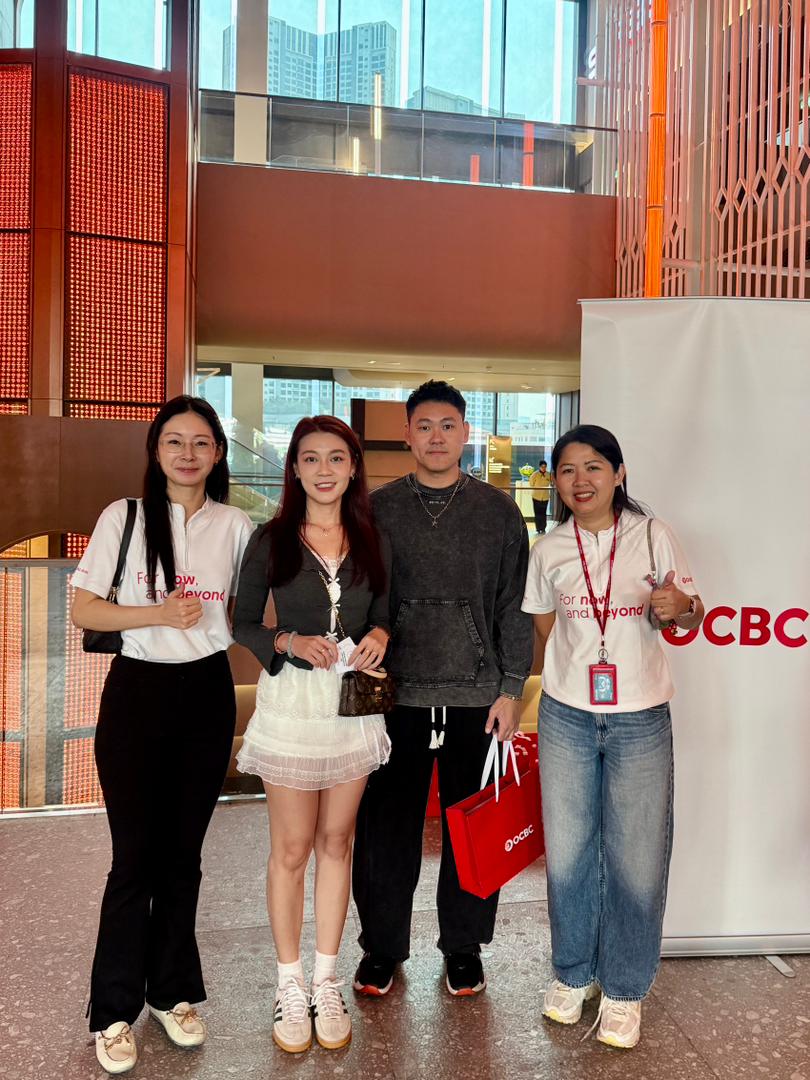
Our thanks to the OCBC Emerging Business team for the partnership — and to the clients whose files made the case. You can see one of them in full in our case study on a Malaysian OCBC account opened entirely from China.
If you are planning a Malaysian entity from China and want to know, before you spend anything, which route your structure qualifies for and how long it will realistically take — talk to us, or read more about our corporate bank account opening service.
Frequently asked questions
What exactly is the OCBC Preferred Partner certificate — did ONEKEY BIZ apply for it?
No. It is issued by OCBC Bank (Malaysia) Berhad and signed by Goh Ying Yin, National Sales Head, Emerging Business, awarding ONE BUSINESS SOLUTION SDN. BHD. the Preferred Partner · China Business 2026 recognition "for your continuous support and partnership". It is the bank's acknowledgement of an existing working relationship, renewed for 2026 — not an application we submitted, and not a marketing badge of our own design. That distinction is the whole point: the claim is the bank's, in writing, over a named signature.
Can a Chinese shareholder really open a Malaysian corporate account without flying to Malaysia?
In most of our files, yes. Because OCBC operates a locally incorporated bank in mainland China as well as in Malaysia — headquartered in Shanghai, with branches and sub-branches across 14 mainland cities including Beijing, Tianjin, Qingdao, Suzhou, Shaoxing, Wuhan, Chengdu, Chongqing, Guangzhou, Shenzhen, Foshan, Zhuhai and Xiamen — there is an established route for identity verification and document sighting inside the group's own network. Where that route applies, the director completes their part at an OCBC branch in their own city. The caveat matters, though: the route is decided by the bank case by case, based on the shareholding structure, the directors' nationalities and residence, and the nature of the business. It is common in our experience; it is not a guarantee, and we will tell you which route your case qualifies for before you commit any money.
Is one month realistic for incorporation plus a corporate bank account?
It is the timeline every corporate account we submitted in the first half of 2026 has followed, on a clean file: week 1 name reservation and SSM incorporation; week 2 registered office with an LHDN-stamped tenancy, company secretary, statutory registers and the bank KYC pack; week 3 submission, certified translations and director verification; week 4 approval, account number, internet banking and initial deposit. It assumes shareholder documents are ready and the business is a straightforward trading, services or construction operation. Regulated activities and multi-layer offshore holding structures take longer, and we say so at the outset rather than at week five.
Why do so many foreign-owned companies get stuck at the bank rather than at SSM?
Because the two steps work differently. Incorporation with SSM is procedural: the requirements are published and a complete application is approved. Opening an account is discretionary — the bank carries its own anti-money-laundering and counter-financing-of-terrorism obligations and may decline a file it cannot make sense of. The six recurring failures we see are an ownership chain that stops at an offshore holding company, a new company with no explanation of what it will actually do, a registered address with no substance, uncertified Chinese-language corporate documents, signatories who are all overseas with no agreed verification route, and a source of funds described in a single line. None of these are exotic, and every one of them is knowable before submission.
We already have a Malaysian company that cannot open an account. Can that be rescued?
Usually, yes — and it is a large part of what we do. The work is diagnostic before it is anything else: we read the existing file the way the bank read it, identify which of the six failure points applies, and rebuild the pack around it. In practice that most often means evidencing the ownership chain down to the natural persons, replacing a mailbox address with a registered office backed by an LHDN-stamped tenancy, producing certified translations, writing a specific business profile with named customers and suppliers, and documenting source of funds consistently with the shareholders' own profiles and any China ODI filing. A previous decline is not permanent, but resubmitting the same file is not a strategy.
Related services
We handle the process described in this article end-to-end.
- Corporate Bank Current Account Opening (Malaysia)Corporate bank account opening with OCBC Bank or Alliance Bank Malaysia.
- China ODI (Outbound Direct Investment) Filing for Investing in MalaysiaEnd-to-end China Outbound Direct Investment (ODI) filing with SAFE and MOFCOM.
- Sdn. Bhd. Company Incorporation in MalaysiaRegister a private limited company (Sdn. Bhd.) with SSM end-to-end.
This article is general information only, not legal, tax or immigration advice. Policies, thresholds and official fees are set by the relevant Malaysian authorities and may change. Talk to our consultants about your specific situation.