Every person who works on a Malaysian construction site has to be registered with the Construction Industry Development Board (CIDB) as construction personnel. That covers the general worker, the bar bender, the site supervisor and the project manager, whether Malaysian or foreign. The proof of that registration is the card the industry calls the CIDB Green Card (Kad Hijau, formally the Construction Personnel Registration Card). Contractors usually discover the rule the day a CIDB enforcement officer walks onto site and starts asking workers for their cards. This guide explains who needs a Green Card, the SICW safety course that comes first, the exact CIMS steps for employers, what it costs, how foreign workers are handled differently, and what happens when someone is caught without one.
Quick answer (as at October 2026): To get a CIDB Green Card, the worker must be at least 16, hold a valid MyKad or a passport with a valid work permit, and first pass the SICW (or e-SICW) safety induction course. The employer then applies online in CIMS (cims.cidb.gov.my); foreign workers can only be registered through an employer ID. CIDB charges RM35 for one year up to RM135 for five years, the same for locals and foreigners. Working on site unregistered is an offence under section 33(4) of Act 520, with a fine of up to RM5,000.
| Item | CIDB rule (CIDB registration page and FAQ, December 2024 edition) |
|---|---|
| Legal basis | Act 520, s.33(1): construction personnel must be registered; s.33A: skilled workers and site supervisors must also be accredited |
| Minimum age | 16 years |
| Course first | SICW, e-SICW, e-SICW CIDBH, or another CIDB-recognised safety certificate or passport |
| Where to apply | CIMS online; foreign workers (PLKS / EP) and IMM13P holders only through an employer ID |
| CIDB fee | RM25 per year + RM10 processing: RM35 (1 yr) to RM135 (5 yrs) |
| Validity | Malaysians 1–5 years; foreign workers follow the work permit expiry |
| Penalty | Up to RM5,000 for working unregistered (s.33(4)) |
What the CIDB Green Card actually is
The Green Card is the physical evidence of a construction personnel registration kept by CIDB under the Construction Industry Development Board Act 1994 (Act 520). The registration is the legal requirement, and the card is the proof. CIDB says so in its own FAQ: once a worker is actively registered, they may enter the site and work even before the card arrives, because the registration certificate generated in CIMS, the CIDB Malaysia app and the online personnel search all prove the same thing.
The Green Card should not be confused with the company's own CIDB papers. A contractor holds a Contractor Registration Certificate (PPK) with a grade from G1 to G7, plus SPKK or STB where needed. None of those cover the people on site. A G7 contractor with a perfect PPK can still be fined because its subcontractor's crew have no cards. Our CIDB licence guide covers the company side; this article is about the workers.
The card also does a second job that many employers do not know about. Every actively registered person aged 16 to 70 is covered by CIDB's group takaful protection plan, with benefits including RM21,000 for accidental death and up to RM18,000 for permanent disability from an accident. For people registered from 1 October 2024 the insurer is Etiqa Family Takaful; claims must be lodged within 60 days of the incident. An unregistered worker who is injured on site has none of this.
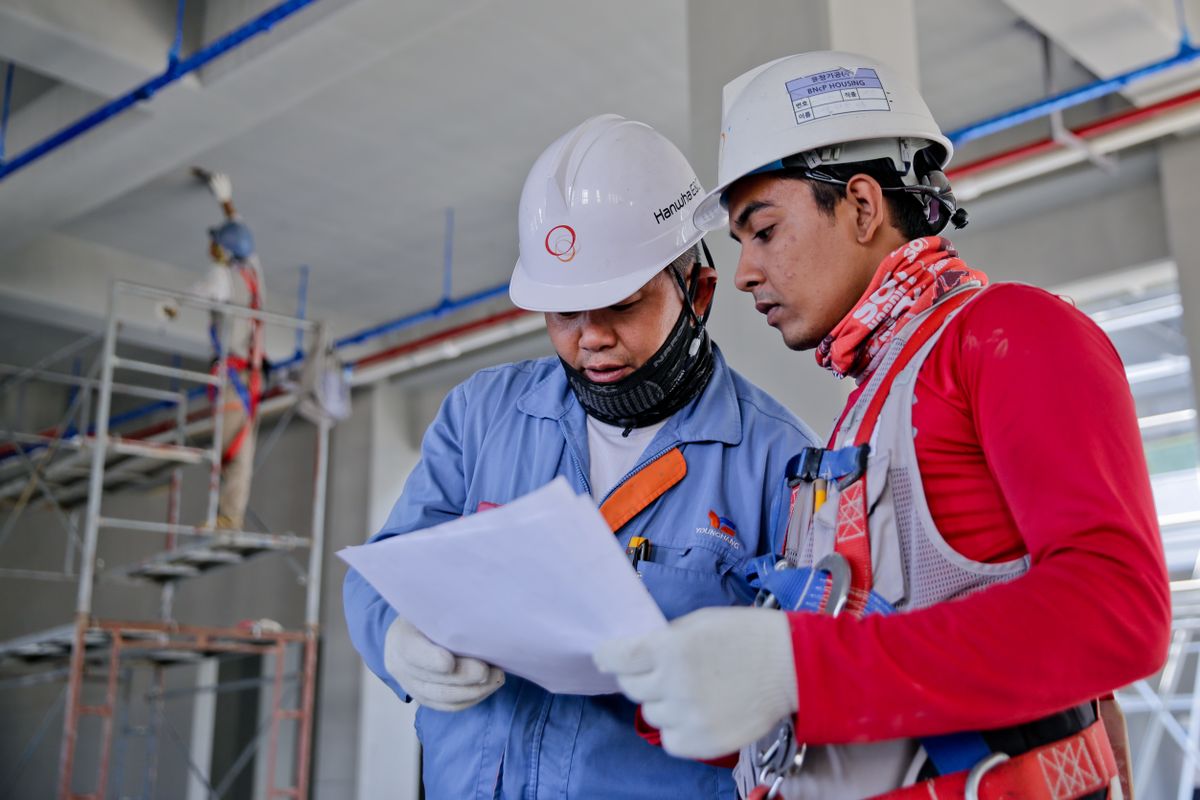
Who needs a Green Card, and in which category
CIDB's FAQ answers the question in one line: every individual who carries out, or undertakes to carry out, construction work in Malaysia under Act 520. In practice that means anyone whose job is physically on a construction site. CIMS assigns each person a category automatically, based on the highest academic and skills qualification declared:
| Category | Who falls into it |
|---|---|
| Construction trainee | Practical training at a training institute or in the industry |
| General construction worker | No skills or academic certificate; most foreign workers start here |
| Administration | Diploma or degree holder in a non-technical field |
| Semi-skilled worker | Has a trade skill not listed in the Third Schedule of Act 520 |
| Skilled construction worker | Trade listed in the Third Schedule (or equivalent); must also be accredited under s.33A |
| Site supervisor | SKKP Level 4 (accredited construction site supervisor) |
| Construction project manager | SKKP Level 5 or 6, or a diploma or degree in a technical field |
The category matters beyond the card. If you have skilled workers or supervisors, they also need CIDB accreditation under section 33A, and those numbers count when CIDB looks at your technical staff for a grade upgrade. If a certificate a worker holds is missing from the CIMS dropdown, CIDB's instruction is to raise it through eBantuan with proof, rather than registering the person in a lower category and fixing it later.
Step one: the SICW safety induction course
No CIMS application can be completed without a recognised safety certificate. The standard one is the Safety Induction for Construction Workers (SICW) course, which covers basic site safety and health. There are three ways to get it:
- Physical SICW class at a CIDB-accredited training provider. The certificate is linked to the worker's MyKad or passport number, and CIMS picks it up automatically.
- e-SICW / e-SICW CIDBH, the online self-paced version run by CIDB Holdings. It is module learning followed by a self-assessment, available in several languages, which helps foreign workers who do not read Malay or English well.
- Another CIDB-recognised safety certificate or safety passport, which has to be uploaded in CIMS for checking.
Course fees are set by the training provider, not by CIDB, so they are not part of the RM35–RM135 registration fee. Two practical rules save time. First, the course is done once: CIDB's FAQ confirms that a worker does not have to attend SICW again to renew the registration. Second, for foreign workers the course record is tied to the passport number. If the passport is replaced, the employer must enter the old number in the foreign worker section during renewal, or CIMS will not find the course record and the worker may be told to repeat it.

Step two: how to apply for a CIDB Green Card in CIMS
All new applications and renewals are online through the CIDB Centralized Information Management System (CIMS). The route depends on who the worker is:
- Malaysian (MyKad) workers can register through their employer's ID or through an individual ID they create themselves.
- Foreign workers on a PLKS or Employment Pass, and IMM13P holders, can only be registered through an employer ID.
The employer's process for a new Green Card runs like this:
- Sign up or log in to CIMS with the employer ID.
- Open Construction Personnel and start a new registration for each worker.
- Enter identity details. Copies of MyKad or passport are not required, because CIMS checks them against national records. IMM13P holders must upload a copy of the pass and a passport-size photo.
- Complete the three sections CIMS will not skip: employer (or self-employed) details, the safety certificate, and the beneficiary who will receive takaful benefits. CIDB's FAQ says an application cannot move forward if any of these three is missing.
- Add qualifications (optional but important): academic certificates from government-recognised institutions and skills certificates from CIDB or CIDB-recognised bodies. These decide the category and trade.
- Choose the registration period and the address where the card should be posted.
- Pay online by online banking or credit/debit card. CIDB does not accept cash. Card payments can also be made at a CIDB state or branch counter.
- Download the registration certificate, which CIMS generates automatically once payment succeeds. It can be printed free and is valid proof while the card is in the post.
If a Malaysian worker's identity details do not come up within three days, the worker must go to the nearest CIDB state or branch office with their MyKad for thumbprint verification. For foreign workers the common failure is a mismatch: whatever the employer types must match the work permit exactly, including name spelling and passport number. Anything else fails the immigration check.
If you would rather not handle the course bookings and CIMS entries yourself, our CIDB Green Card application service registers whole crews: we book SICW, submit the registrations and keep a card register ready for inspections.
Fees, payment window and how long it takes
CIDB's fee is a flat RM25 per year of registration plus a RM10 processing fee per application. It is the same for Malaysians, foreign workers and IMM13P holders.
| Registration period | Processing fee | Registration fee | Total paid to CIDB |
|---|---|---|---|
| 1 year | RM10 | RM25 | RM35 |
| 2 years | RM10 | RM50 | RM60 |
| 3 years | RM10 | RM75 | RM85 |
| 4 years | RM10 | RM100 | RM110 |
| 5 years | RM10 | RM125 | RM135 |
Three timing rules come from CIDB's FAQ and registration page:
- 30 days to pay. Once CIMS generates the proforma invoice, the employer has 30 days to pay. After that the invoice is cancelled automatically and the application has to be made again.
- No refunds. A successful payment cannot be claimed back, so check the worker's details before paying. The posting address can be changed only before payment.
- Card delivery. CIDB's registration page says the card is printed and posted within 14 days of payment; its December 2024 FAQ allows up to 60 days. Either way the worker can start once the registration is active.
The fee is small. The real cost of getting it wrong is the cost of a worker standing idle because the SICW slot was not booked, or a whole crew sent off site during an inspection.

Foreign workers: what is different
Most Green Card problems on Malaysian sites involve foreign workers, because their registration depends on a second government record. The key differences:
- Employer ID only. A foreign worker cannot register on their own. The employer named on the work permit makes the application.
- Validity follows the permit. A Malaysian picks 1 to 5 years and the expiry is set from their date of birth. For a PLKS or EP holder, the registration ends when the permit ends. The Green Card can never outlast the work permit, so renew the permit first.
- A legal permit is a precondition. One of CIDB's general conditions is a valid work permit from the Immigration Department. A worker without a valid PLKS cannot be registered at all, and CIDB has warned that contractors found hiring illegal workers with false documents face disciplinary action that can suspend or cancel the contractor's own registration.
- New passport, new card. The card is normally printed once and never reprinted on renewal. The exception is a foreign worker renewing with a new passport number, who gets a new card.
- Leaving the company. When a foreign worker leaves, the employer must submit the Immigration Department documents to CIDB to remove the worker from its CIMS record.
Because the Green Card is tied so closely to the work permit, it makes sense to plan both together. Our guide to the PLKS foreign worker permit, levy and quota covers the permit side, including the 2027 minimum wage change that affects construction labour costs.
Renewal, changes and checking a card
Renewal opens 60 days before the registration expires and follows the same CIMS flow, with the existing SICW record reused. Payment is again RM35–RM135 depending on the period. Our CIDB renewal guide covers Green Card renewal alongside the company's PPK and SPKK renewals; the short version is that a lapsed card means the worker is unregistered again until it is renewed.
Other changes are also made in CIMS:
- Change of employer (for local or IMM13P workers): the employer updates it under Construction Personnel → Personnel Card → Personnel Card Listing.
- Beneficiary: updated during renewal, or at any time under Construction Personnel → Personnel Insurance → Update Beneficiary Detail.
- Note the date on the card. CIDB points out that the date printed on the card is the card's own expiry, not the registration's. The registration expiry is the one on the CIMS certificate, the CIDB app and the online directory.
To check whether a worker is registered, before hiring a subcontractor's crew for example, search the MyKad, passport or IMM13P number in CIMS's Construction Personnel Search or the CIDB Malaysia app. Doing that check for a subcontractor's workers before they start is cheap insurance.
Penalties and enforcement
CIDB's FAQ is explicit: a person who carries out construction work without being registered may be treated as committing an offence under section 33(4) of Act 520, and on conviction can be fined up to RM5,000. The exposure for the contractor goes further than that fine:
- Site inspections. CIDB enforcement teams check Green Cards during site operations. Missing cards are recorded along with other Act 520 breaches such as undeclared projects and unaccredited skilled workers, and serious cases have led to stop-work notices.
- Compounds. CIDB issues compounds to contractors for Act 520 offences, including construction personnel registration, alongside contractor registration and project declaration offences.
- Disciplinary action on the contractor's registration. Repeated or serious breaches, especially involving illegal workers, can lead to suspension or cancellation of the contractor's CIDB registration, which is far more expensive than any fine.
- No takaful cover. An unregistered worker who is injured or killed on site falls outside CIDB's group protection plan.
| Situation | Consequence |
|---|---|
| Working on site without an active registration | Offence, s.33(4) Act 520: fine up to RM5,000 |
| Skilled worker or supervisor not accredited | Breach of s.33A; recorded during enforcement |
| Registration lapsed, renewal not yet paid | Treated as unregistered until renewal is paid |
| Foreign worker without a valid PLKS | Cannot be registered; contractor risks CIDB disciplinary action plus immigration offences |
| Non-registered visitor with Special Permission | Allowed on the declared project, but no takaful cover |
Common mistakes we see
- Treating cards as the subcontractor's problem. The workers are on your site and in your project declaration. Ask for the crew's CIMS search results before work starts.
- Registering before the permit is final. Details typed from an old passport or a pending permit cause mismatches and wasted payments, and payments are not refundable.
- Losing the SICW link. A foreign worker's new passport without the old number entered can mean repeating the course.
- Skipping the beneficiary. CIMS blocks the application, and an empty or outdated beneficiary also slows takaful claims later.
- Missing the 30-day payment window on a batch of invoices, then redoing every application.
- Reading the card date as the registration date. Check expiry in CIMS or the app, not on the plastic.

What we recommend
For a small contractor with a stable crew, registering Malaysians for the full five years (RM135) is the cheapest and simplest option, because the course is not repeated and the card is printed once. For foreign workers, align every Green Card with the PLKS renewal date and keep a single spreadsheet of permit expiry, Green Card expiry and passport number for each worker. Before every new subcontract, ask for the subcontractor crew's CIMS search results.
ONEKEY BIZ handles CIDB Green Card registration in Malaysia for whole site teams, from SICW booking to the CIMS submission and the card register, along with the company's own CIDB grade, renewal and SPKK. Talk to us about your crew list and project start date.
Frequently asked questions
How to apply for a CIDB green card?
The worker first completes the SICW (or e-SICW) safety induction course. The employer, or a Malaysian worker using an individual ID, then applies online in CIMS at cims.cidb.gov.my, fills in employer details, the safety certificate and a beneficiary, chooses a registration period and pays online within 30 days. The registration certificate is generated as soon as payment succeeds and the card is posted afterwards.
How much is the CIDB green card fee?
CIDB charges RM25 per year of registration plus a RM10 processing fee: RM35 for one year, RM60 for two, RM85 for three, RM110 for four and RM135 for five years. The fee is the same for Malaysians, foreign workers and IMM13P holders. The SICW course fee is charged separately by the training provider, and payments to CIDB are not refundable.
Can a foreign worker get a CIDB green card?
Yes, but only through the employer ID in CIMS, and only with a valid work permit (PLKS or Employment Pass) from the Immigration Department. The details entered must match the permit exactly. The registration expires with the work permit, so renew the permit first and the Green Card after it.
What is the fine for working without a CIDB green card?
A person carrying out construction work without being registered with CIDB may be charged under section 33(4) of Act 520 and fined up to RM5,000 on conviction. Contractors can also receive compounds and, for serious or repeated breaches such as hiring illegal workers, face disciplinary action against their own CIDB registration.
Can a worker start work before the green card arrives?
Yes. CIDB says a worker may enter the site and work as long as the registration is active. The registration certificate printed from CIMS, the CIDB Malaysia app and the online Construction Personnel Search all prove registration while the card is in the post (CIDB states 14 days on its registration page and up to 60 days in its FAQ).
Related services
We handle the process described in this article end-to-end.
- CIDB Green Card (Construction Personnel Registration)Construction personnel Green Card registration & renewal.
- CIDB Grade G1 Contractor RegistrationContractor registration for projects up to RM200,000.
- CIDB Grade G2 Contractor RegistrationContractor registration for projects up to RM500,000.
Sources & references
- CIDB — Construction Personnel Registration (eligibility, categories, fees, validity, Special Permission)
- CIDB — Soalan Lazim Pendaftaran Personel Binaan dan Kebenaran Khas Memasuki Tapak Bina (SL-PPB-2024-Rev00, 16 Dec 2024)
- CIDB CIMS — Centralized Information Management System
- Construction Industry Development Board Act 1994 (Act 520) — CIDB
This article is general information only, not legal, tax or immigration advice. Policies, thresholds and official fees are set by the relevant Malaysian authorities and may change. Talk to our consultants about your specific situation.