
Quick answer
Instruments listed in the First Schedule of the Stamp Act 1949 are chargeable with stamp duty (s.4), and an instrument executed in Malaysia must be stamped within 30 days of execution. Late stamping attracts penalties under s.47A, and an unstamped instrument is not admissible as evidence in court. The Stamp Duty Self-Assessment System is being phased in from 1 January 2026. Stamp duty is paid to LHDN at cost with the official receipt.
Last reviewed: · Reviewed by:ONEKEY BIZ compliance team
01
Overview
Tenancy agreements, share transfers, loan documents, sale and purchase agreements and many other instruments must be stamped. Stamping is how the government collects duty on them, and it is also what makes the document usable in court.
Section 4 of the Stamp Act 1949 makes the instruments in the First Schedule chargeable with duty, and an instrument executed in Malaysia must be stamped within 30 days of signing. After that, Section 47A imposes a late-stamping penalty — RM25 or 5% of the deficient duty, whichever is greater, if stamped within three months, rising for longer delays.
From 1 January 2026 the Stamp Duty Self-Assessment System (SDSAS) is being phased in, shifting more responsibility to the parties to assess and pay correctly, with penalties under Section 72C. We confirm which regime applies to each instrument when we stamp it.
Who needs this
- Landlords and tenants signing tenancy agreements
- Parties to share transfers and sale agreements
- Companies signing loan, service or supply agreements
02
Documents you need to prepare
Instrument
- Signed agreement or instrument (original or copy as required)
- Execution date
Valuation
- Consideration, rent or market value supporting the duty assessment
Parties
- IC or company registration of the parties
- Submit within 30 days of signing to avoid s.47A penalties.
- Stamp duty itself is paid at cost and is not part of our fee.
03
How to get it done with ONEKEY BIZ
- 1Review instrument Day 1
Duty category and value confirmed.
- 2Submit for stamping Day 1–2
Instrument submitted through LHDN's stamping system.
- 3Assessment & payment Day 2–5
Duty assessed and paid.
- 4Stamped copy Done
Stamped certificate / copy returned.
You do
- Send the signed instrument promptly
- Pay the assessed stamp duty
We do
- Confirm duty category and regime
- Submit for stamping
- Settle duty and return the stamped copy
04
What you receive
Proof the instrument is duly stamped.
Official receipt for duty paid on your behalf.
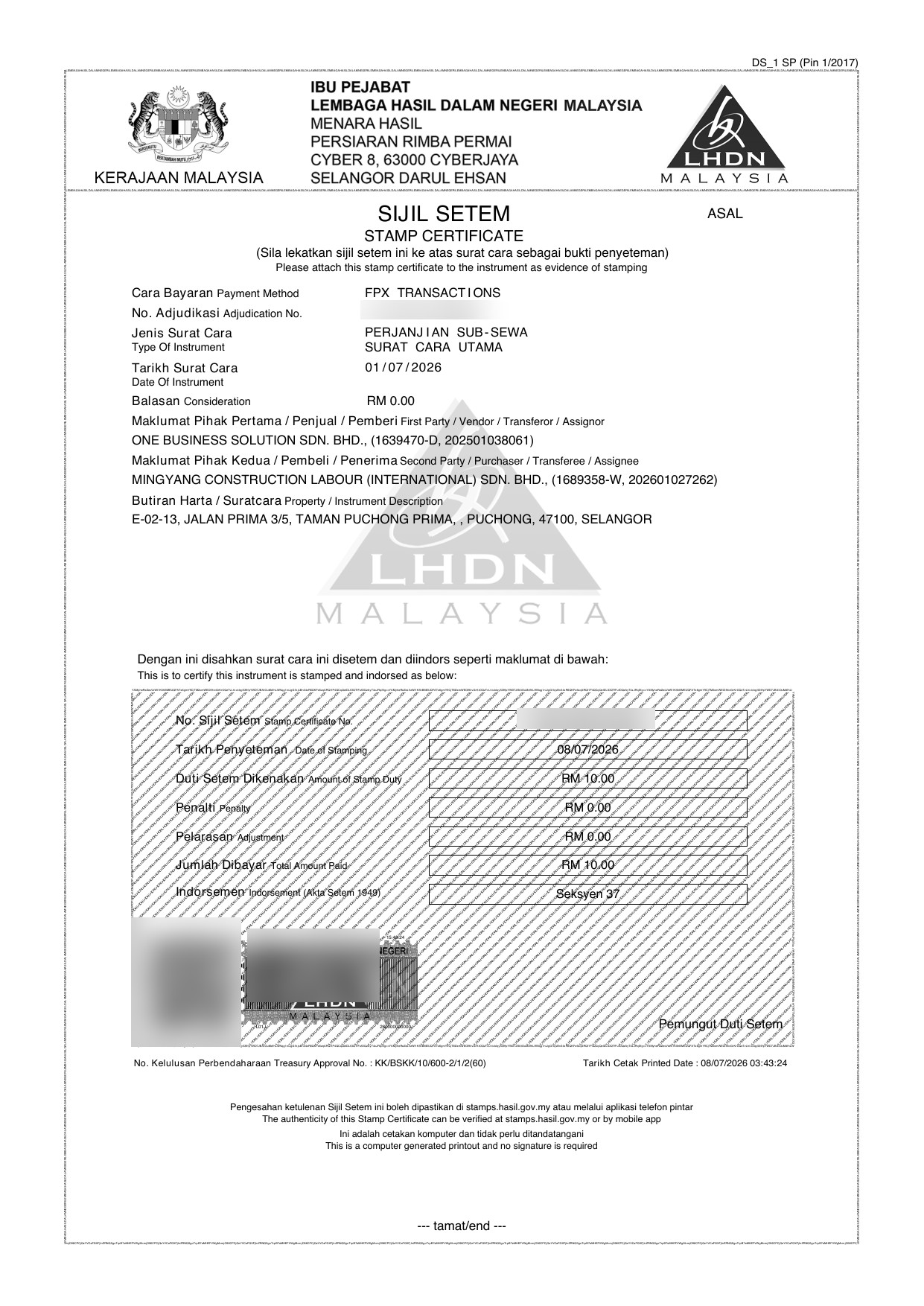
Real clients we've done this for
Official sources
Frequently asked questions
What if we are past 30 days?
Stamp as soon as possible; the s.47A penalty increases with the delay.
Is an unstamped agreement valid?
It may be binding, but it is not admissible as evidence in court until stamped.
Does SDSAS apply to us?
It is being phased in by instrument type from 2026; we confirm per document.