
Quick answer
The Industrial Co-ordination Act 1975 requires a manufacturing company with shareholders' funds of RM2.5 million or more, or 75 or more full-time paid employees, to hold a manufacturing licence. Applications are submitted to the Malaysian Investment Development Authority (MIDA) for approval by the Ministry of Investment, Trade and Industry (MITI). Shareholders' funds means paid-up capital, reserves and retained profits.
Last reviewed: · Reviewed by:ONEKEY BIZ compliance team
01
Overview
Manufacturing in Malaysia is coordinated under the Industrial Co-ordination Act 1975 (ICA). The Act decides which manufacturers must be licensed, and MIDA — the government's investment agency under MITI — processes the applications.
The licence is triggered by size: shareholders' funds of RM2.5 million or more, or 75 or more full-time paid employees. Shareholders' funds are calculated as paid-up capital plus reserves and retained profits, so a profitable small factory can cross the line without raising new capital. Once licensed, the company must operate within the products and conditions approved.
The licence is also the starting point for many incentives and other approvals, so the products, capacity and investment described in the application should match the company's plans. We prepare the application to reflect the actual project, not a template.
Who needs this
- Manufacturers with shareholders' funds of RM2.5 million or more
- Factories with 75 or more full-time employees
- Foreign manufacturers establishing a Malaysian plant
02
The two thresholds that decide whether you need a licence
Manufacturing in Malaysia is coordinated under the Industrial Co-ordination Act 1975, and the Act draws the line by size rather than by industry. A manufacturing company needs a licence if its shareholders' funds are RM2.5 million or more, or if it has 75 or more full-time paid employees. Either threshold on its own triggers the requirement — they are not cumulative conditions.
Shareholders' funds is the term that catches people out. It is not paid-up capital alone: it is paid-up capital plus reserves plus retained profits. A factory that started below the line and has been quietly profitable for several years can cross RM2.5 million without ever issuing a new share, and the obligation arrives with the accounts rather than with a decision.
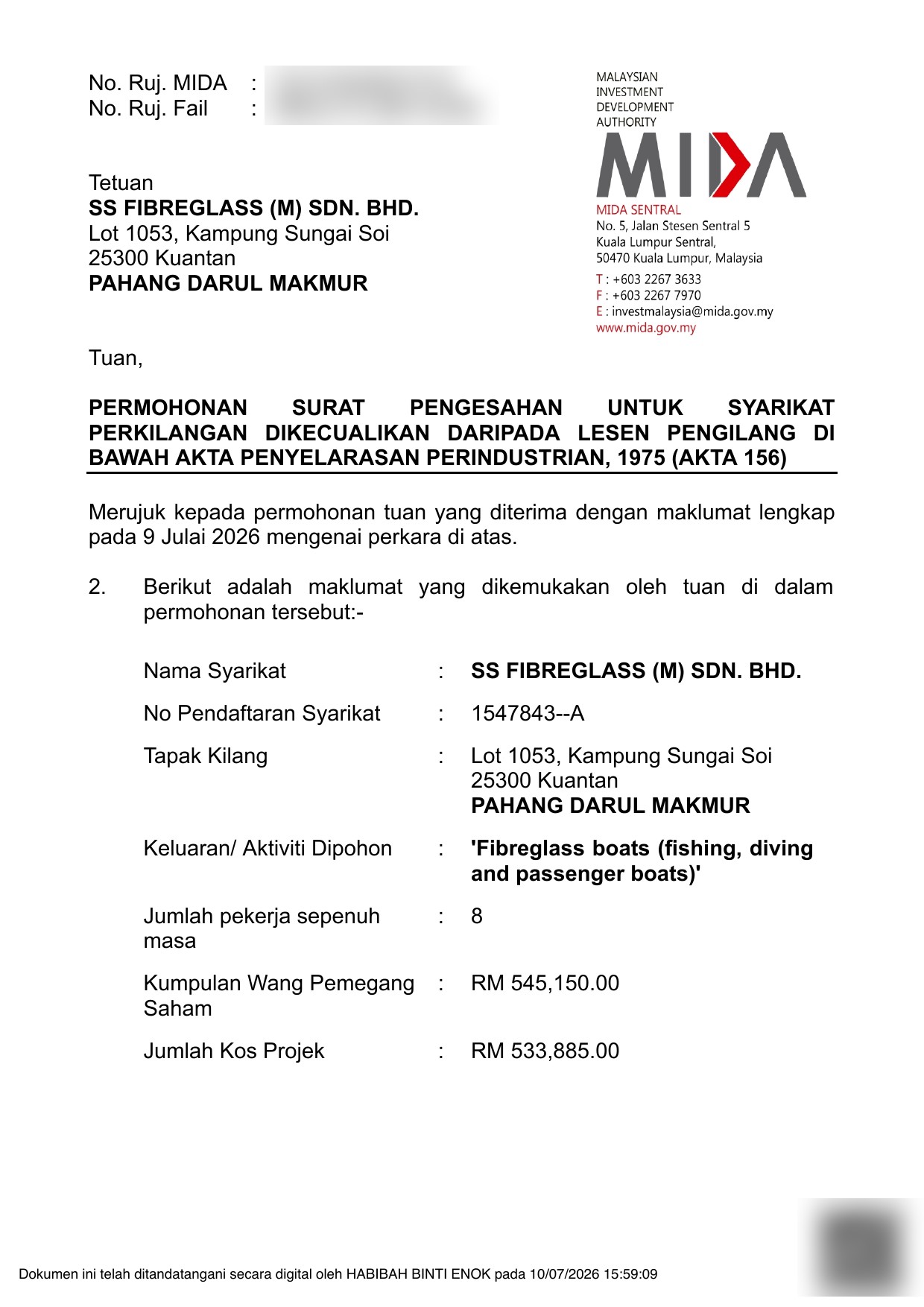
Below both thresholds a licence is not required, but the company can apply to MIDA for a formal exemption. That letter is worth having: banks, local councils and Customs frequently ask to see either a manufacturing licence or an exemption before granting their own approvals, and 'we are below the threshold' is harder to evidence than a letter that says so.
Are shareholders' funds RM2.5 million or more?
Shareholders' funds = paid-up capital + reserves + retained profits.
Either threshold on its own triggers the licence.
Does the company have 75 or more full-time paid employees?
The headcount test applies independently of the capital test.
Not compulsory, but commonly requested by banks, councils and Customs.
Are you likely to cross either threshold within the next 2–3 years?
Retained profits can cross the line without any new investment decision.
We flag the numbers to watch and when to revisit.
Applications are submitted to MIDA and approved by MITI under the Industrial Co-ordination Act 1975.
03
What the licence commits you to
A manufacturing licence is not a general permission to manufacture. It is granted for the products, capacity and conditions described in the application, and the company is expected to operate within them. Adding a product line or materially changing the process is a variation to be applied for, not an internal decision.
That is why the application should describe the project the company will actually run, rather than the widest possible scope or a template borrowed from a similar factory. An over-broad application invites queries and delay; an under-scoped one has to be varied within a year. Getting the products, capacity and investment right at the outset is the cheapest part of the whole exercise.
The licence is also the doorway to other things. It is the reference point for incentive applications under the New Investment Incentive Framework, and it is what other agencies look for when assessing the factory. What it does not do is replace them — local council premise licences, DOSH plant approvals and DOE environmental clearances are separate, run on their own timetables, and should be mapped alongside the licence rather than after it.
04
Documents you need to prepare
Company
- SSM company profile and constitution
- Latest audited financial statements (to compute shareholders' funds)
- Shareholding structure
Project
- Products to be manufactured and production process
- Factory location, tenancy or title
- Machinery list and production capacity
People
- Current and planned full-time employee numbers
- Shareholders' funds include retained profits, not only paid-up capital.
- Other approvals — local council, DOSH, DOE — may still be required for the factory.
05
How to get it done with ONEKEY BIZ
- 1Threshold test Week 1
Shareholders' funds and headcount assessed against ICA.
- 2Project file Week 1–3
Products, process, machinery and location documented.
- 3Submit to MIDA Week 3–4
Licence application submitted.
- 4MIDA / MITI review Per MIDA
Queries answered until decision.
- 5Licence issued Done
Manufacturing licence issued by MITI.
You do
- Provide accounts and project details
- Confirm products and capacity
We do
- Test the ICA thresholds
- Prepare the application file
- Submit to MIDA and follow up
- Flag other factory approvals needed
06
What you receive
Approval to manufacture the listed products.
Products, conditions and obligations under the licence.
Real clients we've done this for
Official sources
Frequently asked questions
How are shareholders' funds calculated?
Paid-up capital plus reserves and retained profits.
Who approves the licence?
Applications go to MIDA and are approved by MITI.
Does a licence cover all factory approvals?
No. Council, DOSH and DOE approvals are still separate.