SSM's Corporate Registry System (CRS) is now the way every Malaysian company is incorporated and every statutory change is lodged. Getting there was messy. The launch planned for 30 June 2026 was postponed, the legacy systems were reopened, and then closed again for a week. The CRS went live on 14 July, was taken down for maintenance within a day, and ran with a nightly maintenance window until August. Much of what was written during those weeks, including some of our own early coverage, is now out of date. This guide sets out what the CRS is, what it replaced and what it did not, the actual timeline, the fee exemptions still running, and what a foreign-owned company should do with it now.
Quick answer: as at 9 October 2026, SSM's Corporate Registry System has been live on the SSM4U portal since 9.00 am on 14 July 2026. It replaced MyCoID, e-Secretary and counter lodgement of statutory company documents. Annual returns and financial statements still go through MBRS. On 29 September 2026 SSM extended the waiver of late-lodgement fees for filings made through the CRS to 31 December 2026 (it was due to end on 30 September), so overdue CRS documents can still be lodged without a late fee until the end of the year. By 15 September SSM had approved 162,730 CRS transactions, including 9,514 new incorporations.
Key takeaways
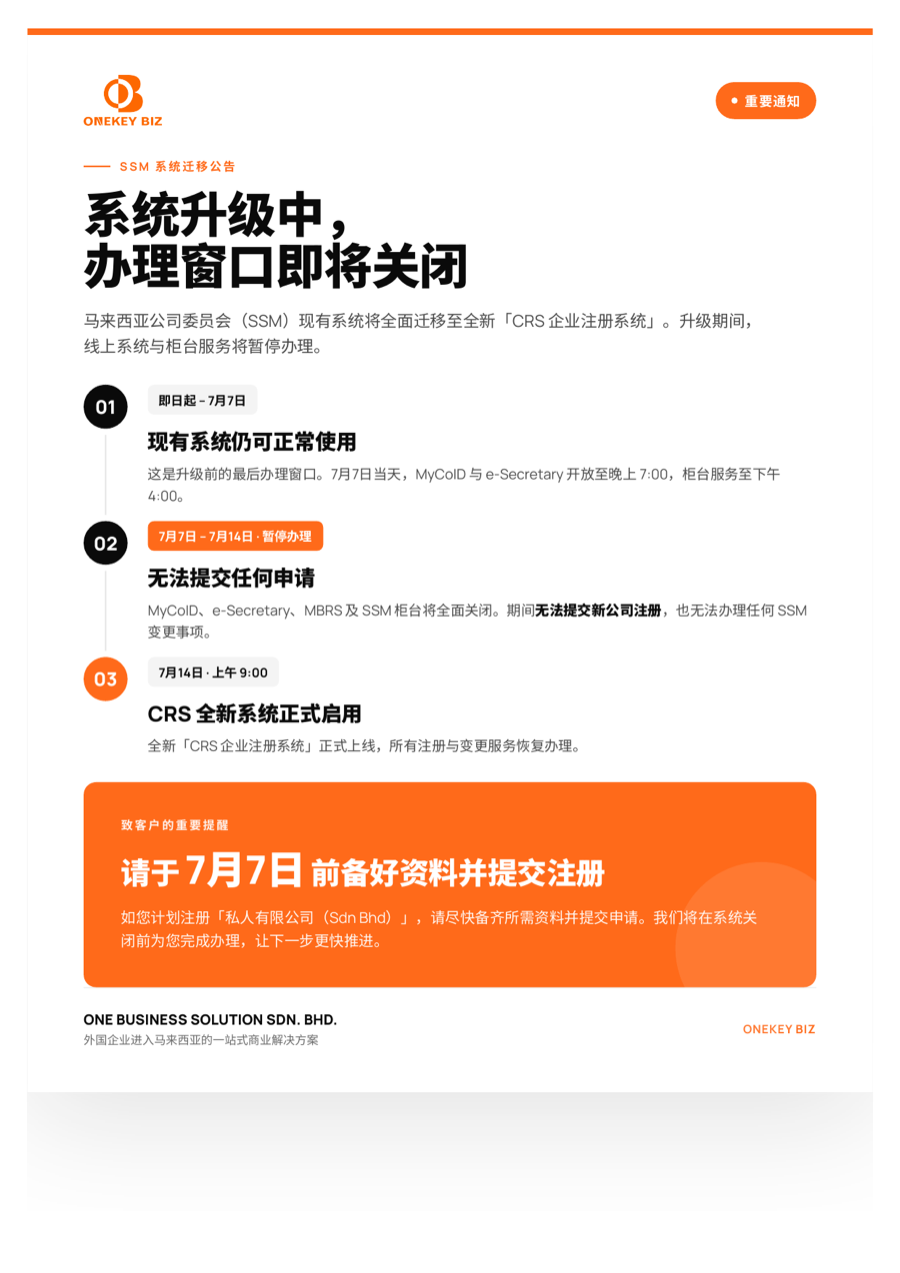
- The CRS opened on 14 July 2026, not on 30 June. SSM postponed the 30 June launch and reopened MyCoID, e-Secretary and counters at 3.00 pm that day, then closed them again from 7 July.
- Phase 1 covers statutory company documents: name search, incorporation, company information updates, charges, and related lodgements. SSM has not published dates for Phases 2 and 3.
- MBRS is still where annual returns and financial statements go. The CRS did not replace it.
- Three separate fee exemptions applied, and two were extended. The one still open, for CRS filings, now runs to 31 December 2026.
- Changes of nature of business and business address also go through the CRS. SSM revised Practice Directive 2/2017 on 5 August 2026: notify within 14 days of the change. See our MSIC code and nature of business guide.
- Express Filing no longer exists. SSM's CRS FAQ confirms it is not available on the CRS.
- Beneficial ownership reporting is in the Act itself since the Companies (Amendment) Act 2024 came into force on 1 April 2024. The threshold is 20%, not 25%.
What the CRS is and what it replaced
SSM describes the CRS as its replacement for "existing legacy systems, including the MyCoID portal and other related systems," delivered through a single integrated platform. It is accessed through the SSM4U portal, the same portal SSM uses for its other online services. There is no separate "MyCRS" website: any site presenting itself as a separate CRS portal outside ssm4u.com.my should be treated with caution.
SSM is rolling the CRS out in three phases. Phase 1, which is the one now live, covers the lodgement of companies' statutory documents. In practice that means name searches and reservations, incorporation of new companies, changes to company information (directors, secretaries, registered address, shares), registration of charges, and the related lodgements, extensions of time and rectifications that used to go through MyCoID, e-Secretary or an SSM counter.
| Filing | Where it goes now | What it replaced |
|---|---|---|
| Name search and reservation; incorporation of a Sdn Bhd | CRS (via SSM4U) | MyCoID |
| Director and secretary changes, registered address, share allotments, change of name | CRS | MyCoID / e-Secretary / counter |
| Registration of charges; extensions of time; rectifications | CRS | MyCoID / counter |
| Annual return (s.68) and financial statements (s.259) | MBRS, unchanged | Not replaced by CRS |
| Express Filing (paid fast-track) | Not available on CRS | Discontinued |
The actual timeline, June to September 2026
The dates below are taken from SSM's own announcements and its FAQ on the resumption of SSM systems and counter services (updated 2 July 2026). They differ from what was widely reported in June, because the first launch date was not met.
| Date | What happened |
|---|---|
| From 20 June 2026 | MyCoID and SSM counters close ahead of the planned launch (SSM treats 20–30 June as the closure period) |
| 30 June 2026 | Planned CRS launch postponed. MyCoID, e-Secretary and SSM counters reopen at 3.00 pm |
| 7 July 2026 | Final lodgement through the counter (4.00 pm) and through MyCoID and e-Secretary (7.00 pm) |
| 7–14 July 2026 | All lodgement closed while SSM makes final preparations. No company could be incorporated in this week. |
| 14 July 2026, 9.00 am | CRS Phase 1 goes live on SSM4U |
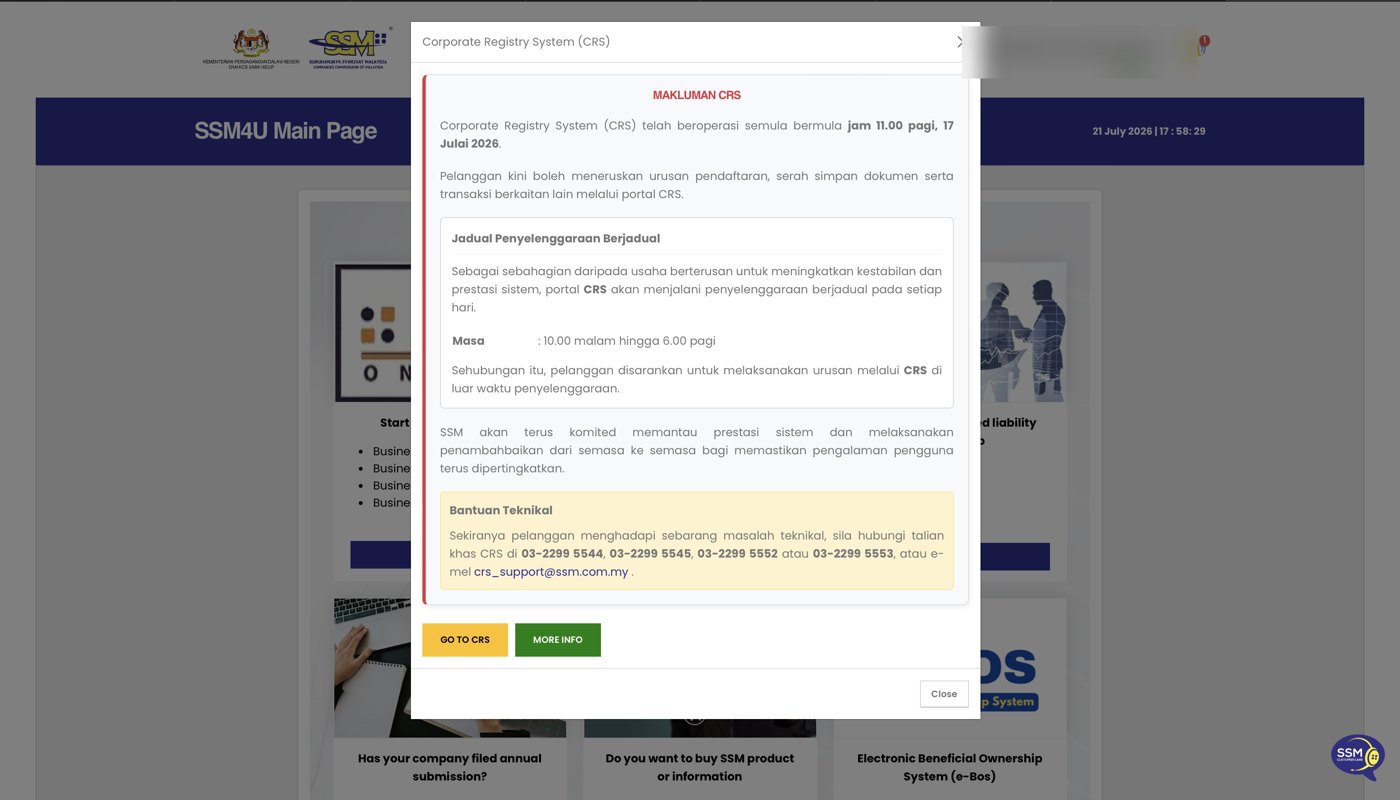
| 15–17 July 2026 | CRS taken down for main-system maintenance after heavy traffic |
| 17 July 2026, 11.00 am | CRS resumes, with daily maintenance from 10.00 pm to 6.00 am |
| 17 July – 2 August 2026 | Daily maintenance window in force (a stabilisation period, not a permanent schedule) |
| 5 August 2026 | SSM revises Practice Directive 2/2017: changes of business address and nature of business are notified through the CRS within 14 days |
| 30 August 2026 | SSM extends the MBRS 2.0 exemption for annual returns and financial statements from 31 August to 30 September 2026 |
| 29 September 2026 | SSM extends the CRS late-lodgement fee exemption from 30 September to 31 December 2026 |
| 30 September 2026 | MBRS 2.0 exemption ends |
| 31 December 2026 | Late-lodgement fee exemption for filings through the CRS ends |
The fee exemptions: three windows, one still open
SSM granted relief from late-lodgement fees three times during the transition, and they are easy to confuse. Each covers a different set of documents and a different system.
| Exemption | Covers | Window | Status on 9 Oct 2026 |
|---|---|---|---|
| Legacy closure | Documents that fell due while MyCoID and counters were closed | Documents due 20–30 June 2026 | Closed |
| MBRS 2.0 | Annual returns and financial statements lodged through MBRS 2.0 | 1 July – 31 August 2026, extended 1–30 September 2026 (the extension only covers lateness of more than 7 days and up to 3 months under PD 1/2017) | Closed |
| CRS | Filings made through the CRS | 14 July – 31 December 2026 (extended on 29 September from 30 September) | Open until 31 December 2026 |
Where the CRS stands now
Since the daily maintenance window ended on 2 August 2026, SSM has not announced any further scheduled outage. Routine Phase 1 lodgements are being processed through SSM4U in normal turnaround, and filing calendars can be planned on ordinary working hours again. SSM reported on 6 October 2026 that it had approved 162,730 CRS transactions by 15 September, including 9,514 new company incorporations.
One rule changed in August. SSM revised Practice Directive 2/2017 on 5 August 2026 so that a change of business address (including branches) or nature of business is notified through the CRS within 14 days of the change, instead of waiting for the next annual return. Our guide to choosing and changing your MSIC code covers the process.
What has not changed is the scope question. SSM has said the CRS will be implemented in three phases but, as at 9 October 2026, has published neither the scope nor the dates of Phase 2 or Phase 3. Treat any claim that a particular filing "is moving to CRS soon" as unsourced until SSM publishes it on its CRS page. In the meantime, the platform rule is simple: company documents go through the CRS, and annual returns and financial statements go through MBRS.
Access: SSM4U, identity verification and no Express Filing
The CRS can only be reached by logging in to SSM4U. Existing SSM4U users keep their accounts. New users must register and verify their identity before they can transact; SSM's registration guidance has Malaysian users complete this in person, at an SSM counter or kiosk. For a foreign shareholder or director living outside Malaysia, this is the practical reason incorporations and changes are lodged by the company's Malaysian secretary, who already holds a verified account.
Two process changes affect planning:
- No Express Filing. SSM's CRS FAQ states plainly that Express Filing is not available through the CRS. Everything moves through the standard queue, so build buffer days into any deadline that depends on a company number, such as a bank account, a licence application or an Employment Pass.
- Drafts expire. Incomplete applications saved on the CRS are not kept indefinitely, so prepare documents fully before starting an online lodgement.
Beneficial ownership: what foreign shareholders must get right
Beneficial ownership (BO) reporting is where foreign-owned companies most often go wrong, and the rules have tightened. The Companies (Amendment) Act 2024, in force from 1 April 2024, placed BO reporting in the Companies Act itself. Section 60A defines a beneficial owner as a natural person who ultimately owns or controls the company, including a person who exercises ultimate effective control.
Under SSM's reporting framework, a person is a beneficial owner of a company limited by shares if, for example, he or she:
- holds, directly or indirectly, at least 20% of the shares; or
- holds, directly or indirectly, at least 20% of the voting shares; or
- has the right to exercise ultimate effective control over the company, its directors or its management; or
- has the right to appoint or remove directors holding a majority of the voting rights at board meetings.
For a Sdn Bhd owned by a foreign parent, the parent company is the shareholder but not the beneficial owner. The BO register must look through the holding company, and any nominee arrangement, to the natural persons behind it. A founder who holds 60% of a Shenzhen parent that owns 100% of the Malaysian company is a beneficial owner of the Malaysian company. So is a 25% investor in that parent, because 25% of 100% is above the 20% threshold.

Two practical checks after the migration. First, pull the BO information SSM holds for your company and compare it line by line with your own register; any submission in flight around the June cut-over is worth re-checking. Second, whenever shares are transferred or allotted, lodge the BO update in the same batch. A share movement without a matching BO update is exactly the kind of mismatch an integrated registry surfaces. Our beneficial ownership disclosure service handles the register and the lodgement.
Incorporating a Sdn Bhd under the CRS
The legal requirements for a new company did not change with the platform. The route through it did. For a foreign-owned Sdn Bhd the sequence is:
- Appoint a licensed secretary with a CRS-ready SSM4U account. The secretary lodges on your behalf, so foreign founders need not travel.
- Name search and reservation (RM50). An approved name is reserved for 30 days.
- Prepare the incorporation documents. These include director particulars and consents, the registered address, share structure, an optional constitution and beneficial owner details. At least one director must ordinarily reside in Malaysia.
- Lodge on the CRS (RM1,000 incorporation fee). SSM issues the notice of registration once the application is complete; there is no paid fast-track.
- Post-incorporation. A company secretary must be appointed within 30 days of incorporation (s.236); open the bank account, inject the paid-up capital needed for your licences (for example RM500,000 for most foreign-owned services companies, RM1 million for wholesale and retail under WRT), and register with LHDN and, if you hire staff, EPF and SOCSO.
For the full step-by-step, including documents and timing, see our Sdn Bhd incorporation guide for foreign companies, or let our Sdn Bhd incorporation service handle the CRS lodgement end to end.
| SSM fee (unchanged by the CRS) | Amount |
|---|---|
| Name search and reservation (30 days) | RM50 |
| Incorporation of a company limited by shares | RM1,000 |
| Change of company name (s.28), on top of the name reservation | RM100 |
| Annual return (lodged via MBRS) | RM150 |
Professional fees charged by your secretary are separate from SSM's fees. Late-lodgement fees apply on top when a document is lodged after its deadline, subject to the exemption windows above.
What changes in the day-to-day filings
Most post-incorporation obligations are the same as before; they are simply lodged through the CRS. The 14-day notifications (directors, secretary, registered address, allotments) and the 30-day ones (change of name, constitution) are covered in our guide to SSM's 14-day and 30-day clocks. A change of name is a good example of the gap between the SSM step and everything after it. The CRS lodgement takes days, but banks, LHDN, SST, CIDB and councils each need updating separately. See our checklist of what to update after a company name change.
Common mistakes after the migration
- Relying on dates reported in June. The CRS did not launch on 30 June; it launched on 14 July. Deadlines and waivers follow the real dates.
- Assuming the annual return moved to the CRS. It did not; it is still lodged through MBRS.
- Missing the 31 December exemption. The CRS waiver was extended once, from 30 September to 31 December 2026. An overdue CRS document lodged on 1 January 2027 may pay a late fee it would not have paid a day earlier.
- Using a 25% BO threshold. The statutory framework uses 20%. Investors between 20% and 25% are routinely left off BO registers drafted from older templates.
- Planning on Express Filing. It no longer exists.
- Trying to self-register as a foreign director. Identity verification is built for residents; lodging through your Malaysian secretary is faster and avoids a trip.
What to do now
- Existing companies: ask your secretary to confirm, in writing, that every CRS document since 14 July has been lodged and whether any was late. Lodge anything outstanding before 31 December 2026.
- Companies with holding structures or nominees: review the BO register against the 20% test and against what SSM holds.
- Companies with an anniversary coming up: diarise the annual return in MBRS, not the CRS, and the financial statements that follow.
- New investors: incorporate through a secretary who is already live on the CRS, and plan without Express Filing.
ONEKEY BIZ's licensed company secretaries lodge on the CRS and MBRS daily for foreign-owned companies, in English and Mandarin. Our company secretary service includes a lodgement log for every statutory document, so you always know what was filed and when. If you are unsure whether anything fell through during the transition, contact our team for a review.
Frequently asked questions
When did SSM's Corporate Registry System (CRS) go live?
At 9.00 am on 14 July 2026, on the SSM4U portal. The launch originally planned for 30 June 2026 was postponed; MyCoID, e-Secretary and SSM counters reopened at 3.00 pm on 30 June and closed again on 7 July, and no lodgements were possible between 7 and 14 July.
Are annual returns and financial statements lodged through the CRS?
No. CRS Phase 1 covers statutory company documents such as incorporation, name searches, director and secretary changes, registered address, share allotments and charges. Annual returns and financial statements continue to be lodged through MBRS, and their deadlines and late fees attach to MBRS.
Is there a late-lodgement fee exemption for CRS filings?
Yes. SSM first exempted late-lodgement fees for submissions under the CRS from 14 July to 30 September 2026, and on 29 September 2026 extended the waiver to 31 December 2026. Separate exemptions covered documents due during the MyCoID closure (20–30 June 2026) and MBRS 2.0 annual returns and financial statements (1 July – 31 August, extended to 30 September 2026); both have ended.
Can a foreign director register on SSM4U and file on the CRS directly?
New SSM4U users must complete identity verification before they can transact, a step designed around Malaysian residents. In practice, foreign-owned companies lodge through their licensed Malaysian company secretary, who already holds a verified account. Express Filing is not available on the CRS, so plan timelines on the standard queue.
What is the beneficial ownership threshold in Malaysia?
Under the Companies (Amendment) Act 2024, in force from 1 April 2024, and SSM's reporting framework, a beneficial owner includes any natural person who directly or indirectly holds at least 20% of the shares or voting shares, or who exercises ultimate effective control. For a subsidiary of a foreign parent, the register must look through the parent to the individuals behind it.
Related services
We handle the process described in this article end-to-end.
- Sdn. Bhd. Company Incorporation in MalaysiaRegister a private limited company (Sdn. Bhd.) with SSM end-to-end.
- Annual Return Filing (Section 68) for Sdn. Bhd.Lodge your company’s yearly annual return with SSM on time.
- Appointment & Resignation of DirectorsUpdate your board — appoint or resign directors (Section 58/201).
Sources & references
- SSM — Corporate Registry System (CRS) official page
- SSM — FAQ: Resumption of SSM System and Counter Services (updated 2 July 2026)
- SSM — CRS Frequently Asked Questions
- SSM announcement — CRS resumed operation from 11.00 am, 17 July 2026
- SSM announcement — Waiver of late lodgement fees extended to 31 December 2026 (CRS), 29 September 2026
- SSM announcement — Extension of MBRS 2.0 late lodgement fee waiver to 30 September 2026 (30 August 2026)
- SSM — Practice Directive 2/2017 (Revised 5 August 2026)
This article is general information only, not legal, tax or immigration advice. Policies, thresholds and official fees are set by the relevant Malaysian authorities and may change. Talk to our consultants about your specific situation.